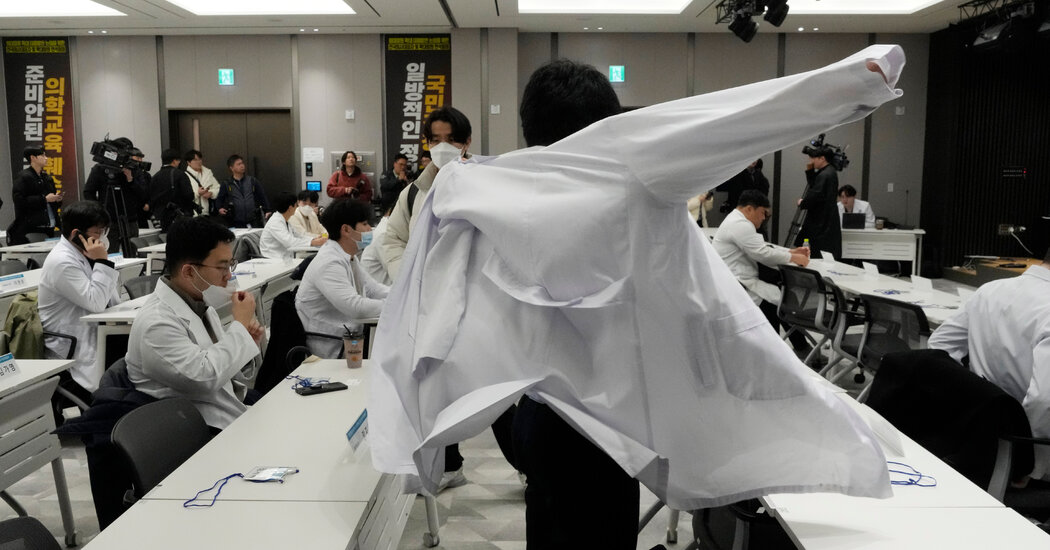

Surgeries postponed. Appointments canceled. Patients turned away from emergency rooms.
For more than a week, procedures at some of the largest hospitals in South Korea have been disrupted because thousands of medical interns and residents walked off their jobs. A prolonged walkout could have disastrous consequences.
The dispute started in early February, when the government proposed admitting more students to medical schools to address a longstanding shortage of physicians in South Korea. Interns and residents, known as trainee doctors, countered by saying that the shortage was not industrywide but confined to particular specialties, like emergency care. They said the government’s plan would not solve that problem, adding that they were victims of a system rife with harsh working conditions and low wages.
The doctors then took to the streets to the protest the plan, threatening to strike or quit their jobs. By and large, senior doctors backed their younger colleagues’ claims. But with surveys showing broad public support for beefing up the ranks of physicians, the government did not budge. Some saw the doctors’ pushback as a tactic to increase their paychecks.
Trainee doctors — who are a crucial part of large hospitals — started submitting their resignations on Feb. 19. As of Wednesday, nearly 10,000, or about 10 percent of all doctors in the country, had done so, according to government data. But most of these resignations have not been accepted by hospitals.
“It is impossible to justify collective action that takes people’s health hostage and threatens their lives and safety,” President Yoon Suk Yeol told reporters on Tuesday.
His government has said that if the doctors return to their jobs by Thursday, they would not face any legal repercussions. Otherwise they could risk losing their medical licenses and face fines of up to 30 million won ($22,000). The Health Ministry this week filed police complaints against a handful of doctors, accusing them of violating medical law.
As of Thursday morning, nearly 300 doctors had returned to work, according to the ministry. But with most trainee doctors still off the job, the dispute shows no signs of resolution.
Here’s what you need to know.
What is the situation in the hospitals now?
Many medical procedures have been pushed back. Patients have been told at the last minute that their appointments have been delayed indefinitely. Some have been redirected to smaller clinics. The government has temporarily allowed hospitals to let nurses fill in for doctors when appropriate. Nonetheless, many major hospitals remain short-staffed, generating complaints from the public.
One case this week was used by both sides to bolster their argument. A woman in her 80s with terminal cancer was turned away by several emergency rooms after her heart stopped beating, with hospitals saying they were at capacity. When she finally was admitted, she was declared dead on arrival.
For the government and its supporters, it showed how a shortage of physicians could be fatal for patients — even though a government investigation concluded that the woman’s death had no correlation to the doctors’ walkout.
For the doctors, it was the clearest sign of a structural problem that has long overburdened emergency care in South Korea. The country’s medical system allows patients with minor injuries or illnesses to seek treatment at emergency rooms, using resources that should instead go to patients in severe or critical condition, doctors claim.
What has the government proposed?
The need for more doctors in South Korea is acute, the government says, especially given its rapidly aging population. It has about 2.6 doctors for every 1,000 people, compared with an average of 3.7 in the countries belonging to the Organization for Economic Cooperation and Development.

Earlier this month, the Health Ministry proposed increasing medical school admissions to about 5,000 students a year, from 3,000, starting in 2025. It would be the first increase since 2006 and, the government said, would mean an extra 10,000 doctors in a decade. The government also pledged to spend over 10 trillion won to improve essential services throughout the country, especially health care in rural areas.
Doctors argue that increasing the number of medical students will do little to change the status quo. A similar attempt by Mr. Yoon’s predecessor, in 2020, to increase the number of doctors resulted in a physician walkout that lasted a month. The government ended up shelving the expansion.
What do the doctors want?
Interns and residents have a long list of grievances. While some established doctors in South Korea are well paid, doctors in training say they work long hours for little pay even though they are the linchpins of the country’s medical system. Interns and residents make around $3,000 a month and often work more than 80 hours a week, according to the medical community. Young doctors often make up a third or more of the work force in some of the major hospitals, and often provide the first line of care for patients.
They say the government has ignored structural issues that make some specializations like cosmetic surgery and dermatology more lucrative than vital services like emergency and pediatrics. The Korean Medical Association and the Korean Intern and Resident Association, two of the nation’s largest groups of doctors, have demanded better working conditions for young doctors in essential services, more equal pay across all specializations and the retraction of the expanded medical school admissions cap.
Under current conditions, it is “impossible for doctors to take care of patients with a sense of mission,” Joo Soo-ho, a spokesman of the Korean Medical Association said on Tuesday.
Is there a political element to the dispute?
The plan to increase the number of medical students enjoys widespread support among South Koreans, according to surveys. In one, as many as 76 percent of respondents backed the government’s plan.
The proposal to increase medical school admissions is part of wider health care policy plan that was announced by President Yoon months before a crucial parliamentary election in April. His approval rating has inched up as he has stood his ground against the doctors.
For most of his two years in office, Mr. Yoon has struggled with low approval ratings, rising consumer prices and scandals connected to his wife, his policies and his handling of disasters. By pushing through changes that his predecessor had tried but failed to implement in the face of resistance from doctors, Mr. Yoon is hoping to improve his profile in an election year.
Choe Sang-Hun contributed reporting.