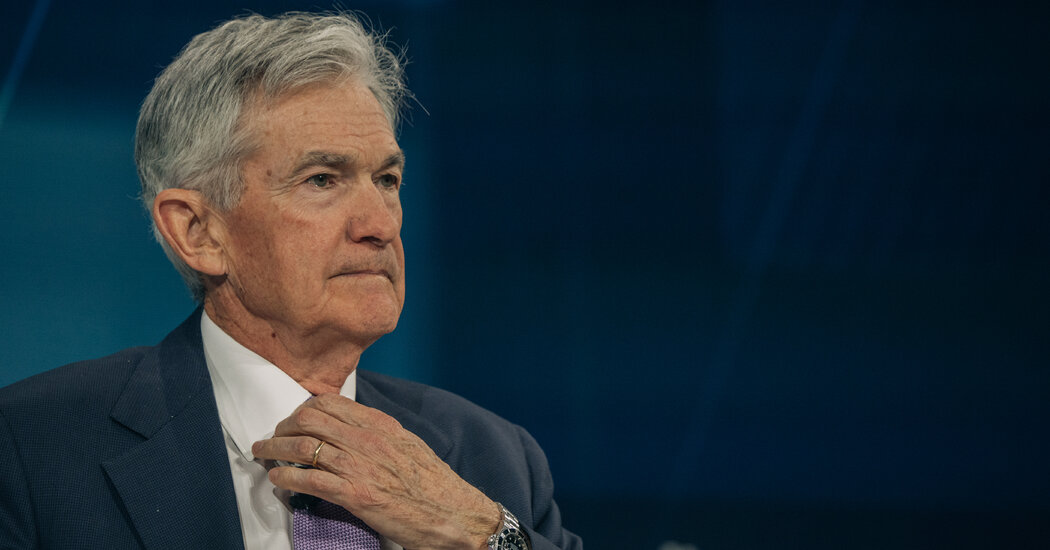

At the Federal Reserve’s final gathering of 2024, Chair Jerome H. Powell announced that the U.S. central bank was embarking on a “new phase” in how it would set interest rates.
The Fed planned to “move cautiously” with cuts going forward, Mr. Powell told reporters at the time, reflecting officials’ thinking that they could afford to be patient with scant signs of an impending recession and lingering inflationary pressures. On Wednesday, the Fed is set to put that approach into action, pressing pause on further reductions for the first time since they began lowering borrowing costs in September.
The question now looming large over Wall Street and Washington is just how long the Fed will be on hold.
For President Trump, who in his first week in office claimed to have a better understanding of interest rates than officials at the Fed, a pause of any length is likely to be seen as too long. Speaking to attendees at the World Economic Forum in Davos, Switzerland, he said that as his economic policies drove down the price of oil, he would “demand that interest rates drop immediately.”
But for policymakers and the economists, investors and former Fed officials who follow their actions closely, the timeline looks very different.
“There is no compelling reason to cut,” said Loretta Mester, who retired as president of the Cleveland Fed in June. “I would want to see convincing evidence that inflation has resumed moving down and right now, I don’t think we have that.”
Officials at the central bank have laid the groundwork for this moment over the course of many months. After delivering a shock-and-awe half-point cut in September — prompted by concerns that the labor market was at risk of weakening too much — the Fed steered through what it described as a “recalibration” phase. It reduced interest rates by a more traditional quarter-point in November and December, reflecting the fact that inflation, while still high, had eased enough for them to feel comfortable lowering borrowing costs further.
Rates are now set in a range of 4.25 percent to 4.5 percent, after recently peaking above 5 percent.
But the decision to cut rates again in December was a close call. One Fed official voted against it and a record of the meeting released earlier this month showed that other officials grappled with recent data that suggested progress on getting inflation back down to the Fed’s 2 percent target was stalling.
Fed officials also had to contend with the specter of a seismic shake-up in economic policy upon the election of Mr. Trump and his imminent return to the White House.
Compared with forecasts released three months earlier, policymakers halved their projections for interest rate cuts in 2025 to just half a percentage point in December, as they raised their expectations for inflation over the course of 2025 and 2026.
For some officials, that shift incorporated assumptions about what another Trump term would bring, given his promises to enact tariffs on trading partners, slash red tape, lower taxes and deport millions of immigrants. Others adjusted their forecasts based on the incoming data alone, underscoring the debate still underway about whether the Fed’s policy settings are tuned right for the current circumstances.
Regardless of the reasons, “almost all participants judged that upside risks to the inflation outlook had increased,” minutes from the December meeting said.
The data reported since the turn of the year has allayed some concerns but has not eliminated them completely. Overall inflation, as measured by the Consumer Price Index, rose more than expected in December to 2.9 percent compared with the same time last year — the third month in a row it has accelerated. The backdrop was more encouraging looking beyond the broader gauge, however, with a “core” measure that strips out volatile food and fuel prices confirming that the underlying trend was slowing.

Job growth has also stayed surprisingly strong in what economists said was a potential sign that businesses have regained steam after a summer slump.
Yields on government bonds, which underpin borrowing across the economy, have risen sharply since November. That reflects, in part, changing expectations about the economic outlook and in turn how much the Fed can lower interest rates. Some officials have argued that this may help the central bank’s efforts to temper activity across businesses and households, but that depends on how long higher borrowing costs are sustained.
“What we learned over the year was that the economy could tolerate high interest rates a bit more than the Fed expected,” said Joseph Gagnon, a former senior Fed staffer. He believes the level of interest rates that neither hastens nor holds back growth — dubbed the “neutral” rate — has risen compared to its level before the pandemic, to around 3.5 percent. Most officials as of December forecast it around 3 percent in the longer run.
The big wildcard is Mr. Trump and how ardently he plans to follow through on his campaign promises. He has already signed a raft of executive orders aimed at ending the cost-of-living crisis that has raged since the pandemic, eliciting skepticism from economists who question how effective his energy-focused approach will be. He threatened tariffs on Colombia and vowed to soon impose levies on products from America’s largest trading partners, Canada, Mexico and China.
Economists expect policies like that to result in higher prices for Americans. The question is whether they will cause just a one-off increase for consumers or kick off successive rounds of price spikes that would require the Fed to act.
That would mark a departure from his first term, when the more limited tariffs Mr. Trump imposed did not lead to surging prices. Transcripts of Fed meetings from that period indicated little consternation about the impact on inflation, although the policies did cause enough concern about the hit to growth to lead the central bank to lower interest rates by 0.75 percentage points.
Karen Dynan, a professor at Harvard who was the chief economist at the Treasury Department during the Obama administration, said it would be “dicey to apply the old conventional wisdom that you should look through supply shocks at this point” because of the high starting point for inflation this time around. While Americans’ expectations of how inflation will evolve over time have stayed more or less in check despite recent increases, Ms. Dynan said this situation should not be “taken for granted.”
“If tariffs come on the high side and if deportations bite more than expected, you could very well imagine inflation going back up and that could put the Fed on pause for the whole year,” added Mr. Gagnon, who is now at the Peterson Institute for International Economics.
Against this backdrop, the bar for additional interest rate cuts appears to have risen. Traders in federal funds futures markets roughly expect the Fed to lower rates twice this year, starting in June. A cut sooner than that point, such as in March, would require more tangible proof that inflation was headed lower.
Donald Kohn, a former vice chair of the Fed, said officials will also probably need confirmation that the inflation risks they fear “aren’t crystallizing.”
“As long as the economy remains resilient, there’s a case for waiting to see how these things play out and what the effects are,” he said.