
In The Investor’s Manifesto, William Bernstein lays out the four abilities every investor needs to be successful:
First they must possess an interest in the process. It is no different from carpentry, gardening, or parenting. If money management is not enjoyable, then a lousy job inevitably results, and, unfortunately, most people enjoy finance about as much as they do root canal work.
Second, investors need more than a bit of math horsepower, far beyond simple arithmetic and algebra, or even the ability to manipulate a spreadsheet. Mastering the basics of investment theory requires an understanding of the laws of probability and a working knowledge of statistics. Sadly, as one financial columnist explained to me more than a decade ago, fractions are a stretch for 90% of the population.
Third, investors need a firm grasp of financial history, from the South Sea Bubble to the Great Depression. Alas, this is something that even professionals have real trouble with.
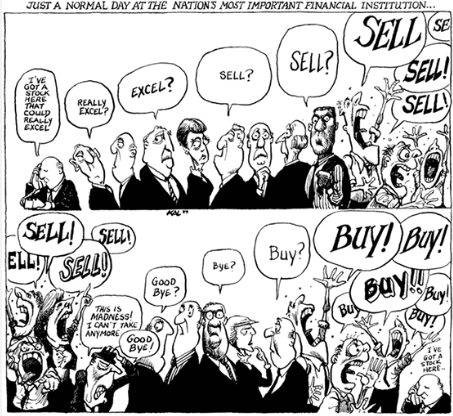
Even if investors possess all three of these abilities, it will all be for naught if they do not have a fourth one: the emotional discipline to execute their planned strategy faithfully, come hell, high water, or the apparent end of capitalism as we know it. “Stay the course”: it sounds so easy when uttered at high tide. Unfortunately, when the water recedes, it is not.
I’d like to spend some time on the historical component because I think it’s so important.
As a young analyst in the investment business I quickly learned that my lack of experience made it difficult to keep up in many of my meetings with more seasoned investors.
I needed to level up because it takes time to gain market wisdom and experience. You have to live through some cycles and you can’t speed up the process.
So I did the next best thing and dove headfirst into reading everything I could get my hands on to get a better grasp of financial market history.
I read Frederick Lewis Allen, John Brooks, Charles Kindleberger, Charles McKay, George Goodman, Peter Bernstein, Maggie Mahar, Bethany McLean, Edward Chancellor, Jeremy Siegel, John Kenneth Galbraith, Fred Schwed, Charles McKay, Roger Lowenstein and more.
The more I learned the more I realized how much I didn’t know.
Here are some ways studying market history can help you become a better investor:
It gives you perspective on the extremes. Market moves always feel unprecedented in the moment.
And sure, every market environment is different. More data. We learn from history. New technologies and research tools. But the emotional pendulum always swings from one side to the other between fear and greed, risk and reward, panic and euphoria.

As Jesse Livermore once said, “Another lesson I learned early is that there is nothing new in Wall Street. There can’t be because speculation is as old as the hills. Whatever happens in the stock market today has happened before and will happen again.”
Markets can always go higher or lower than you think but nothing lasts forever.
It teaches you about cycles. Howard Marks once wrote, “In the world of investing nothing is as dependable as cycles. Fundamentals, psychology, prices and returns will rise and fall, presenting opportunities to make mistakes or to profit from the mistakes of others. They are givens.”
The hard part about cycles is they don’t run on a set schedule. Some booms last longer than others. Some crashes are more painful than others.
It helps build humility. Studying market history helps you understand the difficulty of predicting the future.
The pundit graveyard is littered with brilliant investors, economists and fund managers who were blinded by certainty in the moment.
History teaches you to avoid overconfidence.
It doesn’t tell you everything. Market history can help you build baselines, set expectations and help you build probabilities for a potential range of outcomes.
But it can’t help you predict the future.
Every market crash in history looks like an obvious buying opportunity because you know when the chart turned around. No one knows that in real-time.
Plus, history is unemotional. Backtests are unemotional. Humans are not. You can’t backtest how you would have felt at the time.
As Fred Schwed wrote the following in his classic book, Where Are the Customers’ Yachts:
Like all of life’s rich emotional experiences, the full flavor of losing important money cannot be conveyed by literature. You cannot convey to an inexperienced girl what it is truly like to be a wife and mother. There are certain things that cannot be adequately explained to a virgin by words or pictures. Nor can any description that I might offer here even approximate what it feels like to lose a real chunk of money.
Some things you have to experience for yourself.
This is why my new book is heavy on market history and data but also spends a lot of time focusing on investor behavior and the psychology of the markets. One is not useful without the other.
It doesn’t matter how smart you are, how much you study or how data-driven you are about the markets. If you don’t have the right temperament to control your emotions when things get out of hand you will not be successful in the markets.
And they will get out of hand because human nature is the one and only constant.
Michael and I talked about financial market history and much more on this week’s Animal Spirits video:
Subscribe to The Compound so you never miss an episode.
Further Reading:
An All-Time Bull Market
Now here’s what I’ve been reading lately:
Books:
My podcast book tour: