
It was always going to be a hard year for Bangladesh. Last summer, amid an economic collapse, protesters toppled a tyrant and pushed the country to the brink of chaos.
Then a month ago, as a new government was still working to steady Bangladesh’s economy, came the devastating news that the United States was placing a new 37 percent charge on the country’s goods. Bangladesh relies on revenue from its exports to buy fuel, food and other essentials.
President Trump soon paused those tariffs on Bangladesh and dozens of other countries after the world recoiled. But the possibility they will be reinstated worries the workers who make a living in Bangladesh’s garment factories.
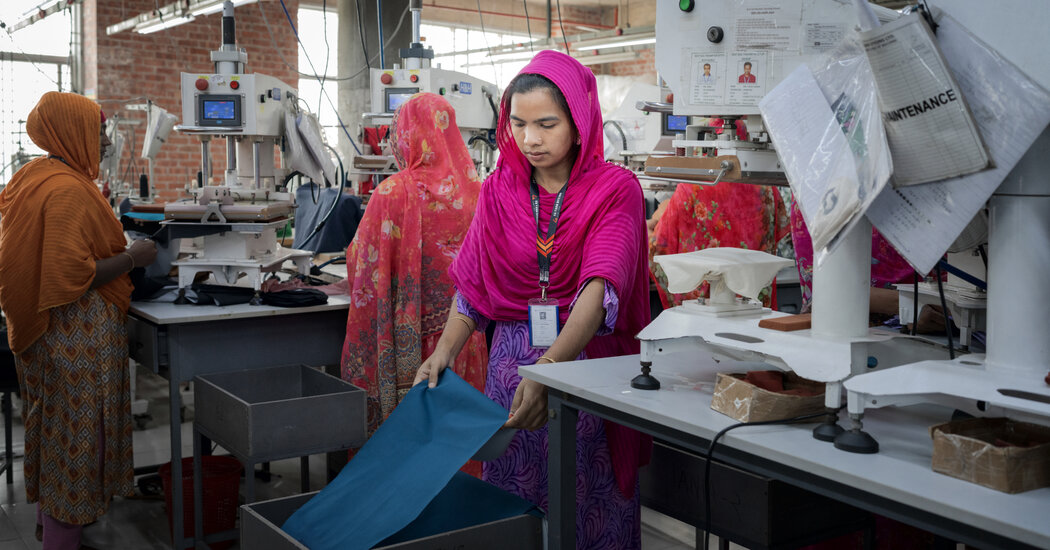
Murshida Akhtar, 25, a migrant from northern Bangladesh living near Dhaka, has been supporting her family from sewing machines for the past five years. One day recently, she and 200 other workers, 70 percent of them women, signed on for new jobs at 4A Yarn Dyeing, in the industrial hub of Savar.
Ms. Akhtar conceded feeling apprehension about the tariffs. But she was excited for the change in jobs. She expected to be paid $156 a month at 4A — slightly more than at her previous job and with a shorter commute and a nicer work environment.
“My worry is that orders will be reduced,” she said. “Then there is less work.”
Bangladesh, a country of 170 million people crammed onto a delta the size of Wisconsin, was derided as an economic lost cause after its violent birth in the 1970s. It has grown steadfastly since the 1980s on the back of its garment industry. Bangladeshi workers, and women in particular, made the country a seamstress to the world. In the process, the average Bangladeshi has become better off than the average citizen of even India, the giant country next door.
Ms. Akhtar is one of about four million Bangladeshis directly employed in the making of garments for export. Perhaps five times as many, including her husband and their son, depend on jobs like hers.
A tariff like the one Mr. Trump has planned, along with side effects like the 145 percent tariff that he applied to Chinese goods, would break the very engine of Bangladeshi growth.
Before Mr. Trump paused the tariff, Bangladesh’s interim leader, the Nobel Peace Prize-winning economist Muhammad Yunus, wrote him a letter asking for a 90-day reprieve. Mr. Yunus promised that his country would buy more American cotton and other goods to help reduce its trade surplus, which last year was $6 billion.
Rashed Al Mahmud Titumir, an economist at the University of Dhaka, was less deferential. He called the tariff threat “an ugly display of power.” It came just as the country, after decades of enviable growth, was facing a recession and vulnerable, he said.
A currency crisis in 2024 weakened the government of Sheikh Hasina, who had come to rule with an iron grip over 15 years. Her ouster caused an immediate security vacuum. Nine months later, Bangladesh has yet to come up with a plan to restore its democracy.
Nearly 85 percent of Bangladesh’s exported goods are garments, and more ship to the United States than to any other country. Even if Mr. Trump does not bring back the 37 percent tariff when his self-defined grace period ends in July, Bangladesh will face the 10 percent tariff that he levied on virtually the entire world.
Even 10 percent is hard to swallow in a low-margin business like the clothing trade. Competition is fierce from China, the only country that exports more, as well as from India, Vietnam, Cambodia and Sri Lanka.

Bangladesh’s political upheaval was viewed as a sign of hope by Western proponents of liberal democracy. India was annoyed at the demise of an alliance it had built with Ms. Hasina. But the administration of former President Joseph R. Biden Jr. welcomed Mr. Yunus.
Bangladesh’s central bank scrambled to contain the fallout from a plundering of the financial system by Ms. Hasina’s regime. It anticipated a year of reduced growth but believed that business would perk up to normal by 2026. Tariffs put an end to that hope. The World Bank has already lowered its expectations for Bangladesh’s next two years of growth.
The country is feeling the heat from the International Monetary Fund, which cleared a $4.7 billion loan last year.
“We are under tremendous pressure from the I.M.F. to reduce subsidies and hike the prices” of fuel, said Fahmida Khatun, the director of the Center for Policy Dialogue, a think tank in Dhaka.
The 10 percent tariff and the prospect of more strike at the heart of a garment sector that has transformed itself. In 2013, a gigantic sweatshop called Rana Plaza collapsed, killing more than 1,100 workers. The grotesque loss of life made foreign buyers, major Western clothing brands among them, doubt that they could stick with their local partners.
But the industry rallied, understanding that it needed to change to survive. There is still a vast space where Rana Plaza once stood, on the main road from Dhaka into Savar. The grim conditions the site represents have guided the future of Bangladeshi manufacturing.
The industry has consolidated. While the number of companies making garments has shrunk, the value of their exports and the number of people employed has grown. Bangladesh is home to 230 garment factories certified under the Leadership in Energy and Environmental Design program, a U.S.-led protocol of best practices policed by inspectors who make periodic visits. That is more than any other country in the world.
Among them is 4A Yarn Dyeing, where Ms. Akhtar works. Despite its name, it hasn’t dyed yarn for years. It concentrates on higher-value outerwear, mostly jackets with fancy zippers, waterproofing and other hard-to-make bits. It proudly lists buyers from American brands ranging from Carhartt to Calvin Klein, but has even more European customers than Americans.
The five working floors of 4A Yarn Dyeing’s factory heave with workers cutting, sewing and stitching the latest for Costco’s Jachs New York series. Giant wall-mounted fans hum against the sewing needles and piped-in music. The space is well lit, airy and pleasant, even in Savar’s premonsoon seasonal swelter.
Signage around the factory floors is in English first, not the local Bangla. Like other Bangladeshi factories, 4A Yarn Dyeing is used to the prying eyes of foreign inspectors.
The exterior of the factory is fronted by a cascade of hanging greenery. The rooftops hold solar panels that help power the operations.
In August, the factory fell under attack during the uprising that took down Ms. Hasina. Khandker Imam, a general manager, recalled with pride how his factory kept operating.
Mobs had gathered outside his factory, as they had at nearly every other; many of Bangladesh’s businesses fell under suspicion of having collaborated with Ms. Hasina. “One thousand people came, to attack our factory,” Mr. Imam said. He donned a helmet and joined his workers to hold back the crowd outside the gate.
In the end, no one was seriously injured, and not a single day of production was lost, Mr. Imam said. The company, like the country, has gotten used to surviving life-threatening disruptions.
“The whole economy of this country depends on this sector,” said Mohammad Monower Hossain, the company’s head of sustainability. The people’s movement that overthrew Ms. Hasina understands this, too. As a country, he said, “we have only our labor.”