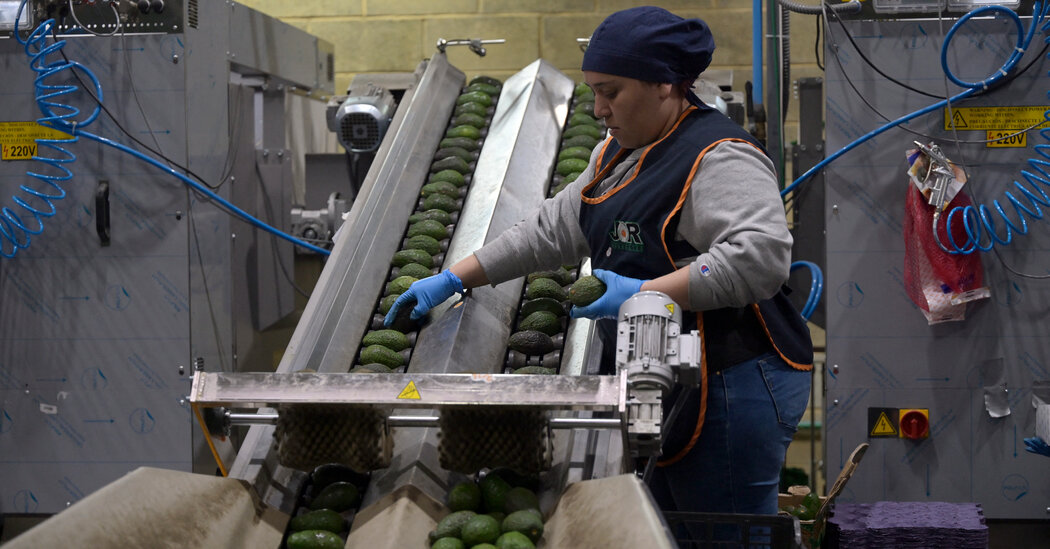

Victoria Gutierrez has been thinking about avocados a lot lately.
President Trump was warning that hefty tariffs on food and other supplies from Mexico, Canada and China were coming. So Ms. Gutierrez, the chief merchandising officer for Sysco, the global food distributor, and a task force inside the company began sifting through the thousands of suppliers the company works with to see what products could be affected.
The good news for Sysco, a company with nearly $79 billion in annual revenues, was that the shortages and supply-chain challenges arising from the Covid pandemic had caused it to diversify and, in some cases, duplicate its suppliers for key products.
The bad news? Avocados.
“The majority of avocados eaten in the United States come from Mexico. Can we today meet the full demand for avocados in the U.S.? No,” Ms. Gutierrez said in mid-February. She added, “There’s not a lot that’s growing in the United States in the winter.”
On Tuesday, the threat of tariffs became a reality. The Trump administration placed a 25 percent tariff on all imports from Canada and Mexico. It has also added 20 percent tariffs on goods from China this year, on top of levies that remain from Mr. Trump’s first term.
But even before Tuesday, companies like Sysco were scrambling to build up inventories, particularly of less perishable goods, or find new suppliers in countries not targeted by the new tariffs.
“We have a few million pounds of coffee that we get from Mexico,” said Will Ford, the chief operating officer at Westrock Coffee, a private-label coffee manufacturer that produces for McDonald’s and Walmart, in an interview in February, before the tariffs took effect. “We’ve been looking at trying to source from a different Central American origin. Maybe we’ll replace Mexico with Honduras or with Guatemala.”
It’s one thing to build up a limited inventory of coffee or tequila from Mexico, but nearly impossible to do so with perishable goods like avocados. There, companies have two choices: They either bear the additional costs from the tariffs or pass them along to consumers.
Mexico, the world’s biggest producer of avocados, supplies about half the avocados used at the Chipotle restaurant chain. That company said this week that it would not charge customers extra, at least for now.
“It is our intent as we sit here today to absorb those costs,” Scott Boatwright, the chief executive of Chipotle, said in an interview with “NBC Nightly News.” He cautioned, however, that if costs became a “significant headwind,” prices could rise.
The chief executive of Target, Brian Cornell, on the other hand, told CNBC on Tuesday that the retailer was likely to raise prices on fruits and vegetables imported from Mexico “over the next couple of days.”
The ability of companies to pass along the tariffs to inflation-weary consumers may be limited, some analysts warn. Packaged food companies, for instance, may have to “absorb at least some of the costs,” rather than risk losing market share, analysts at S&P Global Ratings wrote in a report in mid-February.
Just a few years ago, the chief supply chain officer or procurement manager at large companies focused mostly on searching the globe for the lowest-cost producers — or, for companies trying to market sustainability to customers, those that could demonstrate that they produced their food or goods in a climate-friendly and ethical manner.

The Covid pandemic, and the resulting shortages and shipping delays from far-flung manufacturers, led many companies to duplicate their suppliers or, in some cases, to “nearshore,” shifting from suppliers in Asia, for instance, to those closer to the United States, like Canada and Mexico. The idea was to build safety nets into the supply chain.
But on Tuesday, those locales turned into a detriment as neighbors to the north and south were struck with tariffs.
Mondelez International, the snack giant based in Chicago, has a factory in Salinas, Mexico, that makes Oreo and Chips Ahoy! cookies as well as Ritz crackers. That factory accounts for roughly 18 percent of the company’s U.S. sales, according to estimates from analysts at Piper Sandler. The plant, the analysts wrote in a note in February, “is also its most cost-efficient, making it difficult to repatriate production to the U.S. without incurring higher production costs.”
Mondelez did not respond to an email seeking comment.
Some alcohol companies are particularly exposed to the new tariffs. Last month, Diageo, which derives 45 percent of its U.S. sales from tequila and other liquors imported from Mexico and whiskey from Canada, warned it could see a $200 million hit to its operating profits in the second half of this year. Likewise, analysts note that more than 75 percent of Constellation Brands’ sales in the United States come from beers imported from Mexico, such as Modelo and Corona.
Constellation Brands did not return emails seeking comment, and a spokeswoman for Diageo pointed to a comment made by executives to Wall Street analysts and investors in early February: The company hoped to reduce the impact of tariffs by as much as 50 percent through its supply chain and “other mitigation strategies.”
At Sysco, which provides food and beverages to restaurant chains as well as major hospital and school systems, Ms. Gutierrez said the company had altered its supply chain during Covid significantly.
“Before, maybe we had one partner for a product,” Ms. Gutierrez said in the interview in mid-February. “Now we had two or three. Or if we had someone from one country, it became two or three” countries.
Moreover, large global food companies like Sysco are increasingly having to adapt to climate-related or other issues that can send prices for ingredients soaring or simply make them difficult to find, like eggs, which have skyrocketed in price in recent months from the outbreak of avian flu in America.
The most obvious parts of Sysco’s supply chain that will be affected are perishable fruits and vegetables.
“From Mexico and South America, we get avocados, limes, tomatoes and onions,” Ms. Gutierrez said. From Canada, Sysco imports canola oil and wheat, but also frozen potato products, like French fries.
In an email on Tuesday, Sysco said that while there might not be an immediate alternative for every product affected by the tariffs, it was trying to identify options for its customers.
“For supply chain officers, uncertainty and dealing with shocks to the system is the name of the game,” Ms. Gutierrez said. “Whether it’s storms in a certain geography or, now, tariffs.”