
The Supreme Court declined on Tuesday to hear a challenge to new admissions criteria at an elite public high school in Virginia that eliminated standardized tests, clearing the way for the use of a policy intended to diversify the school’s student body.
As is its custom, the court gave no reasons for turning down the case. Justice Samuel A. Alito Jr. issued a dissent, joined by Justice Clarence Thomas, that was harshly critical of an appeals court’s ruling in the case upholding the new criteria and rejecting the challengers’ argument that they unlawfully disadvantaged Asian Americans.
The Supreme Court’s “willingness to swallow the aberrant decision below is hard to understand,” Justice Alito wrote. “We should wipe the decision off the books, and because the court refuses to do so, I must respectfully dissent.”
The Supreme Court struck down race-conscious admissions programs at Harvard and the University of North Carolina in June but left open the constitutionality of admissions standards that do not directly account for race in trying to diversify enrollment. Still, the majority opinion, by Chief Justice John. G. Roberts, quoted an earlier ruling that stated, “what cannot be done directly cannot be done indirectly.”
The court’s decision not to take up the case from Virginia, along with an order this month declining to block West Point’s race-conscious admissions program, suggests that most of the justices are not eager to take immediate steps to explore the limits of its ruling from June.
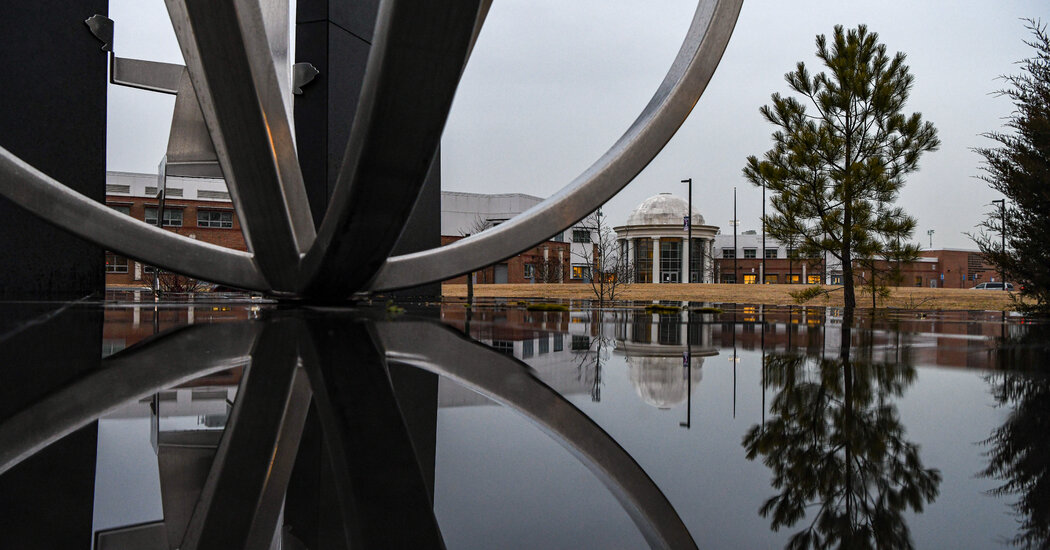
The revisions to the Virginia admissions program followed protests over the 2020 murder of George Floyd. Amid concerns about how few Black and Hispanic students attended the school, one of the country’s top public high schools, Thomas Jefferson High School for Science and Technology in Alexandria, Va., adopted what it said were race-neutral admissions standards. The school board did away with a rigorous entrance examination and offered admission to the top students from each middle school in the area rather than the top applicants from any school.
Admissions officers were also instructed to consider “experience factors,” such as whether students were poor, learning English or attending a middle school that was “historically underrepresented.” But the officers were not told the race, sex or name of any applicant.
A group of parents, many of them Asian American, objected to the plan and, calling themselves the Coalition for T.J., sued to stop it.
But a divided three-judge panel of the U.S. Court of Appeals for the Fourth Circuit, in Richmond, Va., ruled in May that Thomas Jefferson did not discriminate in its admissions. The Pacific Legal Foundation, a libertarian law group representing the parents, asked the Supreme Court to hear their appeal, saying the new admissions plan was “intentionally designed to achieve the same results as overt racial discrimination.”
The Supreme Court’s decision in June in Students for Fair Admissions v. Harvard, the coalition’s petition said, “might mean little if schools could accomplish the same discriminatory result through race-neutral proxies.”
Lawyers for the school board responded that the new admissions criteria had nothing to do with race and were focused instead on removing socio-economic and geographic barriers.
“The new policy is both race neutral and race blind,” the school board’s brief said. “It was not designed to produce, and did not in fact produce, a student population that approximates the racial demographics of Fairfax County or any other predetermined racial balance.”
After the changes went into effect in 2021, the percentage of Asian American students offered admission dropped to 54 percent from 73 percent. The percentage of Black students grew to 8 percent from no more than 2 percent; the percentage of Hispanic students grew to 11 percent from 3 percent; and the percentage of white students grew to 22 percent from 18 percent.
In the Fairfax County school system in 2020, about 37 percent of students were white, 27 percent were Hispanic, 20 percent were Asian and 10 percent were Black.

Writing for the majority in the appeals court’s decision in May, Judge Robert B. King, who was appointed by President Bill Clinton, said the before and after numbers were not the right place to start. That would, he said, quoting from the school board’s brief, turn “the previous status quo into an immutable quota.”
He added that the school had a legitimate interest in “expanding the array of student backgrounds.”
Justice Alito, in dissent on Tuesday, questioned that reasoning. “What the Fourth Circuit majority held, in essence, is that intentional racial discrimination is constitutional so long as it is not too severe,” Justice Alito wrote. “This reasoning is indefensible, and it cries out for correction.”
He elaborated, quoting from an earlier decision. “Even though the new policy bore ‘more heavily’ on Asian American applicants (because it diminished their chances of admission while improving the chances of every other racial group), the panel majority held that there was no disparate impact because they were still overrepresented in the T.J. student body,” Justice Alito wrote.
He added: “That is a clearly mistaken understanding of what it means for a law or policy to have a disparate effect on the members of a particular racial or ethnic group. Under the old policy, each Asian American applicant had a certain chance of admission. Under the new policy, that chance has been significantly reduced, while the chance of admission for members of other racial and ethnic groups has increased.”
In dissent in the Fourth Circuit, Judge Allison J. Rushing, who was appointed by President Donald J. Trump, made a similar point. The majority, she wrote, had refused “to look past the policy’s neutral varnish” and consider instead “an undisputed racial motivation and an undeniable racial result.”
The decision reversed a 2022 ruling by Judge Claude M. Hilton of the Federal District Court in Alexandria, who found that the changes made by the school board had disproportionately burdened Asian American students and were “racially motivated.” The discussion of the planned changes, he wrote, was “infected with talk of racial balancing from its inception.”
“It is clear that Asian American students are disproportionately harmed by the board’s decision to overhaul T.J. admissions,” Judge Hilton wrote. “Currently and in the future, Asian American applicants are disproportionately deprived of a level playing field.”
The Supreme Court has already had one encounter with the case, Coalition for T.J. v. Fairfax County School Board, No. 23-170.
In April 2022, the court rejected an emergency request from the coalition to block the new admissions criteria while the case moved forward. That was before the court’s decision in June banning race-conscious admissions in higher education.
Even so, the court’s three most conservative members — Justices Clarence Thomas, Samuel A. Alito Jr. and Neil M. Gorsuch — said they would have granted the request.