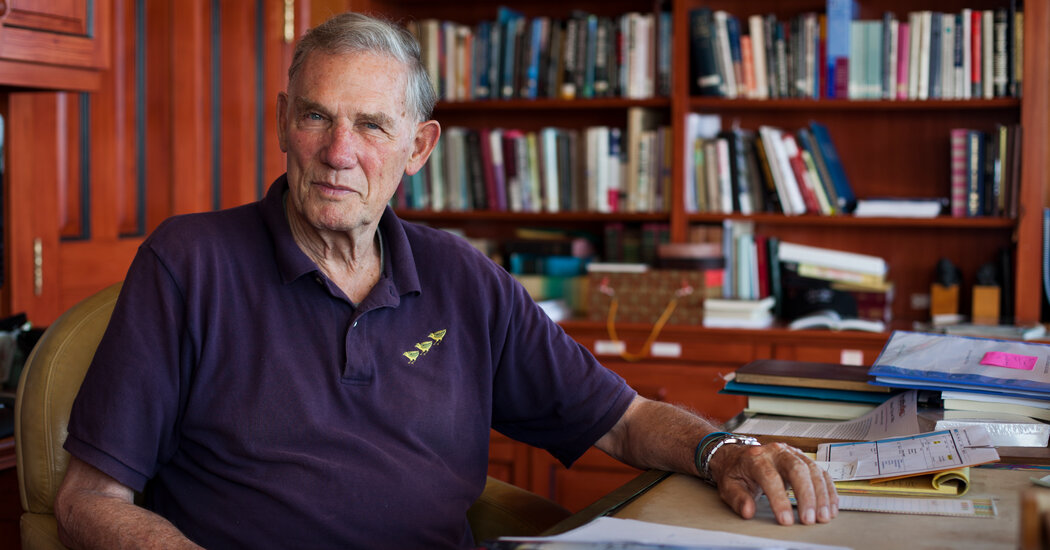

Robert A.G. Monks, a lawyer and businessman from a prominent Massachusetts family who unsuccessfully ran for the U.S. Senate three times but found a calling in his 40s as an influential defender of shareholder rights, died on April 29 at his home in Cape Elizabeth, Maine. He was 91.
The cause was pancreatic cancer, which was diagnosed about a week before his death, his son, Bobby, said.
By age 40, Mr. Monks had worked his way up to partner at the Goodwin Procter law firm in Boston, amassed a fortune running a regional oil and coal firm and other businesses, and made the first of three unsuccessful runs for U.S. senator in Maine.
While campaigning during a Republican primary there in 1972, he noticed “big, slick bubbles of industrial discharge” in a river, Mr. Monks wrote in an unpublished memoir. That and other signs of pollution made him wonder how corporate behavior could be better controlled. His answer was to persuade shareholders to assert their ownership rights by pressuring corporate executives to act more responsibly toward society at large. This epiphany, as he described it, ultimately gave him the sense of purpose and direction he had been seeking.
He pursued his activist-shareholder agenda at the U.S. Labor Department, where he was appointed in 1983 to oversee the pension system. And in 1985, Mr. Monks, with Nell Minow, founded Institutional Shareholder Services, or ISS, which advises investors on how to vote on such matters as elections of directors, compensation policies and shareholder proposals.
ISS, now majority-owned by Deutsche Börse of Germany, and a rival company, Glass Lewis, are today the largest providers of such advisory services. Their influence is such that some corporate leaders and Republican politicians, accusing the firms of pursuing “woke” agendas, have recently called for the Securities and Exchange Commission to rein them in.
Mr. Monks’s main target was the concentration of power at the highest levels of corporate leadership. In 1991, he campaigned for a seat on the board of Sears, Roebuck & Co., whose share price had plunged amid losses of market share to more nimble retailers. Among other things, he sought to curb the powers of Edward A. Brennan, who was then serving as both chairman and chief executive of Sears.
Mr. Monks lost in that effort but continued to push for changes in Sears’ strategy. In May 1992, he bought a full-page ad in The Wall Street Journal naming Sears board members and shaming them as “non-performing assets.”
Sears at the time had been seeking to diversify, buying up financial service companies like the brokerage firm Dean Witter Reynolds and Discover credit card operations. But under pressure from Mr. Monks and other investors, Sears decided later that year to dump those businesses and focus on retail.
In 2003, Mr. Monks turned his attention to Exxon Mobil. At the company’s annual shareholders meeting, he lectured Lee Raymond, the chairman and chief executive. “The scope of your operations is global, and goes beyond the usual language of business into politics and foreign policy,” Mr. Monks said. “The scope of your power, Mr. Chairman, is truly imperial. You are an emperor.”
In addition to starting ISS, Mr. Monks founded a small fund-management firm, wrote books and essays, gave speeches and formed coalitions with other corporate-governance crusaders.
Partly as a result of his efforts and those of like-minded activists, more companies split the jobs of chairman and chief executive. (Among S&P 500 companies, 61 percent now divide those roles, up from 20 percent in 2000, according to ISS.) Far fewer boards are dominated by insiders, and institutional investors are more inclined to demand effective and ethical governance, Ms. Minow, the ISS co-founder, said.
Mr. Monks told The New York Times in 2007, “The notion that a company that creates a problem is exempted from trying to find a solution to that problem is like being in the elephant business but not having anyone in charge of going behind the elephant and cleaning up after it.”
In one area, executive pay, he conceded that he was unable to change behavior. Pay packages for chief executives have continued to climb from levels he considered “obscene” decades ago.

Using another animal metaphor, Mr. Monks described the limits of shareholder power: “When two gorillas get ready to fight, they throw dust at each other. I’m in the gorilla-dust business, and I’m in the gorilla-dust business not because I like it, but because it’s the only game in town.”
Robert Augustus Gardner Monks was born in Boston on Dec. 4, 1933, and spent his early years in what he described as a “rambling mansion” in the western Massachusetts town of Lenox. His ancestors, including Gardners and Peabodys, had been wealthy for generations. Dividends from AT&T and General Electric sustained the family comfortably through the Depression.
His father, George Gardner Monks, was a priest in the Episcopal Church and led the private Lenox School. His mother, Katherine (Knowles) Monks, ran the household and helped oversee family properties.
After graduating from St. Paul’s School in Concord, N.H., Mr. Monks went to Harvard, earning an undergraduate degree in history in 1954. He had stood out as a 6-foot-6 rower for the varsity crew and was awarded a Phi Beta Kappa key. He later rowed for the University of Cambridge in England, where he also studied history as a Fiske scholar.
In 1954, he married Millicent Sprague, known as Milly, a descendant of the Carnegie steel family. She later founded a dance company in Maine and wrote a memoir, “Songs of Three Islands: A Story of Mental Illness in an Iconic American Family.” She died in 2023.
In addition to his son, Mr. Monks is survived by a daughter, Melinda Monks; three grandchildren; and six great-grandchildren.
Mr. Monks earned his law degree at Harvard in 1958. At Goodwin Procter, his first stop after law school, he impressed colleagues with his ability to find clients among his many family connections. At age 31, though, he was tired of law and left Goodwin to take on various executive roles revitalizing and in some cases selling family businesses.
A friend recruited him to be a director of Boston Co., a fund management concern, where he became chairman and a major shareholder — and cashed in when the firm was sold in 1981. Donations to Republican causes set him up for his Labor Department appointment during the Reagan administration.
As a dogged Republican candidate for the Senate, Mr. Monks lost to Senator Margaret Chase Smith in the primary in 1972, to Senator Edmund Muskie, a Democrat, in the general election in 1976, and to Susan Collins, a Republican who remains in office, in the 1996 primary. He concluded that his political talents were slight. In his memoir, however, he wrote that campaigning was a joyful experience that brought him into contact with working-class people he never would have met otherwise.
A 1999 biography of him by Hilary Rosenberg was titled “A Traitor to His Class,” a label that Mr. Monks called appropriate. A devotee of transcendental meditation, he enjoyed being a maverick and needling plutocrats — a tendency that had the effect of shrinking his social circle, he wrote.
Even so, he was careful not to exaggerate his heroism. “I’m more conservative than I like to think,” he told The Financial Times in 2005. “I’m talking a brave game, but I have a lot of money, and I’m never risking anything I can’t afford to lose.”