
A May 1985 report in the journal Nature was alarming. High above Antarctica, a massive hole had opened in the ozone shield that protects life on earth from the sun’s ultraviolet rays.
The finding confirmed what scientists had warned of since the 1970s: Atmospheric ozone was being broken down by the wide use of chlorofluorocarbons, chemicals known as CFCs, which were found in aerosol sprays, refrigeration and air conditioning.
Just over two years later, dozens of nations meeting in Montreal signed an agreement to significantly reduce CFCs, which the Environmental Protection Agency estimated would prevent 27 million deaths from skin cancers.
“This is perhaps the most historically significant international environmental agreement,” Richard E. Benedick, the chief United States negotiator, said at the time.
Ever since, the Montreal Protocol, as the pact is known, has stood as a milestone of collective action in the face of a planetary environmental threat, as well as a rebuke of the lack of international resolve to tackle the more dire and complex threat of climate change.
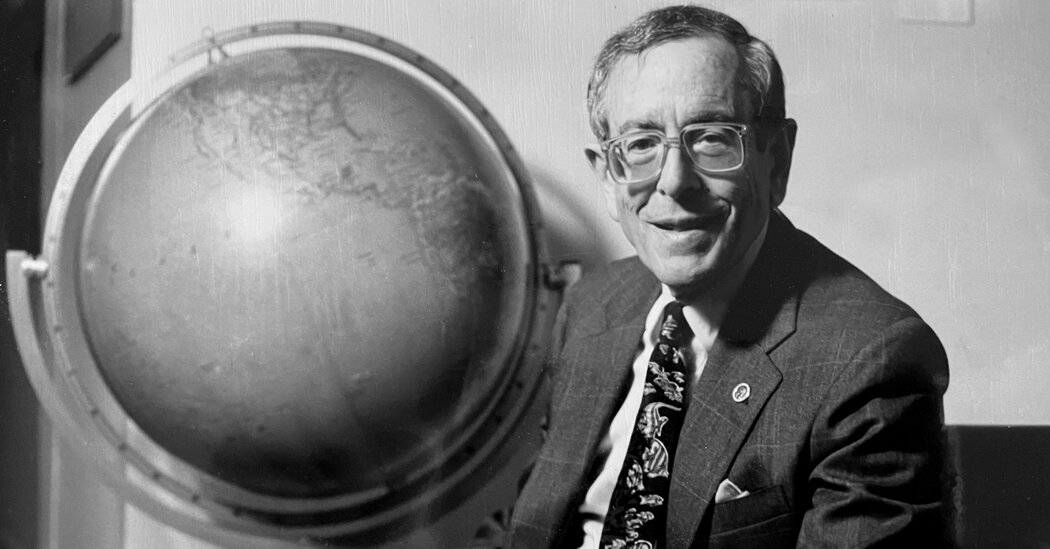
Mr. Benedick, who was a career diplomat in the State Department when the Montreal Protocol was signed in 1987, and who patiently wore down opposition from foreign nations while withstanding powerful internal critics in the Reagan administration, died on March 16 in Falls Church, Va. He was 88.
His daughter, Julianna Benedick, said he had suffered from advanced dementia and that he had been living in a memory care home since 2018.
It is no small paradox that a global treaty to address atmospheric pollution was negotiated during the presidency of Ronald Reagan, who was elected as a champion of business and a sworn enemy of government regulations.
But support for addressing the threat of CFCs to human health was possible because environmental issues were less bitterly partisan than they would later become, and because U.S. industry, chiefly DuPont, the largest maker of the chemicals, preferred an international treaty to the possibility of more draconian cuts by Congress.
Still, as Mr. Benedick wrote in a 1991 book about the road to a deal, “Ozone Diplomacy: New Directions in Safeguarding the Planet,” success was never assured in the nine months in which the treaty was hammered out. “Most observers in and out of government,” he wrote, “believed at that time that an agreement on international regulation of CFCs would be impossible to reach.”
Mr. Benedick, described as energetic and dogged by colleagues, was instrumental to the success. “He was a tenacious guy; he was like a terrier with a bone,” John D. Negroponte, then an assistant secretary of state who was Mr. Benedick’s superior and ally, said in an interview. “The atmosphere in this town — it was an uphill fight; I don’t think it would have happened without him.”
In the Reagan administration, leaders of the State Department and the Environmental Protection Administration favored regulating CFCs. But in the middle of the international talks, strong opposition emerged from Donald P. Hodel, the interior secretary, and William R. Graham Jr., the White House science adviser.
Mr. Hodel said Americans worrying about skin cancer from ozone loss should not expect more government regulation, but should try “personal protection,” namely, hats, sunglasses and sunscreen.
His comments, once leaked to the press, were widely mocked, inspiring editorial cartoons of fish and animals — which are also at risk from ultraviolet rays — in sunglasses. Environmentalists greeted Mr. Hodel at a news conference with their faces smeared white with sunscreen.

Other opposition came from foreign countries, chiefly Japan, the Soviet Union and the European bloc, which argued that the scientific link between CFCs and ozone depletion was not proved.
The State Department sent key scientists from the U.S. government’s science agencies to Moscow, Tokyo and Brussels to educate their counterparts.
“I think it helped get the message across,” Mr. Negroponte said. “Dick was the brains behind that.”
In the end, President Reagan came down on the side of Mr. Benedick and the State Department, overruling the anti-regulatory faction in his administration. Among the reasons suggested for the decision was that Mr. Reagan had recently had a cancerous growth removed.
The Montreal Protocol, which required cutting the use of CFCs by half, was signed by 24 countries in September 1987. It was ratified unanimously the next year by the U.S. Senate. In 1990, the protocol was toughened to eventually phase out CFCs entirely. Today, nearly every country in the world has banned them.
Concentrations of long-lived ozone-depleting chemicals in the stratosphere have gradually declined, with the ozone hole above Antarctica expected to heal by the 2060s, according to the National Oceanic and Atmospheric Administration.
Richard Elliott Benedick was born on May 10, 1935, in the Bronx. His father, Lester L. Benedick, was in the insurance business. His mother, Rose (Katz) Benedick, died while giving birth, and as a result, “He never liked celebrating his birthday,” Mr. Benedick’s daughter said.
Lester Benedick remarried to Jean (Shamsky) Benedick.
Richard, raised in the Bronx, earned a bachelor’s degree in economics from Columbia University, an M.A. in economics from Yale and a Ph.D. from the Harvard Business School, writing a dissertation titled “Industrial Finance in Iran.”
In 1957 he married Hildegard Schulz, whom he met at the International House at Yale. She accompanied Mr. Benedick, then a foreign service officer specializing in economic development in the State Department, to postings in Iran, Pakistan, France and Germany. The couple divorced in 1982.
Mr. Benedick’s second marriage, to Helen Freeman, also ended in divorce. Later he had a long-term companion, Irene Federwisch. In addition to his daughter, from his first marriage, he is survived by a son, Andreas Benedick, also from that marriage; a granddaughter; and two great-grandchildren.
At the time of the Montreal Protocol, Mr. Benedick was deputy assistant secretary of state for environment, health and natural resources and coordinator of population affairs.
“Richard was energetic, even passionate,” said William K. Reilly, who was president of the World Wildlife Fund, where Mr. Benedick was a fellow after negotiating the Montreal Protocol. “It was a career highlight for him and for the United States, a masterful diplomatic achievement.”
When he returned to the State Department under President George H.W. Bush, Mr. Benedick attempted to apply ozone diplomacy to the issue of global warming, which scientists had begun to warn was the most perilous environmental threat. A government scientist, James Hansen, told the Senate and the press in 1988 that the evidence that global warming had begun could be detected “with 99 percent confidence,” which became front-page news.
Mr. Reilly, who led the E.P.A. under Mr. Bush, said the politics of the administration did not favor action. Secretary of State James A. Baker III “chose to recuse himself from climate,” Mr. Reilly said. Mr. Bush’s chief of staff, John H. Sununu, vetoed a proposal from the E.P.A. to have the president propose a global treaty on carbon emissions. When Mr. Hansen reappeared before the Senate in 1989, the White House censored his testimony to inject doubts that human activity caused climate change.
Mr. Benedick was not a scientist, but he was a great admirer of nature and the outdoors.
“He absolutely loved taking our family to the national parks,” Ms. Benedick, his daughter, said. “He planned five cross-country trips when we were children in the ’70s and ’80s. We’d fly to California and visited pretty much every national park driving east. He’d have us get up at the crack of dawn to watch the sunrise over Yosemite or Bryce or Zion or Monument Valley.”