
A prominent group of chief executives said almost six years ago that making profits for shareholders was only part of their business — and not necessarily the main part.
Speaking collectively as the Business Roundtable, C.E.O.s from companies like Johnson & Johnson, FedEx, Wells Fargo and Amazon said that, really, they were devoted to serving employees and customers, protecting the environment and treating suppliers ethically.
Thank you, I wrote in a column back then. And may I sell you a bridge?
Now that many companies are muting their commitments to programs embracing diversity, equity and inclusion, as well as to environmental sustainability, I can’t say I’m shocked.
The Trump administration has declared D.E.I. to be “illegal” and “immoral.” It has derided efforts to ensure “sustainability” and stave off climate change as misguided undertakings that are only weakening America. Faced with the administration’s threats of litigation and investigation, corporate America is, to a large extent, bending with the political wind. My colleagues, here and at other news organizations, have been documenting the retreat on these issues by countless companies, including Target, Meta, Google, Goldman Sachs, Morgan Stanley, BlackRock and Vanguard.
The spectacle of corporations changing their posture in waves, like groves of saplings in a storm, may seem startling.
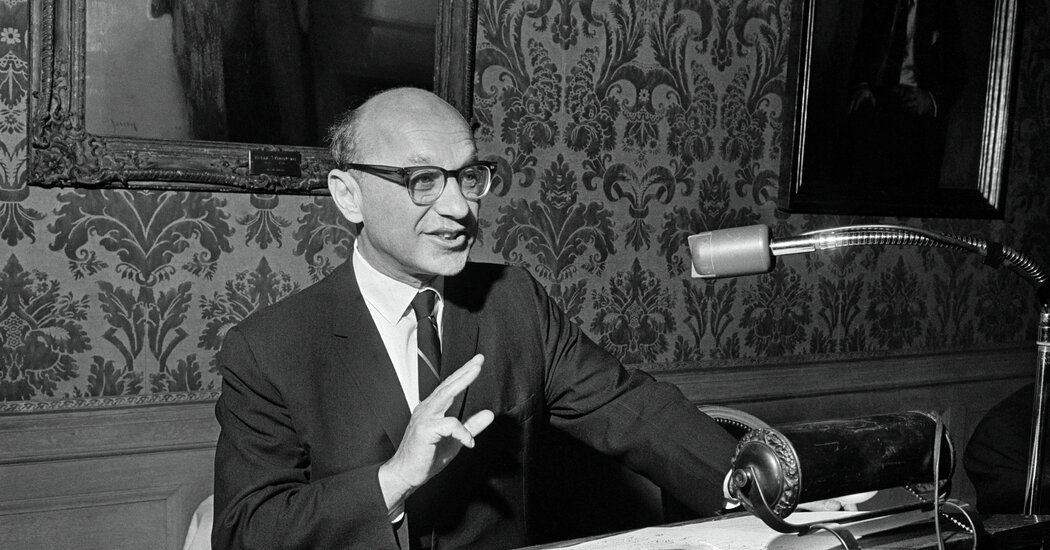
But corporations have always done this. What we’re seeing now is an accelerated version. In fact, it’s what Milton Friedman, who was both a Nobel laureate economist and a high priest of conservative, free-market ideology, said they should do.
Social Responsibility
Professor Friedman chose to explain his views in The New York Times Magazine to a broad swath of Americans, including many who were not entirely comfortable with right-wing political beliefs.
His article, published on Sept. 13, 1970, carried a provocative headline: “A Friedman doctrine — The Social Responsibility of Business Is to Increase Its Profits.” In it, he acknowledged that many leading companies in those days — as in the recent past, before the Trump victory — openly advocated a broad sense of corporate responsibility.
This was a grave mistake, he contended. “The businessmen believe that they are defending free enterprise when they declaim that business is not concerned ‘merely’ with profit but also with promoting desirable ‘social’ ends; that business has a ‘social conscience’ and takes seriously its responsibilities for providing employment, eliminating discrimination, avoiding pollution and whatever else may be the catchwords of the contemporary crop of reformers.”
This kind of talk was naïve, vacuous and worse, he said. Professor Friedman, an apostle of unfettered capitalism, said that if anyone took corporate social responsibility seriously, it would lead the United States on the road to socialism. Instead, he wrote, what companies should do was stick to their essential function: Using resources efficiently to maximize profits.
Businesses needed to abide by government rules and regulations, he said. Furthermore, he allowed that sometimes executives had to speak as though they believed that corporations had a responsibility to do more than simply make money.
“If our institutions, and the attitudes of the public make it in their self-interest to cloak their actions in this way,” Professor Friedman wrote, “I cannot summon much indignation to denounce them.” But he did so anyway, calling them “incredibly short sighted and muddle-headed” as well as “socialist” and “collectivist.”
One motivation for writing this full-throated defense of pure profits was clear in his piece: He was troubled by the rise of shareholder proxy campaigns, in which shareholder votes push corporations to act in a progressive manner. Professor Friedman referred specifically to the “G.M. crusade,” a pioneering shareholder rights campaign begun earlier that year and spearheaded by Ralph Nader.

Professor Friedman died in 2006. Mr. Nader remains active, and this past week, I called him for his perspective on shifting corporate views on D.E.I. and sustainability since the 1960s.
He said that in the General Motors campaign, “We had three goals: to get G.M. to produce safer cars, less polluting cars and more fuel-efficient cars.” The effort centered on a proxy fight — ostensibly, an electoral battle for a plurality of shareholder votes.
But, Mr. Nader said, there was never a serious hope of winning a proxy vote contest because the organizers only owned a handful of shares, while richer and more conservative investors had vastly more resources. Instead, the G.M. campaign was a battle for the nation’s hearts and minds.
Mr. Nader’s tactics were inspired by a proxy battle at Eastman Kodak, started a few years earlier by the community organizer Saul Alinsky. Mr. Alinsky, who died in 1972, said he took on Kodak because it was the most powerful institution in its home base, Rochester, N.Y. The point of the campaign was to persuade the company to use its clout to get Rochester to build decent housing for poor people of color.
In his classic book, “Rules for Radicals: A Pragmatic Primer for Realistic Radicals,” Mr. Alinsky wrote, “There was never any thought, then or now, of using proxies to gain economic power inside the corporation or to elect directors to the board.”
He added, “Boards of directors are only rubber stamps of management.”
Similarly, Mr. Nader said that he knew at the outset of the G.M. campaign in 1970 that it would be impossible to “win” a shareholder voting contest outright. But the campaign succeeded in putting pressure on the company for a while, he said. “Kicking and screaming, they started producing safer cars, more fuel-efficient cars and less polluting cars,” he said.
But obviously, he said, “when you look back, it’s clear that they didn’t do nearly enough.” And, he added, proxy campaigns and corporate commitments can only go so far.
That shouldn’t be surprising, he said, because corporate executives and board members “just put their fingers in the wind and when the wind changes, they just back off. It’s a rhetorical cycle, but it doesn’t much change how they actually behave one way or another.”
On the other hand, Mr. Nader said, most corporate executives are pragmatists who understand that having a diverse work force and making efficient use of energy “is in their companies’ own interest.”
If the political cycle shifts again, expect to hear much more from corporate America about the need for social responsibility, Mr. Nader said.
Profits and Politics
I don’t expect — or want — corporate executives to be political leaders. I would prefer that they do the right thing, and I’m troubled when they don’t. But I invest in them anyway.
Maybe that’s because I learned early on to be skeptical of smooth-talking strangers. As an investor, I focus on the money. As I’ve said before, when somebody offers something for nothing, I reach into my pocket to see if my wallet is there.
My wallet is intact. That’s at least in part because I’ve been careful to separate my personal and political opinions from my investments. I don’t necessarily trust all publicly traded companies or approve of all of their practices, but I hold a piece of them through broad, cheap stock and bond index funds that put money into the entire global market. I intend to keep doing so, regardless of changes in fashion or politics.
Now, on a personal note: I’m taking a break — a monthlong sabbatical.
The Strategies column will be back in the spring. Let’s see what the winds of change have done to corporate America by then.