
The pay stubs tell the story. Hefty deductions to help cover the cost of Kenya’s new funds for affordable housing and health insurance. More money subtracted for jacked-up contributions to the National Social Security Fund and an increase in the tax rate.
In a matter of months, Kenyans with a 45,000-shilling-a-month salary — roughly $350 — saw their take-home pay shrink 9 percent, to $262.
Pay stubs for an employee at Shining Hope for Communities, a nonprofit in Kenya:
JUNE 2024
“People who are salaried are crying,” said Kennedy Odede, the founder of a self-help association in Nairobi’s Kibera slum.
The increased payroll taxes are one element of President William Ruto’s desperate bid to raise revenue to keep the government running and pay off Kenya’s staggering foreign debt.
New excise taxes were put on sugar, alcohol and plastics. A tax on business profits doubled to 3 percent. Government fees for money transfers and for phone and internet data services went up 15 to 20 percent. A tax on every import, including essentials like wheat and cooking oil, to be used for railroad development was increased to 2 percent from 1.5 percent. Some exemptions for retirees were scrapped. The list goes on.
Tax increases are never popular. But the impact on countries like Kenya, with low incomes and crippling debt, is particularly acute. Years of harum-scarum borrowing and spending combined with economic wallops from the Covid-19 pandemic, soaring interest rates and inflation helped drive up Kenya’s debt to $80 billion.
Kenya has to use nearly 60 percent of its revenue for paying off its loans. It is a common problem across Africa, where many countries spend more on interest payments than on health or education.
At the same time, countries need billions of dollars in new financing for basic medical care, schools, clean water, sewage systems, paved roads and climate-related disaster relief.
Getting the country’s finances in order is a prerequisite for long-term growth. But there are limited options to raise such revenue in Kenya, where 40 percent of its 52 million people live in poverty and youth unemployment is estimated to top 25 percent. Small businesses and subsistence agriculture make up much of the economy.
According to one estimate, 83 percent of the country’s labor force works in jobs that are out of tax collectors’ sight, including as hairdressers, maids, street sellers and drivers.
That means the sliver of the population that works in enterprises that record salaries bears most of the tax burden.
“Our buying power has really decreased because of the taxes,” said Elizabeth Okumu, who works at Shining Hope for Communities, or SHOFCO, the nonprofit organization Mr. Odede started two decades ago.

The country’s economic crisis has pushed the value of the shilling lower in relation to the dollar, meaning that the cost of imports has soared. Six months ago, a thousand shillings ($7.73) were enough for cooking oil, flour, rice and sugar, said Ms. Okumu, chairwoman of SHOFCO’s urban network in Nairobi. Now, she said, she can buy only sugar and flour with that same amount.
Last year, proposed tax increases set off deadly riots in Nairobi, the capital. More than 50 people were killed, and part of Parliament was set on fire. The government temporarily backed down, only to reimpose many of the additional taxes and fees a few weeks later.
The government has been talking to the International Monetary Fund about a new loan package. The fund is likely to ask for additional guarantees that the Ruto administration will cut spending and raise more revenue. But you can’t squeeze much water from a wrung-out towel.
Behind the widespread discontent with specific policies is a deep cynicism about the government’s ability to either pay back the debt or provide essential services.
Regular reports from the country’s auditor general, Nancy Gathungu, detail gross examples of corruption or mismanagement. At the end of last year, for example, she said, the government could not account for more than $1.24 billion that had been earmarked for debt payments. In March, Ms. Gathungu reported that $64 million worth of government-funded Covid-19 vaccines had never been delivered. Critics have also fumed about extravagant spending by government officials.
“Ruto says we need to pay our debts, but there are no public services to show for it,” said Tatiana Gicheru, a student at Strathmore University in Nairobi. “I can’t walk into a government hospital and get any services.”
Ms. Gicheru, 21, sat outside Java House, a coffee chain in Nairobi, and sipped a latte with her friend Jewel Ndung’u. Ms. Ndung’u, 25, graduated from Strathmore two years ago and has been looking for full-time work as an analyst or a developer. From September to January, she said, she applied for 73 jobs. She got half a dozen callbacks and no job offers.
Where is the affordable housing? Where are health services and public transportation? Ms. Ndung’u asked. Ms. Gicheru added, “Suddenly the system is crumbling.”
Ms. Ndung’u said she would rather see Kenyans directly pay off the debt to China, the country’s biggest bilateral creditor, by using M-Changa, a digital fund-raising platform, instead of giving the money to the government through taxes and trusting it to do it.
As taxes rise, Kenyans have grown angrier about the lack of public services. In November, a crowd of people frustrated about dilapidated roads in Syokimau, a few miles south of Nairobi’s main airport, jeered as they forced their council representative to walk through flooded, muddy streets.
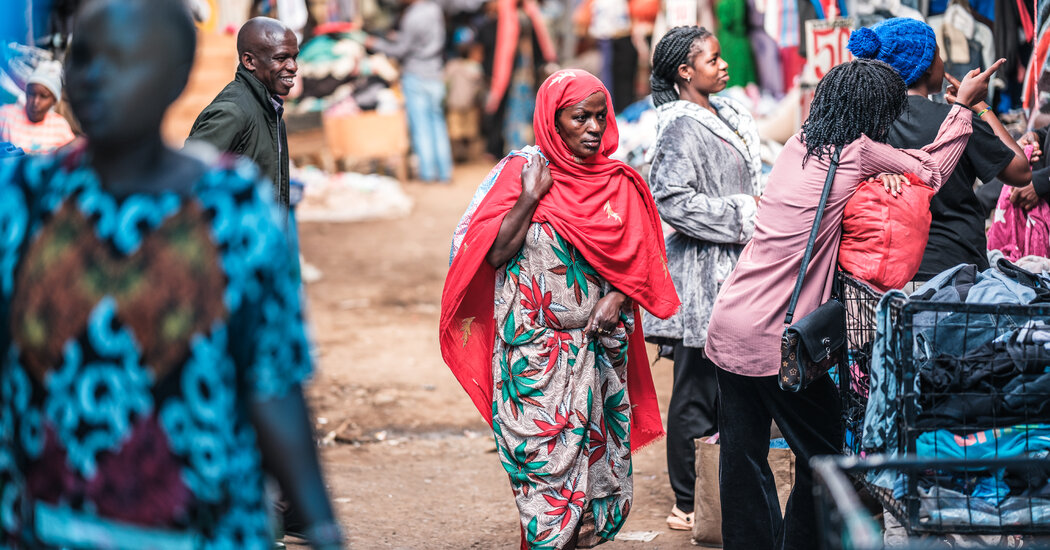
In the southwestern part of Nairobi is Kibera, considered the largest urban slum in Africa. Its dirt streets teem with shoppers, pedestrian commuters, peddlers, hustlers, students in neat uniforms and residents filling bright yellow jerrycans with clean water from coin-operated taps. They navigate around piles of garbage and occasional raw sewage as well as motorbikes and bicycles hauling oversize loads better suited to a sport utility vehicle. There are no government-funded sanitation services in Kibera.
The jampacked skyline features ramshackle homes of plasterboard, rusted roofs, and a forest of haphazard poles and wires on which illegal electricity hookups hang like Christmas ornaments.
Benedict Musyoka, a youth community organizer in Kibera, said a young man had told him: “I won’t marry.” Earning enough to support himself is hard enough, let alone with a wife and child. And the man had a degree. “You are taxing hard, and we have no jobs,” Mr. Musyoka said.
With Kenya’s level of debt, there are no easy options, said Thys Louw, a portfolio manager at Ninety One, a global investment firm in London. Expanding the revenue base — bringing more businesses and people who are not currently paying taxes into the system — is crucial, he said. And there are too many exemptions.
In Kenya, taxes amounted to 16.6 percent of the country’s total output in 2022, according to the Organization for Economic Cooperation and Development. The share is not unusual in Africa, but half the amount found in richer industrialized nations.
June will be one year since the riots, and talk of commemorative gatherings and further protests is bubbling. That is also when the government will be finishing a new budget, which could possibly include further tax rises.
Many people like Ms. Okumu at SHOFCO fear there will be more riots. People work so hard, she said, hoping “that tomorrow they’ll see the light.”
“But when tomorrow comes, it’s still darkness.”
Abdi Latif Dahir contributed reporting.