
My son’s favorite song is “Vampire” by Olivia Rodrigo. It plays on a continuous loop in our home. I wonder if he is old enough to delight in the lore of the vampire, the figure’s sexy and mysterious violence, and the theatrical crescendos of Rodrigo’s voice: “Bloodsucker, fame fucker.”
In mid-October, he assembled a vampire costume for Halloween, replete with fangs, fake blood and a synthetic black cape that barely enveloped his 10-year-old frame.
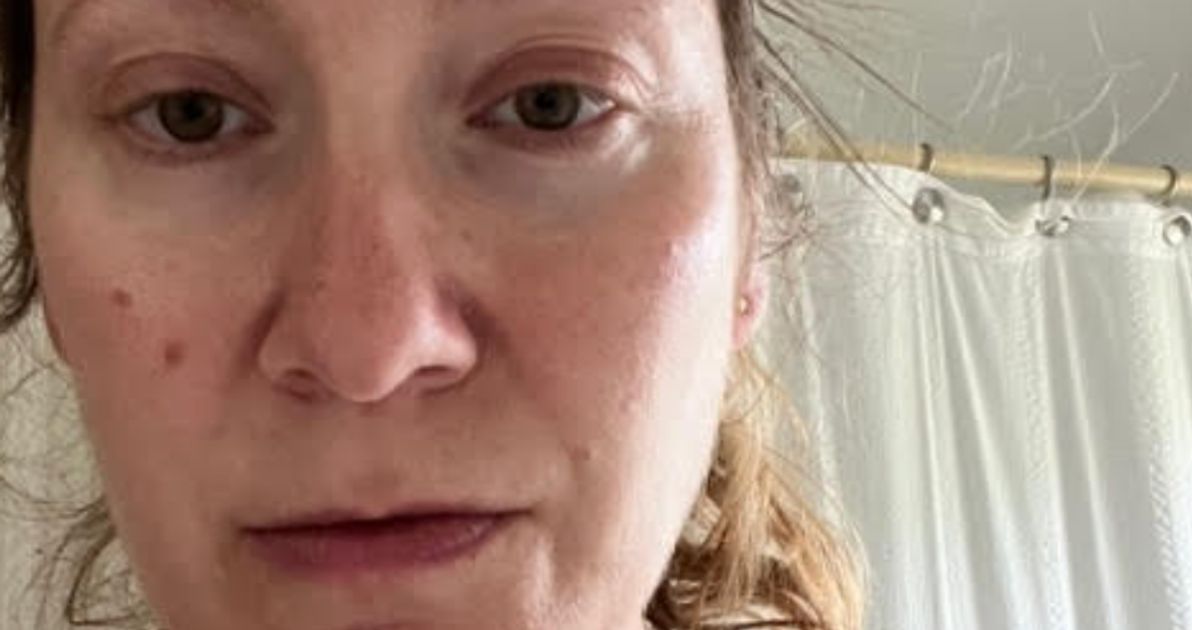
I have a different impression of vampires now that I am one. Because of a condition called lupus, if I’m exposed to direct sunlight, even for 10 minutes, a fiery rash appears on my chest and chin, and a milder rash — call it a blush or a butterfly rash — spreads across my cheeks and nose.
The sun also causes me to turn febrile. I shiver and shake. It weakens my legs, sometimes to the point of immobility. It gives me one swollen, cyclopean eye. No wide-brimmed hat or SPF lotion can fully avert such reactions, so I retreat like a vampire into the dark lair of my home on sunny days. I have installed blinds throughout the bottom floor of the house to make the transformation complete. Call it Transylvania.
When the rashes first erupted at the beginning of last summer, I had hoped they were heat rashes, like the fiery bumps I remembered from childhood beach trips. And when the sweating began, I assumed it might be the early throes of menopause, which, at the age of 43, did not seem unimaginable.
But other symptoms followed. Pain migrated from my fingers to my elbow to my ankle to my knees. The pain was insidious, like a roving animal. My fingers hurt so much that it became difficult to hold a book or press open its spine, something I did every day as a professor.
Weeks later a fog descended on my mind. It was so thick that I worried I would never be able to read a full book again. Sometimes the words swam on the page, and I wondered if my eyes were dry or if my vision was worsening, or both. I wondered: Would this be the end of my career? What would I do instead?
My joints crackled. My skin itched. When I walked, it felt like I listed sideways, uncomfortably drunk. One day, I called a friend because I couldn’t type an email — my fingers had stiffened. Days later, my husband found me in the bedroom mantled in darkness, after I pulled all the lightbulbs out of their sockets; the brightness stung my eyes. I did not know what was wrong with me, but I felt betrayed by my own body.
Autoimmunity is a kind of betrayal. The immune system mistakes the self for an enemy and attacks the body’s healthy tissues and cells. Bodily betrayal is a common refrain of autoimmune sufferers. A body that once functioned in a manner you expected turns on you in unpredictable ways. Your body is without loyalty to the self it serves.

Courtesy of Jennifer Spitzer
As the weeks wore on, I felt more and more like a vampire — hiding from the sun during the day, walking my dog at night, becoming paler and more anemic. It turns out that the vampire has long been associated with diseases like porphyria and lupus, both of which produce symptoms intensified by sun exposure and garlic.
Bram Stoker’s “Dracula,” published in 1897, introduced another enduring trope: that vampires don’t produce reflections in mirrors. There may have been historical reasons for this choice. In the 19th century, mirrors were backed by a plate of silver, a metal that was supposed to drive back evil spirits. Like garlic, silver has antimicrobial properties, which may have reinforced the vampire’s association with disease.
For the first several months of my mysterious illness, I took down almost every mirror in the house, repelled by my own reflection. I couldn’t bear to witness the rashes on my face and my rapidly thinning hair — the bald patches spreading along my forehead. I couldn’t tell if the purple shadows under my eyes were from the illness, the insomnia that plagued me, or the heavy steroids that the doctor had prescribed. When I asked my husband if I looked different, he shrugged and said I looked the same. But deep down I felt I was undergoing a transformation, as if some inner torment were manifesting physically.
Then one day my tongue became scalloped, with indentations along the edges. When I showed my son, he gasped, “OMG, what is that?!” Then he wanted to see it again. He seemed curious and even concerned, but I felt like his mother-monster.

Without a language for my illness, I called myself a vampire. But I wasn’t a bloodthirsty predator, just a formerly able-bodied person suddenly dependent on others for almost everything. The previous year I had taught 125 students and published a book and two articles, but almost overnight I was spending my days shuffling between emergency room visits and medical specialists who seemed faintly alarmed and also baffled by my symptoms.
One ER physician told me “to sleep more and eat clean,” which was not the same as a diagnosis. A nurse practitioner thought my bloodwork suggested “weak” Lyme disease and prescribed doxycycline. But I became sicker, weaker and more despairing.
When the dermatologist called in November to tell me that I had lupus, to give it a name, I felt relieved — because I had my suspicions, because the blood tests had hinted at it — but also devastated, because now I had an unpredictable and incurable disease.
“It is not necessarily fatal,” the internet said, “but it can attack every organ and bodily system.” Like a vampire, I straddled a threshold between life and death.

Courtesy of Jennifer Spitzer
I am lucky to have been diagnosed relatively quickly, with an antinuclear antibody test and a skin biopsy that were both positive for lupus. But this was partly the result of ruthless self-advocacy, painstaking research and navigating the byzantine corridors of the U.S. health care system — which became a full-time job and would have been impossible to do without a medical leave from my institution. I sought out weekly appointments with rheumatologists, pulmonologists, neurologists, optometrists, dermatologists, cardiologists and gynecologists. My diagnosis took under six months, but many people with autoimmune diseases hover in uncertainty for years and even decades.
Lupus remains a shadowy illness, vampiric in its predation of nearly every bodily system and organ — skin, heart, kidneys, lungs, liver and brain. It lacks a clear origin and cure, and is notoriously difficult to diagnose and treat. Nine out of 10 people with lupus are women, and it disproportionately affects women of color. Many patients report feeling belittled by doctors or dismissed as hysterical. Because lupus is largely a women’s disease, there is correspondingly little research into it. Women’s illnesses and conditions remain in the dark like vampires, as do the women themselves.
When I joined an online support group for lupus, made up primarily of women, I noticed how many of the participants discussed feeling vampirelike too. They spoke of extreme sun sensitivity and the way lupus forced them to live their lives at night, at odds with the normative rhythms of everyday life. But sometimes it felt like they were speaking in code, about feeling isolated, misunderstood by doctors and loved ones, cast aside by a scientific community that devoted little attention and resources to diseases like theirs. The more I participated in these forums, however, the less I felt like a misfit suffering in the shadows.
I love Anne Rice’s vampires the most — immortal, sensual, pulsing with desire. They are unlike my vampire, who is fragile and hopelessly time-bound. My vampire feels old for her age. This is where the metaphor ends.
The more well-known metaphor for lupus is the purple butterfly, an affirming symbol of hope and resilience. Two summers ago, my son and I captured a caterpillar in a jar and stuffed the jar full of leaves, hoping we could grow a butterfly ourselves. We stared at it and stared at it, but we eventually decided it was dead and forgot about the jar, which perched on the lip of our living room window. Then after two weeks we were amazed to find a folded-up monarch clinging to the lid, its wings like stained glass. It had a resilience we couldn’t quite fathom. We walked the jar outside and placed the monarch on a leaf, expecting it to fly off. But it refused to move for hours, as if in stunned stupor at its new shape.

Courtesy of Jennifer Spitzer
As I write this, I feel less like the vampire and more like the stunned butterfly, wondering how I will fly in this new body. There is safety in the long and dark winter periods in upstate New York. I had fantasized that I would emerge transformed in spring, that the medications I began in September would lead me to a better place, and mostly they have. But sometimes my limbs feel heavy like weighted blankets. My fingers still stiffen at the joints. I am told to move more, and on most days, I feel a buoyancy that belies my condition, as if I could move with the sky. But other days I fall hard, like a humbled “lupie” still learning her limits.
Nothing about lupus is linear, and the traditional narrative arcs do not apply to chronic illnesses like mine — there will be periods of flare and remission, but no resolution or cure. If I were to plot my progress since June, it would appear an erratic line, tending upward. But this gives me hope. Living with lupus is partly about accepting the unknowns and valuing the good days, while also giving myself permission to mourn my prevampire self. My son, the vampire for Halloween, recently told me we are both vampires, cowering from the sun, only my cape is invisible.
Jennifer Spitzer is an associate professor of literature at Ithaca College. Her writing has appeared in The New York Times, the Los Angeles Review of Books, Avidly and several academic journals. Her book, “Secret Sharers: The Intimate Rivalries of Modernism and Psychoanalysis,” was recently published by Fordham University Press. Jennifer lives in Ithaca, New York, where she is writing a memoir on grief, illness, and Virginia Woolf. Links to her work can be found here: https://www.ithaca.edu/faculty/jspitzer.
Do you have a compelling personal story you’d like to see published on HuffPost? Find out what we’re looking for here and send us a pitch at [email protected].