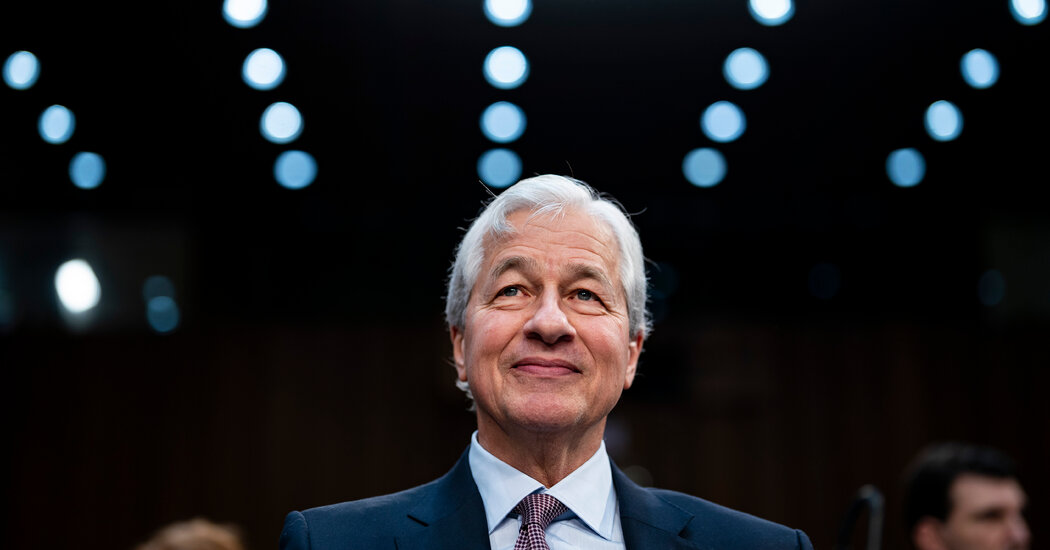

Jamie Dimon sees America at a ‘Pivotal Moment’
Jamie Dimon’s annual letter to JPMorgan Chase shareholders has just been published. The widely read note offers a glimpse of his views on not just business, but the economy at a “pivotal moment for America and the free world,” with deep divisions at home and global uncertainty.
Here are some highlights.
The economy is resilient but the government underpinning it is a red flag. Consumers are spending and investors expect a soft landing. But Dimon warns that the economy is being fueled by government spending and rising deficits. “The deficits today are even larger and occurring in boom times — not as the result of a recession — and they have been supported by quantitative easing, which was never done before the great financial crisis,” he writes.
Inflation may be sticky. “These markets seem to be pricing in at a 70% to 80% chance of a soft landing — modest growth along with declining inflation and interest rates,” Dimon writes, adding that the odds are actually a lot lower.
Global uncertainty is another dark cloud. The wars in Ukraine and the Middle East could further “disrupt energy and food markets, migration, and military and economic relationships.” That shock coincides with a surge in public investment to power a green transition, restructure supply chains and trade relationships, and boost health care spending.
Industrial policy is needed but should be limited and targeted. Dimon says the U.S. must be tough with China, but engage with Beijing. That includes establishing independence on supplies of materials crucial to national security, like rare earth, semiconductors and 5G infrastructure. (According to Dimon, the Inflation Reduction Act and the CHIPs Act get it right.)
Dimon warns about the deep political divisions at home. Dimon doesn’t explicitly weigh in on the election (his public backing for some of Donald Trump’s economic policies caused a stir at Davos in January), but said the U.S. is grappling with “highly charged, emotional and political” issues centering around the border security crisis and the “fraying of the American dream.”
On Basel 3 endgame: Dimon reiterated his concerns that many of the proposed banking rules are “flawed and poorly calibrated.”
On corporate governance: Dimon argues that proxy advisory firms like ISS have become too influential (he recently backed Disney in its fight against Nelson Peltz). He is opposed to recent efforts to split chairman and C.E.O. roles and thinks the universal proxy “makes it easier to put poorly qualified directors on a board.”
HERE’S WHAT’S HAPPENING
Janet Yellen sees progress in China relations, but warns there’s “more work to do.” The Treasury secretary concluded meetings in Beijing on Monday saying that ties between the nations had stabilized, but it was unclear how the relationship would endure in an election year. Her comments came as the Biden administration agreed to give Taiwanese chipmaker TSMC $6.6 billion in grants to begin manufacturing in Arizona in 2028.
Brazil’s supreme court opens an investigation into Elon Musk. Alexandre de Moraes, the chief justice, opened the instruction of justice inquiry after Musk said he would reactivate some X accounts that the judge had ordered blocked. The accounts weren’t disclosed. Moraes has been investigating “digital militias” accused of spreading disinformation.
Gold hits a record high and an oil rally takes a breather. The safe-haven asset reached more than $2,300 a troy ounce, buoyed by worries over a widening conflict in the Middle East and higher demand for the precious metal from central banks and Chinese consumers. The price of Brent crude fell on Monday to trade near $90 a barrel, down from a five-month high reached last week.
Is it show time for Warner Bros. Discovery?
Today marks the two-year anniversary of the Warner Bros. Discovery mega deal closing. Crossing that milestone means that the entertainment giant, which owns HBO, CNN and a lucrative piece of the March Madness broadcasts, can now strike a deal without facing a huge tax hit.
The industry is ripe for consolidation, given challenges in cable and streaming. An obstacle is President Biden’s antitrust cops. “Regulatory constraints are limiting what deals can get done, which is the case in most industries,” Rob Kindler, the global chair of the M.&A. Group at Paul, Weiss, told DealBook.

Warner Bros. Discovery hasn’t gone as hoped. Its stock is down 66 percent since the deal closed as its bet on streaming has languished (alongside rivals not named Netflix). The legacy cable business has been a bigger drag, hurt by cord-cutting.
Its $44 billion debt mountain could also make an acquisition more difficult. But John Malone, the media mogul and a board member, said in November that cash flow is improving, which could set the company up to scout for deals.
A merger with Paramount seems unlikely. Shares fell 5 percent when talks between the two leaked in December, a sign that investors may not look enthusiastically on the company increasing its exposure to linear media. It’s probably a moot point anyhow with Paramount in exclusive talks with Skydance.
Even still, would an alliance with Paramount’s TV networks, like, CNN and CBS through a spinoff or divestiture make sense, down the line?
Targeting Comcast could face challenges, too. Investors may like the potential to combine their cable, studio and streaming businesses. But regulators would likely have tough questions.
Still, don’t count out a deal. As Barry Diller told The Times last year: There seems to always be interest in the Warner media properties. “Whether that will happen depends on whether someone wants to take it,” said Diller, a longtime friend of the Warner Bros. Discovery chief, David Zaslav.
Rethinking the deals-are-bad trope
For decades, the common wisdom in corporate America — as encapsulated in the 2004 book “Mastering the Merger,” by two Bain & Company consultants — was that for all the billions spent on mergers, roughly 70 percent failed.
But a new white paper by one of the book’s authors and two other colleagues finds that the inverse is now true: 70 percent of takeovers succeed. DealBook got the first look at the research to learn what had changed.
Companies have gotten smarter about M.&A. In 2004, the defining deals of the era — including that of AOL-Time Warner — were meant to be transformative and deliver big savings. Today the goals are more modest, such as expanding into new geographies or adjacent businesses, or adding new talent.
Acquirers are also getting more practice. Having more-conservative aims for mergers means companies can do more of them, justifying having in-house teams of M.&A. specialists who can better identify promising acquisitions and make them work. One advancement: more sophisticated analysis of potential takeovers, compared with earlier deals that often relied on less exacting financial considerations like synergies.
“Frequent acquirers have the experience and capability to do the diligence that’s required,” Suzanne Kumar, a Bain vice president and one of the white paper’s authors, told DealBook, pointing to Thermo Fisher Scientific, Constellation Brands and tech giants.
Serial acquirers tend to have better returns. Between 2000 and 2010, companies that did at least one deal a year had 10-year total shareholder returns that were 57 percent higher than businesses that did no deals, Bain found. Between 2012 and 2022, that spread rose to 130 percent — a finding that surprised the researchers.
Unionization efforts come to Harvard Yard
With car companies on high alert over the United Auto Workers’ efforts to ramp up labor organizing, the union has racked up a series of wins far from the factory floor — on college campuses.
The most recent victory was at Harvard University. The school’s nontenure track employees — a group of roughly 6,000 that includes faculty, postdoctorate fellows and preceptors — overwhelmingly voted to unionize last week. That opens the door to negotiations for higher wages, improved job security and bolstering workplace protection.
The divide brings another source of tension to campus. Harvard has been embroiled in a fight over free speech and safety ever since Hamas attacked Israel on Oct. 7, spurring a debate that led to a wave of high-level resignations.
Harvard is far from alone. Staff at Wellesley College and New York University also voted to unionize this year, joining efforts by adjunct professors and postdocs at Boston University, Columbia, Rutgers and the University of Connecticut.
The U.A.W. is at the center of the push. The union has been branching into higher education for years. And its hard-knuckled tactics in securing new contracts from Detroit’s Big Three automakers last year have given it momentum.
After N.Y.U.’s successful unionization vote, Shawn Fain, the U.A.W.’s president, hailed the moment as a historic one for labor organizing efforts on America’s university campuses. “We’ve got their back,” he said.
The week ahead
Congress returns today from its two-week recess to find Ukraine, the TikTok bill and repairing the Baltimore bridge in the spotlight — and a possible House leadership challenge looming. Elsewhere, inflation, central banks and the new earnings season will also be in focus.
Here’s what to watch:
Tuesday: Google’s Cloud Next developers conference opens amid expectations that the tech giant will make a raft of announcements to do with artificial intelligence.
Wednesday: The March Consumer Price Index is set for release. Economists forecast that overall inflation rose by 3.5 percent on an annualized basis, a slight increase from February. Core C.P.I., which removes food and fuel, is expected to have cooled.
Minutes from the last Fed meeting are also due to be published.
Elsewhere, President Biden will hold talks at the White House with Prime Minister Fumio Kishida of Japan. On the agenda: trade, A.I. and China. Also looming over the summit is Nippon Steel’s $14 billion bid for U.S. Steel.
Thursday: It’s decision day on rates for the European Central Bank. Inflation has fallen relatively quickly across much of Europe, prompting the question: Will the E.C.B. cut interest rates before the Fed?
Friday: Wall Street giants begin reporting first-quarter results, including JPMorgan Chase, Wells Fargo, Citigroup and BlackRock.
THE SPEED READ
Deals
The luxury group Puig, owner of the brands Paco Rabanne and Charlotte Tilbury, plans to list in Spain and aims to raise more than 2.5 billion euros ($2.7 billion) in what would be the sector’s biggest I.P.O. in years. (FT)
Could investors’ relative apathy for European stocks push the continent’s biggest oil companies to consider bigger listings in the U.S.? (Bloomberg Opinion)
Policy
Josh Shapiro, the Democratic governor of Pennsylvania, has warned that the Biden administration’s decision to pause liquefied natural gas projects could hurt the party’s chances in November. (FT)
“Maryland Passes 2 Major Privacy Bills, Despite Tech Industry Pushback” (NYT)
Best of the rest
We’d like your feedback! Please email thoughts and suggestions to [email protected].