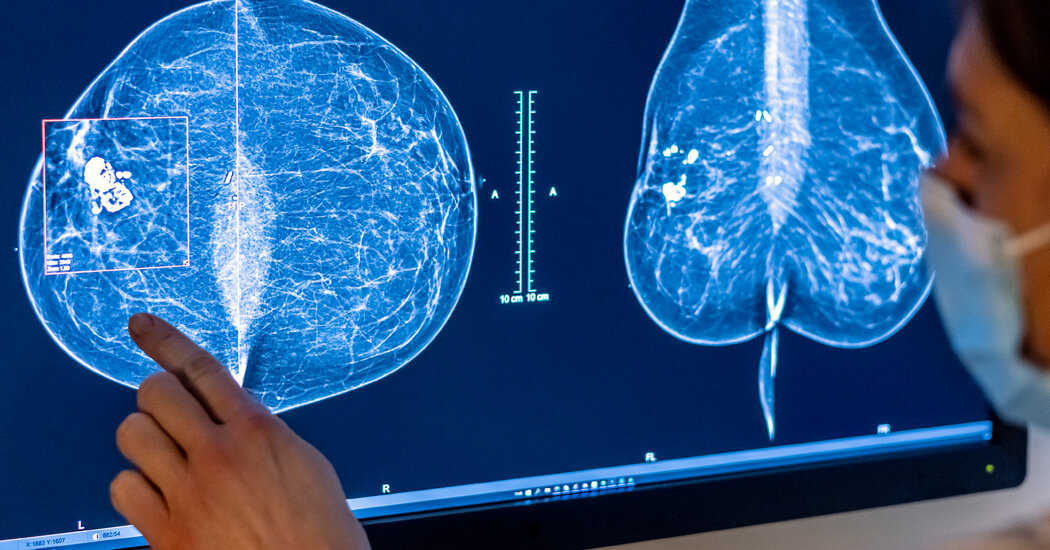

Citing rising breast cancer rates in young women, an expert panel on Tuesday recommended starting regular mammography screening at age 40, reversing longstanding and controversial guidance that most women wait until 50.
The panel, the U.S. Preventive Services Task Force, finalized a draft recommendation made public last year. The group issues influential advice on preventive health, and its recommendations usually are widely adopted in the United States.
In 2009, the task force raised the age for starting routine mammograms to 50 from 40, sparking wide controversy. At the time, researchers were concerned that earlier screening would do more harm than good, leading to unnecessary treatment in younger women, including alarming findings that lead to anxiety-producing procedures that are invasive but ultimately unnecessary.
But now breast cancer rates among women in their 40s are on the rise, increasing by 2 percent a year between 2015 and 2019, said Dr. John Wong, vice chair of the task force. The panel continues to recommend screening every two years for women at average risk of breast cancer, though many patients and providers prefer annual screening.
“There is clear evidence that starting screening every other year at age 40 provides sufficient benefit that we should recommend it for all women in this country to help them live longer and have a better quality of life,” said Dr. Wong, a primary care clinician at Tufts Medical Center who is the director of comparative effectiveness research for the Tufts Clinical Translational Science Institute.
The recommendations have come under harsh criticism from some women’s health advocates, including Representative Rosa DeLauro, Democrat of Connecticut, and Representative Debbie Wasserman Schultz, Democrat of Florida, who say the advice does not go far enough.
In a letter to the task force in June, they said that the guidance continued to “fall short of the science, create coverage gaps, generate uncertainty for women and their providers, and exacerbate health disparities.”
Weighing in again on a hotly debated topic, the task force also said there was not enough evidence to endorse extra scans, such as ultrasounds or magnetic resonance imaging, for women with dense breast tissue.
That means that insurers do not have to provide full coverage of additional screening for these women, whose cancers can be missed by mammograms alone and who are at higher risk for breast cancer to begin with. About half of all women aged 40 and older fall into this category.
In recent years, more mammography providers have been required by law to inform women when they have dense breast tissue and to tell them that mammography may be an insufficient screening tool for them.
Beginning in September, all mammography centers in the United States will be required to give patients that information.
Doctors often prescribe additional or “supplementary” scans for these patients. But these patients frequently find they have to pay all or some of the charges themselves, even when the additional tests are performed as part of preventive care, which under law should be offered without cost.
Medicare, the government health plan for older Americans, does not cover the additional scans. In the private insurance market, coverage is scattershot, depending on state laws, the type of plan and the plan’s design, among other factors.
The task force sets the standards for what preventive care services must be covered by law by health insurers at no cost to patients.

The panel’s decision not to endorse the extra scans has significant implications for patients, said Robert Traynham, a spokesman for AHIP, the association that represents health insurance companies.
“What that means for coverage is that there is no mandate to cover these specific screenings for women with dense breasts at zero-dollar cost-sharing,” he said.
While some employers may choose to have their health insurance plans do so, it is not required by law, Mr. Traynham said.
Kathleen Costello, a retiree in Southern California who was diagnosed with breast cancer in 2017 when she was 59, said she was convinced that mammograms missed her cancer for many years.
She underwent screening annually, and every year she received a letter saying that she was cancer-free. The letters also told her that she had dense breast tissue and that additional screening was available but not covered by insurance.
Six months after an all-clear mammogram in 2016, she told her doctor that her right breast felt stiff. The doctor ordered a mammogram and an ultrasound.
“In 30 seconds, the ultrasound found the cancer,” Ms. Costello said in an interview, adding that she knew because “the technician blanched and left the room.”
The mass was four centimeters in size, Ms. Costello added: “It’s hard for me to accept that it grew in six months from undetectable to four centimeters.”
But Dr. Wong, of the task force, said there was no scientific evidence to prove that supplemental imaging, by either M.R.I. or ultrasound, reduces breast cancer progression and extends life for women with dense breast tissue.
There is ample evidence, on the other hand, that supplemental screenings may lead to frequent false-positive findings and to biopsies, contributing to stress and unnecessary invasive procedures.
“It’s tragic,” Dr. Wong said. “We are as frustrated as women are. They deserve to know whether supplemental screenings would be helpful.”
But medical organizations like the American College of Radiology endorse supplemental screening for women with dense breast tissue. There is research showing that ultrasound in conjunction with mammography does detect additional cancers in patients with dense tissue, said Dr. Stamatia Destounis, chair of the college’s breast imaging commission.
For women with dense breasts who are at average risk of breast cancer, recent research indicates that M.R.I. is the best supplemental scan, Dr. Destounis said, “with far better cancer detection and more favorable positive predictive values.”
The college also recommends annual screening for women at average cancer risk, rather than screening every two years as recommended by the panel. The radiologists group is pressing for a recommendation that all women should be assessed for breast cancer risk before age 25, so that women at high risk can start screening even before they turn 40.
Growing evidence shows that Black, Jewish and other minority women develop breast cancer and die from it before age 50 more frequently than do other women, Dr. Destounis noted.
Trans men who have not had mastectomies must continue to be screened for breast cancer, she added, and trans women, whose hormone use puts them at greater risk for breast cancer than the average man, should discuss screening with their doctor.
While the panel’s advice to start screening at age 40 is “an improvement,” Dr. Destounis said, the final recommendations “do not go far enough to save women’s lives.”