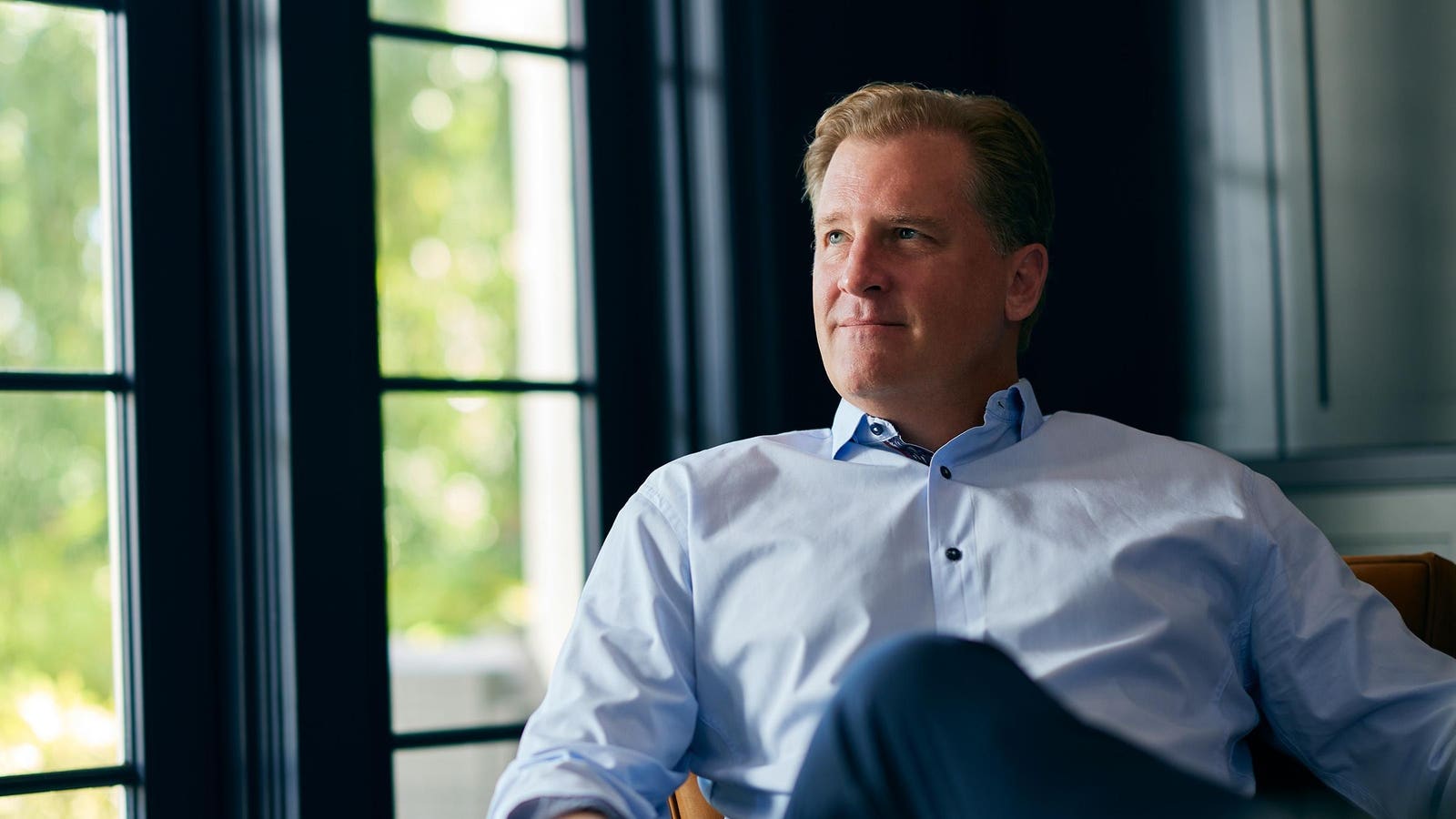

Rick Bates has a nice business finding consumers the best deals on their medicines. But now billionaire Mark Cuban is elbowing in.
By William Baldwin, Senior Contributor
Drug prices are insane.
A prescription for an attention deficit treatment that costs $106 if you say you don’t have insurance has an out-of-pocket cost of $326 if you use the insurance. A month’s supply of a prostate cancer drug shows up at $123 in some stores but at discounter Costco has a price tag of $2,548. A lifesaving leukemia treatment is $68 a month at Walgreens but has an $8,203 price posted at Rite Aid.
Coming to the rescue of the confused and the overcharged: Richard Bates, founder and chief executive of RxSense. This Boston-headquartered firm is in the business of providing price transparency in pharmaceuticals. Last year, it says, it saved 11 million patients an average $76 per script by steering them to low prices. For its business clients it provides intel on a chaotic marketplace, gathering 35 million data points a day on wholesale and retail pricing.
Mary Beth Koeth for Forbes
RxSense’s original product, called SingleCare, works as a sort of Groupon for prescriptions. Type in a drug name and see if there’s a discount coupon good at a pharmacy near you. If the number is lower than what you’d pay using your insurance, you toss the insurance and pay from your wallet.
Consider lisdexamfetamine, the attention disorder drug. Suppose you are in a Medicare Part D insurance plan sold by Centene and administered by Express Scripts. You would be asked to pay $326 for a 30-day supply of 50-milligram capsules at CVS. But if you tell CVS that you’ll skip the insurance and want the SingleCare price, you pay only $106, with CVS handing an undisclosed referral fee to RxSense.
If you grab the low price, you will be punished for price shopping; the $326 counts toward an annual deductible but the $106 doesn’t. And if you pay the steep price, you will be left wondering who’s pocketing the extra $220. Centene, perhaps? CVS? Maybe Express Scripts, which is a “pharmacy benefit manager.” PBMs are ostensibly in business to negotiate great prices on behalf of patients and employers, but transparency is low in their part of the business.
RxSense is in a treacherous line of work. Its main competitor in drug coupons, GoodRx, has struggled to make a profit and its shares trade at 87% off their high. Bates says that it took $20 million of his and two outsiders’ money to get the privately held RxSense off the ground and that he was personally on the hook for debt incurred in the early years. “I have a high appetite for risk,” he says.
Bates, 54, started the firm in 2015, after a career as a health insurance exec ending with the presidency of a PBM. The gamble seems to have paid off. RxSense doesn’t disclose revenue or net income, but Bates says that, not counting one quarter when the firm incurred expenses raising equity money in the venture capital market, it has been consistently in the black for five years.
GoodRx and RxSense now have a new competitive threat: Mark Cuban Cost Plus Drug Company. With this two-year-old outfit the billionaire aims to cut out all the middlemen—coupon dispensers, insurers and PBMs—by selling directly to consumers who either don’t have insurance or have such high deductibles that they’re better off without the insurance. Amazon is also getting into the act with deals on generic drugs.
In the current free-for-all of drug pricing, the insurance companies don’t cover themselves with glory. Try looking for the generic version of the leukemia drug Gleevec while using that Centene insurance for Part D. You will be informed that a 30-day supply of 400-milligram tablets is priced at $3,000 but because you are covered you only have to pay $1,159. Some bargain. Using a SingleCare coupon, you can get it for $68 at Walgreens. Mark Cuban will mail it to you for $41.
Express Scripts is owned by Cigna, an insurance company. It’s one of the three giants in the PBM industry, the other two being the property of UnitedHealthcare, another insurer, and CVS, both an insurer and a drug retailer. Conflicting roles, it seems. (CVS says, in reference to buying lisdexamfetamine with insurance, that the price in this situation is dictated by Express Scripts, but declines to say who gets the extra $220. Centene, Costco and Rite Aid did not respond to questions about drug pricing.)

Cuban has no patience for any of the PBMs. “Either you work with the big three PBMs or you don’t. We don’t,” he says in an emailed response to questions. He adds: “We don’t make you run from pharmacy to different pharmacy to chase their best price.”
How has Bates handled this competition? By diversifying. The consumer-facing work is down to 30% of his revenue, the rest coming from software and data that help health-related companies run their businesses. He’s arming all the combatants on the battlefield: pharmacies, small PBMs, small coupon distributors, large employers self-insuring their work forces. Cuban Cost Plus is one of his clients.
“We try to be Switzerland,” Bates says. “I think Mark Cuban’s business is here to stay.” He has no unkind words for the PBMs, either: “They create tremendous value for the vast majority of their customers.”
PBMs create value? That’s a surprise, given the bizarre price discrepancies that drive RxSense’s original line of work. But Bates points out that the most expensive 1% of drug prescriptions account for half of drug spending. These are medicines, like Wegovy for weight loss and Lantus for controlled-release insulin, still under patent. It is entirely rational for manufacturers to attempt to recover their billion-dollar development costs by charging whatever they can extract from anxious patients, and helpful to have PBMs haggling on behalf of those patients.
Pharmaceutical retailing is evolving rapidly. Soon enough, Bates predicts, insurance won’t apply to off-patent medicines; you’ll shop for them the way you shop for aspirin, and ever more of the volume will move to mail order.
At the same time, the health marketplace will get more complicated. Bates has 200 employees, somewhat more than half his staff, in technical roles, including two Ph.D.s in artificial intelligence. “A significant part of what we deliver today is data management and business intelligence,” he says. There’s growth there, even if there isn’t much in drug retailing.
Were You Gouged?
Airline seats, hotel rooms and new drugs have these in common: high fixed costs, low marginal costs. The consequence is that you may end up paying more than the next customer for the same thing. You may feel ripped off.
The rational strategy for a producer is to carve a market into segments and charge each the most that it will bear. That means a hotel will get a high price for most of its rooms but cut deals through Priceline for rooms that would otherwise go empty. It means an airline will concoct restrictions like a Saturday night stay requirement in order to keep business travelers out of the cheap seats. It explains why a patented drug will have one price in the U.S. and a much lower one in another country, or one price for insured patients and a much lower one, via seemingly altruistic rebate offers, for uninsured patients.
Price discrimination provides much fodder for politicians. So it is that we have the federal government planning to negotiate prices for Medicare participants while Florida makes a show of importing drugs from Canada. And yet price discrimination can benefit customers, even the ones paying the high prices.
Suppose a drug costs $5 billion to develop and next to nothing to manufacture, and that, over the life of the patent, 5 million monthly prescriptions will be needed. To recover its investment, the pharmaceutical company has to average at least $1,000 for a month’s supply.
Suppose that half the patients can afford to pay $1,600 a month and the other half only $600. If the market can be segmented, revenue averages $1,100 and every patient gains. If it can’t be, the revenue potential is $3 billion at the low price or $4 billion at the high price. The drug company won’t invest the $5 billion and every patient loses access.
RxSense’s Rick Bates predicts that, in time, consumers won’t have insurance for unpatented drugs and will shop for them the way they do for headache remedies. But the market for novel remedies will remain a place for the art of the deal.
MORE FROM FORBES