
To optimize your portfolio, you need 3 trillion calculations. Don’t try this at home.
By William Baldwin, Senior Contributor
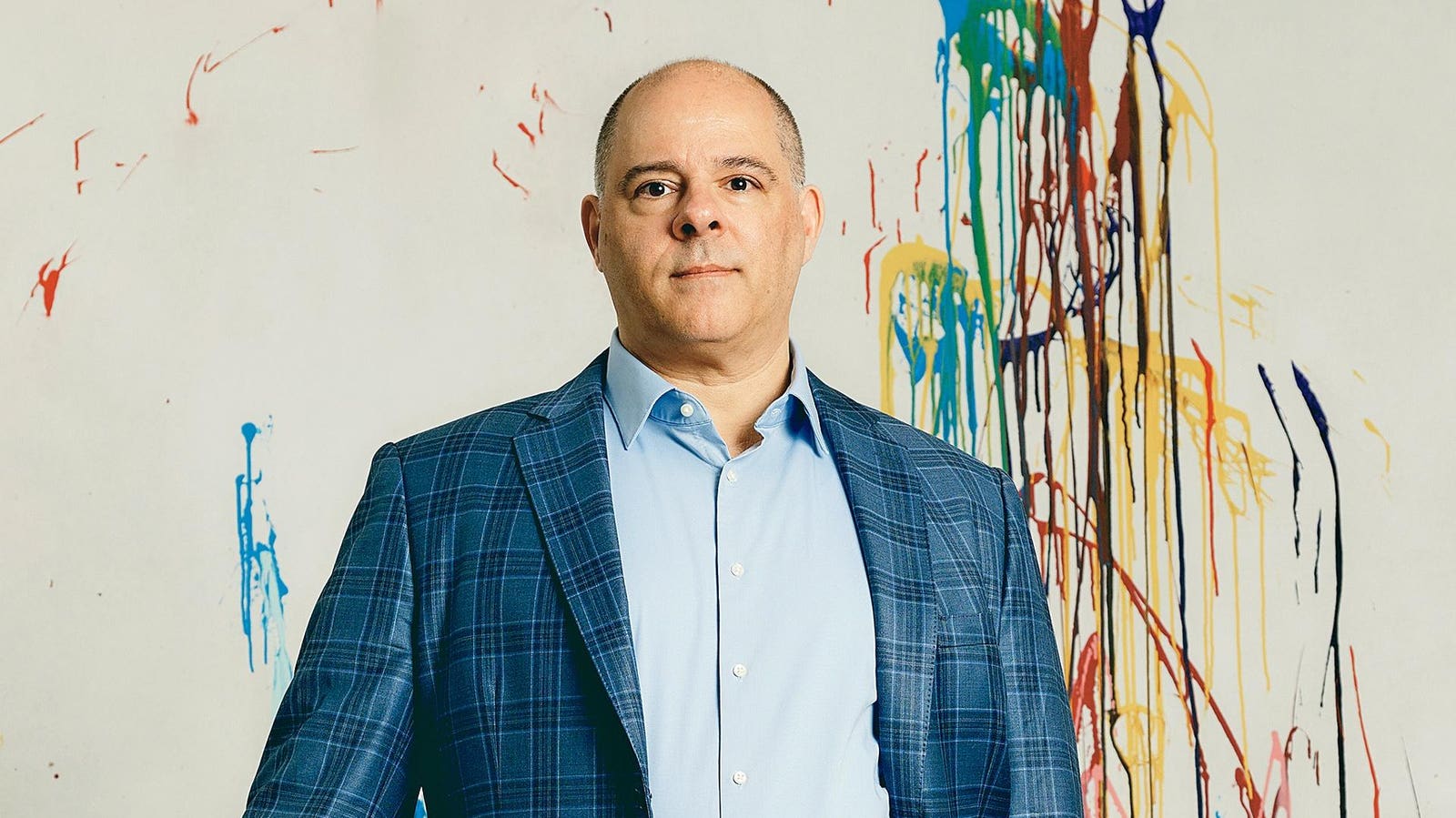
The beauty of theoretical physics intersects with the messy business of stock picking at the Newark, New Jersey, office of PGIM Quantitative Solutions. There, George N. Patterson, a physics Ph.D. who left a career at the National Aeronautics & Space Administration to work on investing, presides over a research team that includes 13 other doctorates.
A physicist on Wall Street? If you’re into partial differential equations, you won’t find this such an odd fit. The equation that describes the drift of stock prices is almost identical to the one that defines the movement of heat. There is a big difference, though, between the disciplines of natural science and finance. Planets follow predictable trajectories, while securities markets are sometimes just nutty. Patterson makes the point: “Gravity never has a bad year.”
As PGIM Quant’s chief investment officer, Patterson has the task of adapting abstract theories found in finance textbooks to the practical assignment of assembling stock, bond and commodity portfolios for mostly institutional clients. Tools: arcane objects like copulas, directed graphs and hidden Markov models. Input: 61 terabytes of data. Output: 400,000 trades a year.
“We’re like a baleen whale filtering tiny shrimp,” Patterson says. A whale in a big pod: PGIM Quant accounts for $102 billion of the $1.3 trillion in global investment management at Prudential Financial, the 149-year-old insurer.
Patterson, 58, remembers from his childhood a visit to the New York Mercantile Exchange with his father, a commodities trader. So perhaps it was not a surprise that, early in his career doing computer simulations at NASA’s Pasadena, California, lab, Barclays Global Investors was able to lure him away. He joined PGIM in 2017.
Can you beat the market with a room full of computers? Not easily. PGIM doesn’t disclose performance of its separately managed accounts, which go back 49 years, but it does have some smallish and more recent mutual funds with observable records. PGIM Quant runs large-company, small-company and international funds with performances over the past five years (per Morningstar) exceeding relevant indexes before expenses but falling behind after. The institutional customers, paying lower fees (posted rates are 0.3% to 0.65% of assets annually), presumably do better.
PGIM’s computer whizzes can earn their keep even if all they do is track the benchmarks. The reason is that endowment and pension clients have different and exacting constraints. One may want to keep up with the S&P 500 while holding no fossil-fuel stocks, another may purge weapons or tobacco, while yet another might want to underweight a sector that is overrepresented in its accounts elsewhere.
The objective is to maximize a score that rewards expected return while penalizing risk. Risk counts, or else you veer off into a portfolio consisting entirely of aggressive growth stocks like Nvidia and Netflix. As it happens, a portfolio consisting of stocks like those would have done very well recently, but it’s not what the client wants and it would be out of place at a prudent institution that was known, in its earliest days, as the Widows & Orphans Friendly Society.
At PGIM Quant, a risk-aware computer gropes toward a high point inside a space with thousands of dimensions, each representing a security that could be owned. Thank goodness for fast chips. This maximizing work is undertaken daily for each client, and each client’s solution grinds through 3 trillion calculations.
The late Harry Markowitz laid out the relation of risk to reward 72 years ago. He calculated the payoff from diversification in terms of the covariance between any two stocks, a measure of their tendency to march to the same beat. The game is to get securities with low (or better, negative) covariances.
The Vault
CALCULATING RETURNS
By 2015, the “fastest-growing big hedge fund on the planet” was Two Sigma Investments, which “math genius” John Overdeck and “computer nerd” David Siegel had built into a $28 billion (AUM) giant by going full-bore quantitative:
Forbes

“The human mind has not become any better than it was 100 years ago, and it’s very hard for someone using traditional methods to juggle all the information of the global economy in their head,” Siegel said at an investor conference earlier this year. In fact, Two Sigma’s data scientists and systems analyze more than 10,000 data sources, using 75,000 CPUs with 750 terabytes of memory. . . . “Eventually the time will come that no human investment manager will be able to beat the computer.”
—Forbes, October 19, 2015
Two Sigma has more than $60 billion in assets today, but Siegel and Overdeck (billionaires both) are locked in a brawl over how to run the business, proving that the human element is alive and well.
All very elegant in a finance textbook, Patterson says, but hazardous in the real world. You measure a covariance by looking at the past several years of stock prices. This input has a lot of what Patterson, borrowing a term from electrical engineering, calls “noise.” Set a computer to work on past prices and it might seize on a fluke, a low covariance between some car company and some fishmeal company. The computer would tell you that a portfolio consisting of Tesla and the fishmeal stock would be especially stable. But this is nonsense.
Another problem with classic portfolio theory is that it assumes a covariance is a single, fixed number. In the real world, the codependency of two assets might be low in placid markets but shoot up during turbulence. This is the essence of what went wrong in the global financial crisis: Everything crashed at once.
Taking wisdom from that experience, quantitative analysts now measure relationships between securities with “copulas,” which explicitly allow for rising codependency during bear markets. The PGIM analysis embodies those, plus other refinements.
Patterson’s team has concocted a graph that uses securities filings to measure the linkages between corporations. (Example: Door manufacturer Jeld-Wen reveals that it gets 15% of revenue from Home Depot.) They are playing around with a Markov model (named for a Russian mathematician) to describe the stock market. This analysis assumes that a genie, hidden in a dark room, plucks up and down moves from one of two urns, one containing random balls with a bullish average, the other with a bearish tilt. Seeing only the balls that come out, you try to divine his rule for choosing the urn.
Patterson doesn’t want his mathematicians to get carried away with any of this. Quantitative work is “a loaded weapon,” he says. If the computer turns up a “statistical anomaly that seems to work but we don’t know why,” he won’t use it. Echoing an aphorism often attributed to Albert Einstein, he defines his goal this way:
“Use enough complexity to model the real world, but not any more than that.”
MORE FROM FORBES