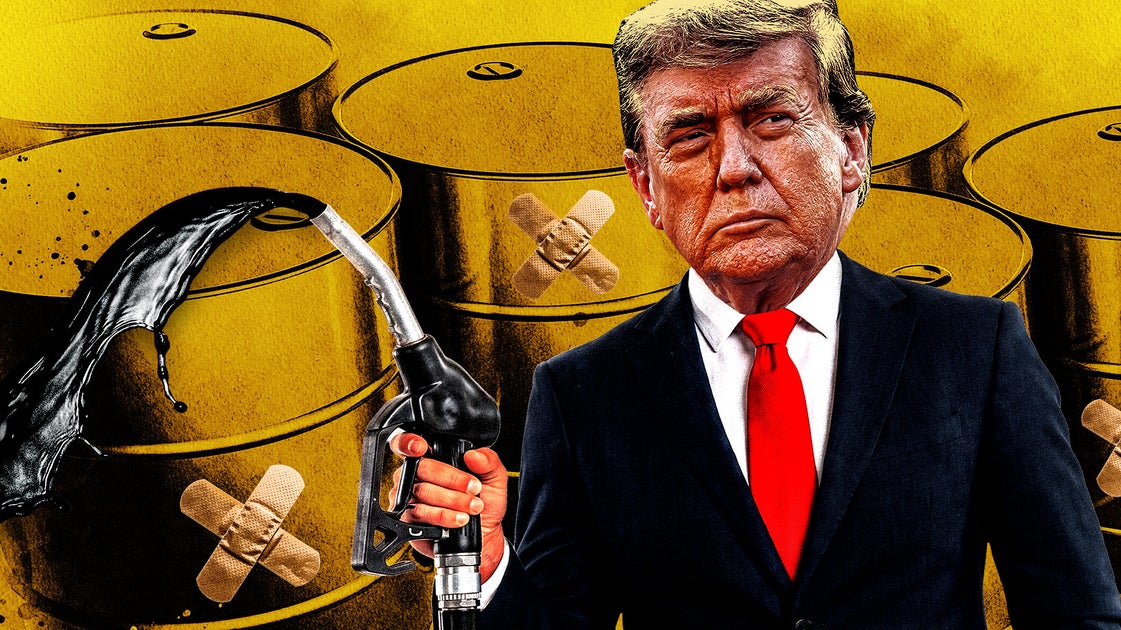

With the midterm elections looming and his approval rating at a record low, President Donald Trump has been casting about for ways to reverse the run-up in fuel prices he created with his ill-advised and deeply unpopular war of choice in Iran.
But with less than four weeks before Election Day, he appears to be running on empty.
In recent days, the White House has introduced or floated a few gimmicky policies aimed at pulling down the cost of gasoline and diesel as Republicans face the possibility of losing both the House and the Senate. Gas prices now average $4.37 per gallon nationally, up 40% from a year ago, and diesel recently hit an all-time high of $6.53 before retreating slightly to $6.28.
The surge in diesel prices could spur more inflation across the economy, since diesel powers the agricultural equipment that produces our food and the trucks that transport just about everything we buy. With struggling truckers warning of financial ruin, the White House is desperate to look like it’s doing something to bring relief.
Their latest idea is an executive order, signed Monday, that temporarily allows the use of “red-dye” diesel in highway vehicles. Such fuel is chemically identical to normal diesel, but dyed to mark it exempt from state tax and the 24.4-cent federal tax when used on farms and off-road. Trump’s order allows commercial truckers and other drivers to use it on a tax-deferred basis through the end of this year.
The order, which Trump himself hyped as “historic” when he signed it onstage during a speech in Nebraska on Monday, is a great example of how little he can do domestically to solve a global supply problem largely of his own making.
“All of these Band-Aids have limited effect, no effect or, in some cases, the opposite effect.”
– Michael Noel, economist at Texas Tech University
Trade groups are already warning gas stations to “proceed with caution” on selling the dyed diesel for highway use, noting the guidance is still unclear, the order brings logistical challenges and truckers will presumably have to pay the taxes later anyway. The National Association of Truck Stop Owners has told members that “the liability and customer risk outweigh any temporary, uncertain benefit,” according to NBC News.
Experts say the order is bound to be limited in its impact and could be counterproductive.
Michael Noel, an economist who specializes in oil and gas at Texas Tech University, predicted the move “wouldn’t amount to a hill of beans.” He said it would be more effective for the government to simply cut checks to truckers.
“When you have a gas-tax moratorium at the pump, that is one of the most inefficient ways to give consumers relief,” Noel told HuffPost, adding that retailers and wholesalers would end up capturing some of the savings.
“It feels like we have a price problem, but it’s really a supply problem. The reality is diesel prices are high and they’re going to stay high until you solve [the war].”
On Tuesday, Trump again floated suspending the federal gasoline tax of 18.4 cents per gallon, saying he was “thinking about that” without offering details. But this proposal too only tiptoes around the edges of the supply problem. The Penn Wharton Budget Model estimates that a gas-tax holiday would knock a mere 13 cents off a gallon of gasoline and 15 cents off a gallon of diesel as suppliers captured their piece of the savings.


Like some of Trump’s unsuccessful efforts to tame sky-high beef prices, the idea of suspending the gas tax has also proven politically unworkable so far: Many Republicans have opposed it because it would siphon money away from a crucial fund earmarked for highway upgrades. Penn puts the revenue loss for the government at $11.5 billion over four months.
“All of these Band-Aids have limited effect, no effect or, in some cases, the opposite effect,” Noel said.
Ever since the U.S. and Israel attacked Iran on Feb. 28, Iran has throttled tankers at the Strait of Hormuz, the vital shippingway through which roughly 25% of the world’s oil moves. That has helped create a global supply crunch for diesel, which, like gasoline, is refined from crude oil. Oil shipments have been hurt further by Houthi attacks on Saudi Arabian refineries and Ukrainian attacks on Russian refineries.
On Friday, Trump announced he had struck a deal in which Russia would supply hundreds of thousands of tons of diesel to the U.S. in the coming months. The waiving of U.S. sanctions on Russian diesel exports over the war in Ukraine would be a major victory for Russian President Vladimir Putin. But some energy analysts reacted with skepticism that Russia has the capacity to export as much diesel as Trump claimed, or that it would significantly reduce U.S. prices.
The White House has also considered but appears to have shelved, for now, the idea of a diesel export ban aimed at boosting domestic supply. Experts say such a move would create shortages and push up diesel prices abroad, and though it might temporarily reduce prices in some U.S. regions, it would likely have the opposite effect over the long haul and undermine the country’s reputation as a trustworthy global supplier.
“That’s really bad long-term economic policy,” Philip Verleger, an economist who’s been tracking energy markets for decades, told HuffPost.
Trump said the administration was backing off the export ban proposal after G7 nations agreed last week to release 100 million barrels of diesel and crude oil from their strategic reserves in the coming months. Verleger said although it could help moderate prices, that commitment would not be enough to meet global demand. In a report Verleger wrote last week titled “The Coming Diesel Disaster,” he compared it to using a Band-Aid “where a tourniquet is required.”
“They are in a terrible jam, and it was predictable.”
– Philip Verleger, economist
Diesel hitting $10 a gallon is an “extreme” scenario, but Verleger says it’s within the realm of possibility. He traces the crisis in large part back to the “Pandora’s box” of refinery attacks that the U.S.-Israeli war in Iran opened up in the Persian Gulf.
“They are in a terrible jam, and it was predictable,” he said of the administration.
The cost to everyday Americans has been steep.
The average U.S. household has paid an extra $540 at the pump since February, compared with projected gas prices absent the conflict in Iran, according to a Brown University energy cost tracker. With the added burden of diesel prices filtering through to grocery store shelves, the effective per-household fuel tax of Trump’s war is approaching $1,000 and counting, enough to wipe out the seed money in a newborn’s newly created Trump Account.
Even heating oil, which is refined from crude, has become a major campaign issue in the pivotal state of Maine. On average, a gallon now costs residents nearly 80% more than it did a year ago. Maine, the most oil-dependent state in the country, could decide control of the U.S. Senate as GOP Sen. Susan Collins fights off Democratic challenger Troy Jackson.
Emily Cain, a Democratic consultant and former Maine state senator, said fuel prices are top of mind for voters as nighttime lows start to dip into the 30s.
“This is the time of year when you ask, ‘Are we putting on our flannel sheets yet? How long can we go before we turn the heat on?’” Cain said. “It’s compounded by the already overwhelming strain of affordability. You hear people talking about it, and they’re mad.”
The sticker shock helps explain why so many voters, including a large share of Republicans, give Trump poor marks on his handling of the economy, even though unemployment remains low. Higher fuel prices have spurred elevated inflation that has wiped out a year’s worth of nominal wage gains.
A Reuters poll released Friday found 78% of Americans blame Trump’s policies for pushing up the cost of living. Majorities in both parties cited rising prices as their top concern, a sign of how much the president could drag his party down at the polls next month. Meanwhile, around two-thirds of Americans disapprove of Trump’s handling of the war in Iran, according to Pew.
Noel said there are no shortcuts to meaningfully lowering diesel prices without a lasting peace deal with Iran and oil moving safely through the Strait of Hormuz. He does have some advice for the administration, though he admits it comes eight months too late.
“Lesson one is don’t start a war you can’t finish, especially in an oil-producing region of the world,” he said.