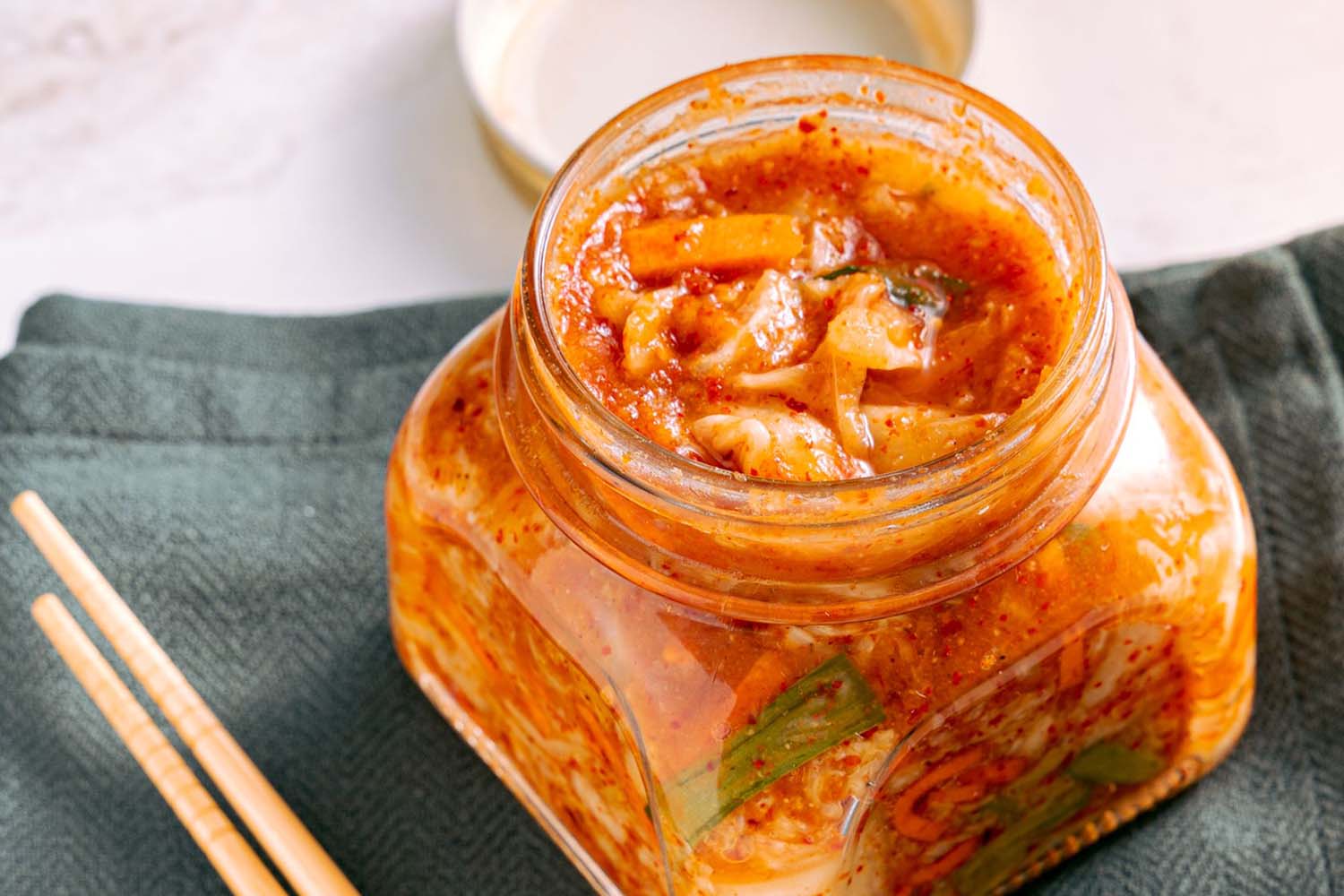

That jar of kimchi that’s gotten noticeably more sour and fizzy since you bought it isn’t a problem. It’s the point. Kimchi is a living fermented food, similar in spirit to sauerkraut, and most of what makes it seem alarming, the sourness, the bubbling, a jar lid that pops when you open it, is exactly what a healthy jar is supposed to do.
Does kimchi go bad?
The short answer: Not in the way most food does. Kimchi is a live fermented food, and its lactic acid bacteria keep working even in the fridge. It gradually gets more sour and complex rather than spoiling on a fixed timeline, unlike a food such as coleslaw that’s simply perishable. Commercial kimchi brands like Mother-in-Law’s describe it staying delicious for up to 12 months or longer, refrigerated. The real signs of spoilage are narrow and specific: fuzzy or colored mold, a foul or rotten smell distinct from normal sourness, or a slimy texture. A thin, flat white film on the surface is usually harmless kahm yeast, not mold.
For general pantry and fridge rules, check the food storage guide. If you’re storing other fermented foods, the sauerkraut and gochujang guides cover related staples.
📋 Does Kimchi Go Bad: At a Glance
| Unopened, refrigerated | 3 to 6 months at peak, often much longer |
| Opened, refrigerated | Continues to ferment; good for months |
| Very sour, aged kimchi | Not spoiled; prized for cooking (mugeunji) |
| Room temperature | Speeds fermentation fast; refrigerate promptly |
| Bulging or leaking lid | Normal; CO2 from active fermentation |
| Real spoilage signs | Fuzzy/colored mold, foul smell, sliminess |
| Thin flat white film | Usually harmless kahm yeast, not mold |
Key Takeaways
- Kimchi is a living fermented food. Its lactic acid bacteria don’t stop working in the fridge, they just slow down, so kimchi changes over time rather than expiring on a fixed date.
- Increasing sourness, fizziness, and a bulging or leaking jar lid are all normal signs of active fermentation, not spoilage.
- Very sour, well-aged kimchi (called mugeunji in Korean) is a genuine delicacy used in dishes like kimchi jjigae and kimchi fried rice, not something to throw away.
- A thin, flat, papery white film on the surface is almost always harmless kahm yeast. True mold is fuzzy, raised, and often green, black, pink, or blue.
- Kimchi’s low pH, typically 3.5 to 4.5 once fermented, makes it naturally resistant to the kind of dangerous bacteria that worry food safety experts about other preserved foods.
- Keeping vegetables fully submerged under the brine is the single most effective thing you can do to prevent real spoilage.
Why Kimchi Doesn’t “Expire” the Way Most Food Does
The science: live bacteria are the preservative, not an additive
Kimchi is fermented by lactic acid bacteria, mainly Leuconostoc and Lactobacillus species, that occur naturally on the vegetables. As these bacteria consume sugars in the cabbage and radish, they produce lactic acid, which drops the kimchi’s pH down to roughly 3.5 to 4.5. That acidity is genuinely protective. Peer-reviewed food science research on kimchi’s fermentation and shelf life describes this drop in pH as what inhibits the growth of undesirable and harmful bacteria in the first place. Unlike a jar of vinegar-based pickles, where acidity is added and the product is essentially inert once sealed, kimchi’s acidity is generated continuously by a living microbial community, similar to how miso paste keeps developing flavor over time. That’s why it keeps changing rather than sitting still.
This also explains why kimchi is one of the more reassuring foods on this site rather than one of the riskier ones. Foods like garlic stored in oil or low-acid canned goods carry real botulism concerns specifically because they create low-oxygen environments without enough acidity to stop Clostridium botulinum. Properly made and maintained kimchi does the opposite. Its active fermentation keeps the pH low and the bacterial environment hostile to that kind of contamination. The CO2 released during fermentation also displaces oxygen in a sealed jar, which is why lids bulge and pop, not a sign anything has gone wrong.
How Long Kimchi Actually Lasts
Unopened
An unopened jar of commercial kimchi, kept refrigerated, is typically described as being at its best for 3 to 6 months, though most brands and food scientists agree it remains good, if increasingly sour, well beyond that, more like cooking wine than a fresh vegetable. Mother-in-Law’s, a major US kimchi brand, states its kimchi will “continue to age if kept cool in the refrigerator and away from oxygen, remaining delicious for up to 12 months or even longer.” Refrigeration is what makes this possible: temperature is the biggest lever on how fast fermentation, and therefore flavor change, progresses.
Tip: a bulging or leaking lid is normal, not a warning sign
Per Mother-in-Law’s own guidance, a raised or distorted lid is caused by CO2 buildup from healthy fermentation bacteria, and the kimchi is safe to eat even if the jar has popped or overflowed slightly during shipping or storage. This is one of the few foods on this site where that kind of pressure is a good sign rather than a red flag.
Opened
Opening the jar doesn’t reset any kind of clock. Kimchi keeps fermenting in the fridge whether the lid has been off once or a hundred times, similar to how soy sauce keeps developing character long after opening. It’s genuinely normal for kimchi to taste noticeably more sour a month or two after opening than it did on day one. Per Mother-in-Law’s own FAQ, freshly delivered kimchi is often at its brightest, most vibrant flavor for about the first month, then continues to mature into deeper, earthier, more tangy territory for many months after that, all while remaining safe to eat. If the sourness outpaces your taste, that’s a flavor preference, not a safety issue.
Warning: know the difference between kahm yeast and real mold

See also
This is the single most useful skill for judging a jar of kimchi. A thin, flat, papery white film that sits on the surface and wipes or skims away easily is almost always kahm yeast, a harmless yeast that can appear during extended fermentation. True mold looks different: fuzzy, raised, and often colored white, green, black, pink, or blue. If you see actual mold, don’t try to scoop around it. Discard the batch rather than eating what’s underneath.
Tip: keep everything submerged under the brine
Vegetables sitting above the brine line are exposed to oxygen, which is exactly the environment mold and unwanted aerobic bacteria need to grow, while anything submerged stays protected by the acidic, low-oxygen brine. Press kimchi back down under the liquid after serving, and use a clean utensil each time to avoid introducing contamination.
Very sour, well-aged kimchi: not a mistake
In Korean cooking, kimchi that’s fermented for many months to a year or more has its own name, mugeunji, and its own dedicated uses, the way aged cheddar is valued differently from fresh cheese. It’s too intensely sour to eat straight from the jar the way fresh kimchi is. That concentrated tang is exactly what makes it prized in cooked dishes like kimchi jjigae (stew), kimchi bokkeumbap (fried rice), and kimchi jjim (braised kimchi with pork). If a jar of kimchi has simply gotten very sour with no mold, sliminess, or off smell, cooking with it rather than discarding it is the traditional move, not a workaround.
How to Store Kimchi to Control Fermentation
Keep kimchi refrigerated at all times except for brief periods at room temperature, which will accelerate fermentation noticeably within just a day or two. Use a container with a tight-fitting lid, glass or ceramic ideally, and store it toward the back of a shelf rather than in the door, where temperature swings are bigger, a principle that applies broadly across the food storage guide. Keep the vegetables pressed below the brine, and consider transferring kimchi to a smaller container as the jar empties to reduce the amount of air space above the liquid. Freezing is possible and keeps kimchi safe indefinitely, but it will soften the cabbage’s texture considerably. It’s better suited to kimchi you plan to cook with, like tofu or other ingredients you’d add to a stew, rather than eat straight as a crisp side dish.
| Storage Stage | What to Expect |
|---|---|
| Unopened, refrigerated | Best flavor 3 to 6 months; safe well beyond |
| Opened, refrigerated, first month | Brightest, freshest flavor |
| Opened, refrigerated, months later | Increasingly sour and complex; still safe |
| Aged 6+ months (mugeunji) | Very sour; ideal for cooking, not raw eating |
| Room temperature | Fermentation speeds up within 1 to 2 days |
| Frozen | Safe indefinitely; softens texture, best for cooking |
Frequently Asked Questions
How long does kimchi last in the fridge?
Commercial kimchi is typically described as being at its best for 3 to 6 months unopened, but brands like Mother-in-Law’s state it stays delicious for up to 12 months or longer, refrigerated. Because kimchi keeps fermenting rather than sitting inert, it doesn’t have a hard expiration point the way perishable food does.
Is it normal for kimchi to get more sour over time?
Yes, and it’s one of the clearest signs the fermentation is healthy and active. Lactic acid bacteria keep producing acid as long as they have sugars to work with, even in the fridge, just more slowly than at room temperature. Increasing sourness is flavor evolution, not spoilage.
Why does my kimchi jar bulge or leak?
Active fermentation produces CO2, which builds up pressure inside a sealed jar. Per Mother-in-Law’s own guidance, this can cause the lid to swell, pop, or leak slightly, and the kimchi is still safe to eat when this happens. Some jars do this more dramatically than others depending on the batch, and that variation is normal.
Is the white film on my kimchi mold?
Usually not. A thin, flat, papery white film is typically kahm yeast, a harmless yeast that can develop during extended fermentation. It can be skimmed off, and the kimchi underneath is fine. True mold looks different: fuzzy, raised, and often colored beyond plain white, and it means the batch should be discarded.
What does actually spoiled kimchi look or smell like?
Fuzzy or colored mold (white, green, black, pink, or blue), a slimy texture, or a smell that’s genuinely foul or rotten rather than sharply sour are the real signs. Ordinary kimchi smells strongly sour and pungent even when perfectly fine, so the distinction is character, not intensity.
What is mugeunji, and is it safe to eat?
Mugeunji is kimchi that’s been fermented for an extended period, typically six months to a year or longer, until it becomes intensely sour. It’s completely safe and, far from being spoiled, is a prized ingredient in Korean cooking for dishes like kimchi jjigae, kimchi fried rice, and braised kimchi with pork.
It can, and this is a genuine, separate consideration from ordinary spoilage. Traditional kimchi often includes jeotgal or aekjeot, Korean fermented seafood and fish sauce, and peer-reviewed research has found that some kimchi products contain histamine and tyramine at levels exceeding the recommended safety limit of 100 mg/kg, with these fish-based ingredients identified as a major contributor. As with other histamine-forming foods on this site, cooking doesn’t reduce it since histamine is heat-stable. This isn’t a reason to avoid traditional kimchi, since plenty of tested batches fall well within safe limits, but it’s a real reason quality control and reputable sourcing matter more for fish-sauce-based kimchi than for varieties made without it.
It’s uncommon. Kimchi’s low pH from active fermentation makes it naturally resistant to the dangerous bacteria that are a bigger concern in improperly stored low-acid foods, the kind covered in the dangerous expired pantry staples guide. The main realistic risks are mold from vegetables exposed above the brine, contamination from unclean utensils or containers, and, for kimchi made with fish sauce or fermented seafood, the histamine consideration covered above.
Should kimchi be left out at room temperature to ferment faster?
Briefly, if you prefer a more sour flavor sooner, but not for storage. A day or two at room temperature will noticeably speed up fermentation. Left out longer than that, texture and quality can suffer faster than the flavor benefit is worth, and it should go back in the fridge promptly.
Can you freeze kimchi?
Yes, and it stays safe indefinitely, but freezing softens the cabbage’s crisp texture considerably. It’s a better fit for kimchi you’re planning to cook into a stew, fried rice, or pancake than for kimchi you want to eat straight as a crunchy side dish.
Not really; if anything, the lactic acid bacteria responsible for those benefits are still active and multiplying as the kimchi ferments further. The probiotic foods guide and gut health guide cover more on how fermented foods like this support digestion.
Is homemade kimchi different from store-bought when it comes to shelf life?
The same basic principles apply either way, but homemade kimchi can vary more depending on salt levels, cleanliness of tools and jars, and how consistently vegetables stay submerged. Commercial kimchi from an established brand tends to be more predictable simply because the process is standardized. Whichever kind you have, the same warning signs, mold, sliminess, and a foul smell, are what actually matter.
Further Reading
Once you’ve got a jar of kimchi at the stage you like, it earns its keep well beyond a side dish. Fold fresher kimchi into rainbow spring rolls or Chinese chicken lettuce wraps, stir it into teriyaki pork bowls, and save the more sour, well-aged jars for cooking into stews or fried rice the way Korean cooks traditionally do with mugeunji. It’s also a natural, tangy topper for tuna tostadas or gluten-free crab cakes.
Better Living may earn commissions through affiliate links and may occasionally feature sponsored or partner content. If you make a purchase through our links, we may receive a small commission at no cost to you.