
When administrators at Princeton University decided to cut the carbon emissions that came from heating and cooling their campus, they opted for a method that is gaining popularity among colleges and universities.
They began drilling holes deep into the ground.
The university is using the earth beneath its campus to create a new system that will keep buildings at comfortable temperatures without burning fossil fuels. The multimillion dollar project, using a process known as geoexchange, marks a significant shift in how Princeton gets its energy, and is key to the university’s plan to stop adding greenhouse gases to the atmosphere by 2046.
The drilling makes an almighty muddy mess, but when all is said and done, the more than 2,000 boreholes planned for the campus will be undetectable, despite performing an impressive sleight of hand. During hot months, heat drawn from Princeton’s buildings will be stored in thick pipes deep underground until winter, when heat will be drawn back up again.
The change is significant. Since its founding in 1746, Princeton has heated its buildings by burning carbon-based fuels, in the form of firewood, then coal, then fuel oil, then natural gas.
“This moment is singular,” said Ted Borer, director of energy plants at the school. “This is when we’re switching to something that doesn’t require combustion.”
Geoexchange is not new, but it’s increasingly a choice made by colleges and universities, particularly in the northern United States, that are seeking to decarbonize. Geoexchange is one type of geothermal system. Other types extract heat from deep in the earth but do not return it.
Lindsey Olsen, associate vice president and senior mechanical engineer at Salas O’Brien, a technical engineering firm, said five years ago, the company was working on two or three campus geothermal projects at one time. That figure has grown to between 20 and 30 projects, she said.
“It really feels like it is doubling every year,” Ms. Olsen said. “For institutions in the northern climate that have heating demands, geothermal is one of the most economically viable technologies for producing low carbon heating.”
Among the colleges where geoexchange or geothermal systems are being tested, installed or are in use: Smith, Oberlin, Dartmouth, Mount Holyoke and William & Mary. Cornell University has dug a two-mile test geothermal borehole at its Ithaca campus, and is using geoexchange at one of its buildings on Roosevelt Island in New York City’s East River. Brown University drilled test boreholes to gauge heat conductivity this past fall, and Columbia University secured a special state mining permit to drill an 800-foot test bore on its New York City campus.
Many of the colleges are using their projects as a classroom, conducting educational seminars and tours.
Geoexchange (also know as ground source geothermal district heating and cooling), works like a heat storage bank. In summer, heat is drawn out of warm buildings, cooling them, and transferred to water that is sent into pipes in a closed loop network deep underground. The heated water is stored beneath the frostline, warming surrounding rock. In winter, that heated water is pumped back up through piping and into buildings.
The systems work in tandem with heat pumps, and because it’s all run by electricity, are far greener than steam boilers that operate by burning natural gas, oil or propane.
Geoexchange especially suits colleges because they usually have lots of buildings close together, the space needed for borehole fields, and their own stand-alone heating, which makes the adoption of new heating and cooling technology easier. They also tend to have the resources for long term investments: the systems require significant upfront costs but are projected to save money in later years.

“Institutions operating for a hundred plus years are willing to invest a lot of money, and thinking long term, and paying attention to the benefits this is going to have,” said Ms. Olsen. Also, she said, “they have students that are demanding it.”
Carleton College in Minnesota spent $42 million on its geoexchange, which was completed in 2021, and expects to break even within 18 years. The system has cut the school’s annual natural gas use by about 70 percent and has cut 25 years off the college’s plan to be carbon neutral, which is now expected by 2025, Sarah Fortner, Carleton’s director of sustainability, wrote in an email.
Ball State University in Indiana has what its administrators say is the largest geoexchange system in the country, with about 3,600 boreholes. The project, which unfolded in two phases, finished in 2012 and 2015, cost $83 million, and has already paid for itself, according to James W. Lowe, the school’s associate vice president for facilities planning and management. The school’s carbon footprint has since dropped by 60 percent, he said.
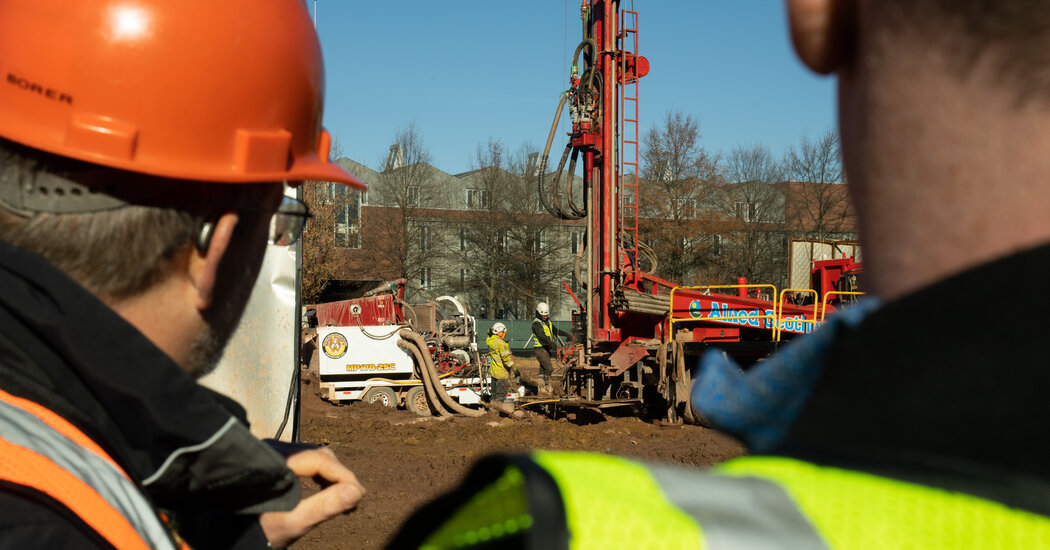
On a recent brisk and bright day at Princeton, Mr. Borer and a few colleagues offered a tour of Poe Field, a three and a half-acre recreational space on the southern edge of campus. It was ringed with construction siding and entirely churned up, a sea of muck.
“This is what saving the planet looks like,” Mr. Borer said. “It’s hugely chaotic. It’s messy. it’s disruptive.” But, he added, “There’ll be kids playing Frisbee here a year from now.”
Five drilling rigs were noisily at work, pounding their way to a depth of 850 feet. Each hole takes two-and-a-half days to complete, and will house vertical piping made of high density polyethylene, doubled back on itself like a giant bendy straw. This piping is closed loop — no liquid goes into the ground — and will be attached to a fatter horizontal pipe that acts like an artery, a conduit for water and heat. Mr. Borer explained what will come next. In the summer, heat will be drawn from buildings into water, and additionally warmed by heat pumps to about 90 degrees Fahrenheit. The hot water will be sent into the underground piping, gradually warming some of the billions of pounds of surrounding subterranean rock from around 57 degrees to about 70 degrees. With chilly weather, the school can extract the heated water. Instead of being around 55 degrees, as groundwater might normally be, the geoexchanged water is expected to be anywhere between 60 degrees to 75 degrees Fahrenheit, Mr. Borer said.
“We’re not talking about extreme temperatures, but there’ll be this huge resource we can draw from to extract heat, and then deliver it to the buildings back in the winter,” he said.
All 2,000 geoexchange bores are expected to be installed by 2033.
The heart of the whole operation is a new energy control center. It houses two huge heat pumps, with space to add more as the system expands, along with two giant water storage tanks, one for hot water, the other cold, each filled with 2.2 million gallons of water, that will be used to heat and cool the campus.
A plant operator will monitor the heat needs and generation in real time, and, like an energy efficiency D.J., can respond to what’s happening and manage heat and cold, deciding when to store heat in one of the tanks or put it back into the geoexchange wells and when to extract heat for showers and kitchens.
Princeton’s project is expected to cost several hundred million dollars; university officials could not provide a more precise estimate. In a recent column, Princeton’s president, Christopher Eisgruber, said that the school would have spent almost as much to maintain or replace its 150-year old steam pipe system. It’s also expected to slash water consumption by 20 percent.
Around the country, geoexchange systems are generating something that is becoming increasingly rare on campuses these days: enthusiasm from students, faculty, staff and alumni.
“I’ve never seen this level of consensus behind a project,” said David DeSwert, executive vice president for finance and administration at Smith College, where a geothermal heating and cooling system is being installed. It is expected to cut the school’s carbon emissions by 90 percent.
“I’m not always the person they’re applauding at a faculty meeting,” Mr. DeSwert continued. “When we were presenting this, they were extremely, extremely happy. And it’s an infrastructure project.”