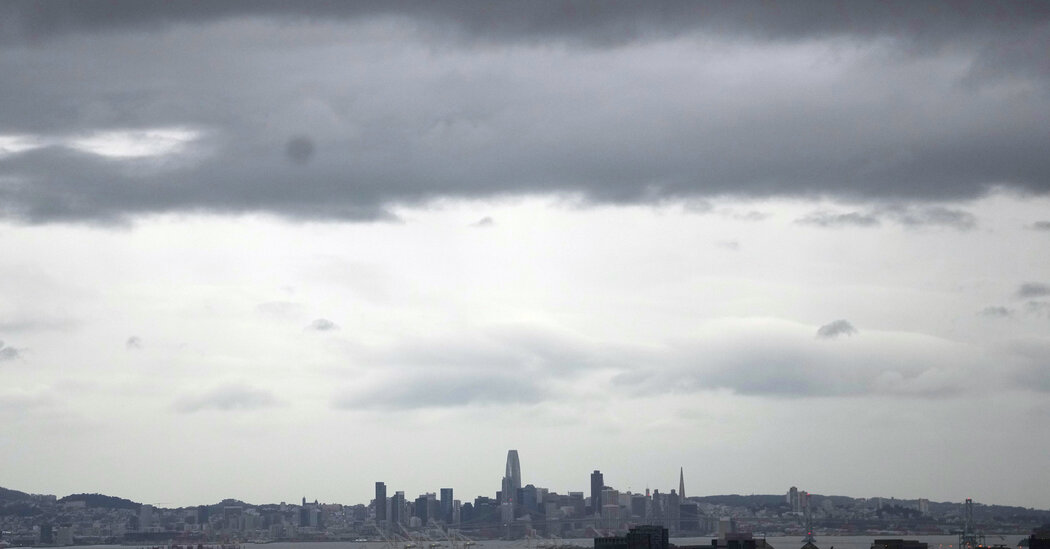

Over the past few weeks, flooding from storms has battered cities in the South and the East Coast, from Louisiana to New Jersey. Overlapping atmospheric rivers over the West Coast have brought heavy rains that are likely to come back in the next few days.
So far this week, Californians have not seen the kinds of weather-generated disasters that struck last winter, with flooding in Ventura County in December and in San Diego in January, my colleague Jill Cowan reports.
Storms are part of the natural cycle that replenishes the water supplies that several states will rely on during the drier months to come, Judson Jones, The Times’s meteorologist, told me.
“The problem comes when there’s too much at one time,” he said.
Climate change makes that a lot more likely. Warmer air holds more moisture, which means storms in many parts of the world are getting wetter and more intense, as my colleague Ray Zhong explained during deluges last year.
Coastal areas are especially vulnerable to climate change, not just because of storms and floods, but from rising seas and erosion. These factors put a tenth of the world’s population, the 896 million people who live near the oceans, at risk. That includes one-fifth of Americans.
The good news is that there is a lot we can do. Urban Ocean Lab, a think tank that promotes environmental policies for coastal cities, has designed a framework that lays out dozens of solutions that governments and communities can implement.
“So often people assume that we need more technological innovation, or we need huge amounts of more money before we can actually do anything meaningful,” the group’s co-founder, Ayana Elizabeth Johnson, said. But, she added, “There are so many solutions that we already have at our fingertips”
Getting ready
Many U.S. coastal cities are large and influential but also have vulnerable populations that are disproportionately affected by pollution and global warming. Whatever cities decide to do can have a huge impact on the climate and the lives of these communities.
Several policies can address both issues. Cities can put in place programs to develop new work forces that will help build solar farms, or redesign waterfronts in ways that are both resilient to climate change and strengthen local economies.
City governments can also help take care of nature. Protecting and restoring coastal ecosystems is a relatively inexpensive strategy to both store planet-warming carbon and shield their residents, especially the most vulnerable, from storm surges and sea level rise.
“It’s important to remember that there are solutions at every geographic scale,” Johnson said. “From a city block to a whole city.”
The work has already started
Over a third of U.S. cities have climate plans, according to research by Urban Ocean Lab and Columbia University. But implementation has been slow, and many cities are underestimating how much climate change will transform their communities.
There is money to act. Urban Ocean Lab identified $21.7 billion in the Inflation Reduction Act, President Biden’s signature climate bill, that coastal cities could use to get ready for global warming.

There are cities already doing a good job on climate:
My colleague Michael Kimmelman recently reported on the progress he has seen in flood-prone Hoboken, N.J., over the past decade. The city is elevating power lines, building cisterns and new sewers and redesigning to cope with rising seas and more intense rainfall.
New York City is working on a major environmental restoration project in Jamaica Bay to return salt marshes and sand dunes to their natural state to protect the ecosystem and the city.
In Baltimore, Md., the city has implemented “resilience hubs,” places where people can gather to talk about their communities, cool off or get food supplies when disaster hits.
You can act, too
A big part of Johnson’s message is that communities need to be organized, and governments need to include them in the decision-making process, for any strategy to address climate change to work.
That means you, and your neighbors, too.
It’s a lot easier to influence municipal policy or a City Council race than it is to affect the outcome of a presidential election, Johnson said.
“Community organizations can certainly approach city government and have an influence on how resources are allocated, how policy and regulations are developed,” she said. “There is a lot of citizen power at the local level.”
That may mean showing up to seemingly inconsequential meetings that could ultimately decide how our cities are protected (or not) from climate change.
“Extreme weather doesn’t have to be a disaster,” Johnson said. “It’s the infrastructure and the built environment and where people live and how people live that determine how bad the impacts of something are.”
Related storm news:
Where do the U.S. and China go from here?
This week we learned that John Podesta is replacing John Kerry as President Biden’s adviser on international climate policy. That raises some questions, including where the U.S.-China relationship is headed when it comes to climate.
The world’s two biggest economies are also the world’s two biggest polluters. The speed at which the U.S. and China agree to reduce emissions sets the tone for the world at large.
Kerry, 80, had a strong relationship with his Chinese counterpart, Xie Zhenhua. Even as the U.S. and China were at odds over security, trade and more, Kerry was able to restart climate talks last year. Those talks paved the way for a deal in November between the two countries to ramp up renewables, providing a jolt of ambition ahead of COP29.
Podesta, 75, also has a long history of dealing with China. As my colleague Lisa Friedman reported, Podesta helped to broker a landmark 2014 climate agreement between the United States and China during the Obama administration, was an architect of the 2015 Paris climate accord and has close ties with climate leaders around the world.
But there are also potential sources of tension ahead. For the past two years, Podesta has led the implementation of the Inflation Reduction Act, a climate law that is fundamentally designed to help the U.S. compete with China on solar panels and sources of renewable energy.
In any case, the U.S. and China are unlikely to strike another big climate deal this year. And if former President Donald Trump regains the White House in November, the U.S. may not have a climate adviser for much longer.
But at least for now, Podesta’s appointment “reassures the international community that the United States will continue to lean into leadership on global climate action,” Manish Bapna, president of the Natural Resources Defense Council, told Lisa. — David Gelles