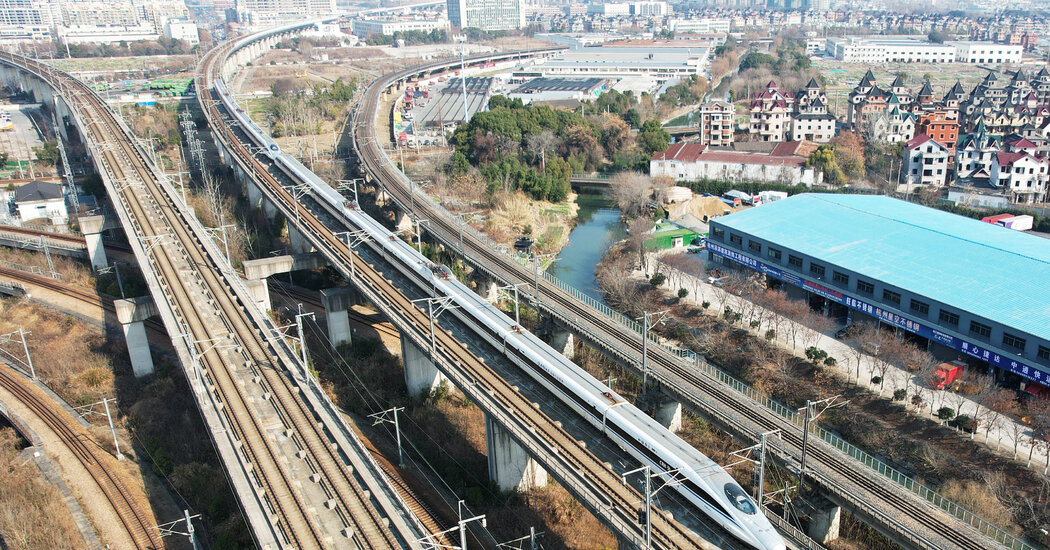

China is taking the rare step of sharply increasing fares for riders on four major bullet train lines, in its broadest move to address rising costs and heavy debts since construction of the system began nearly two decades ago.
The higher prices for train tickets are part of a push to raise prices for public services. Earlier this year, water and natural gas bills started going up in some cities.
Public services in China are heavily subsidized by local governments. But huge municipal debts mean that these governments have less money on hand to keep prices down.
Increasing prices can stem losses at some giant state-owned enterprises that provide these services. And making consumers pay more helps offset the falling prices that are widespread in China’s economy as growth slows.
China has already pushed up electricity charges considerably since 2021 for many factories, although residential customers continue to pay low, subsidized electricity rates.
“Large factories should all be paying a market rate now,” said David Fishman, senior manager in Shanghai for the Lantau Group, a Singapore-based power consulting firm.
Raising rail fares is a fraught political issue in China. The bullet trains are a symbol of the country’s capacity to build infrastructure, often even before there is consumer demand for it. But that infrastructure has been paid for with enormous borrowing, which has reached $870 billion just for China State Railway Group, the state-owned enterprise that runs the rail network.
The finance ministry has ordered a dozen of China’s most indebted provinces to reduce their infrastructure spending this year in exchange for debt relief. China’s leadership is shifting the country’s growth strategy from infrastructure and real estate investments toward high-tech manufacturing and exports. But that has antagonized the United States and Europe, which worry that additional Chinese exports could cause job losses and undermine their industrial base.
China has opened 28,000 miles of bullet train routes since 2008. Routes connect every major city and hundreds of smaller cities and towns. To put its size in perspective: The system is long enough to span the continental United States more than 10 times from New York to Los Angeles. The first line opened right before the Beijing Summer Olympics.
China’s bullet trains typically run at either 186 or 217 miles per hour, depending on the route. Because the tracks are straight, the trains run for long distances without slowing down.
But the debt incurred to build that network is not limited to China State Railway Group. Many of its lines are owned by joint ventures with provincial and municipal governments that helped pay for construction and are becoming less able to subsidize transportation.
Some of the older lines are beginning to require more maintenance. They were built hurriedly during the global financial crisis to employ hundreds of thousands of workers who had lost their jobs when export factories closed temporarily.
The rail system explained the fare increases this month with a statement to the official Xinhua news agency, saying that “operating costs such as line maintenance, vehicle purchase, equipment updates, and employment of labor have undergone major changes.”
The fare increases have drawn considerable commentary on social media in China. Much of it has been negative, as salaries have stagnated in the last several years and real estate prices have plunged.

“Everything is going up, except wages,” one person complained.
Fares are going up for peak travel along routes from Hangzhou to Shanghai, Changsha or Ningbo and Wuhan to Guangzhou. Many of the cities are fairly affluent communities near the Yangtze River and its tributaries in central China. But the price increases will also affect travelers in smaller, less prosperous towns in between.
The peak fares will rise almost 20 percent for first- and second-class tickets at peak times except for the route between Hangzhou and Changsha, where the increases will be smaller. Fares will jump as much as 39 percent for the luxurious V.I.P. business-class seats, which feature lie-flat seats resembling those in business class on intercontinental flights.
The rail system said in its statement to Xinhua that raising the peak fares would make deeper discounts possible for some off-peak tickets and for slower trains that make more stops.
The fare increases may have caught the public’s attention because of their steepness. The rail system increased second-class fares on the country’s most traveled route, between Beijing and Shanghai, by 8 percent in late 2020 and then another 10 percent a year later.
China’s bullet trains are still less expensive than those in the West. “At the end of the day, the Chinese railways still remain cheaper than those in Europe, Japan, and the U.S.,” said David Feng, an international rail consultant in Beijing.
With the price increases, the peak fare of a second-class high-speed train ticket from Wuhan to Guangzhou, a nearly 600-mile trip that takes less than four hours, will soon be $78. A ticket in first class, which has two seats on either side of the aisle like economy class on American trains but more leg room, will cost $125, and a lie-flat business class seat will cost $273.
When the system opened, many in the West predicted its cavernous stations might never be filled. Today, lines serving some smaller cities, especially where economic growth has stalled or worse, are infrequently used. But in the largest Chinese cities, like Shanghai, the trains are popular.
Train stations in these cities have become crowded, particularly during holidays like the recent five-day May Day break. Shanghai’s Hongqiao station, with a departure hall as long as three football fields, was still mobbed two days after the holiday ended.
Platforms in Beijing and Shanghai that were built for 16-car trains are being served by 17- or 18-car trains. The trains run frequently — there are more than 80 a day between Beijing and Shanghai.
But hundreds of smaller cities and towns have built large stations, even if they have as few as one train a day. China State Railway invested another $108 billion last year in further expansion, much of it to connect outlying areas. Yet it reported operating profits of only $470 million, leaving it with little money to pay down debt.
New towns and cities have grown along high-speed rail lines. High-rise zoning for many blocks around each station has meant that large numbers of people live nearby and use them. Many Chinese use the lines to travel weekly or even daily from low-cost towns, where apartments may rent for less than $100 a month, to jobs in larger and much higher-cost cities.
Li You contributed research.