
When David Cameron, Britain’s foreign secretary and onetime prime minister, visited Washington last month, he took time out to press the case for backing Ukraine with Representative Marjorie Taylor Greene, the far-right Georgia Republican who stridently opposes further American military aid to the country.
Last week, Boris Johnson, another former prime minister, argued that the re-election of Donald J. Trump to the White House would not be such a bad thing, so long as Mr. Trump comes around on helping Ukraine. “I simply cannot believe that Trump will ditch the Ukrainians,” Mr. Johnson wrote in a Daily Mail column that read like a personal appeal to the candidate.
If the “special relationship” between Britain and the United States has taken on an air of special pleading in recent weeks, it is because Britain, rock solid in its support for Ukraine, now views its role as bucking up an ally for whom aid to the embattled country has become a political obstacle course.
British diplomats said Mr. Cameron and other senior officials had made it a priority to reach out to Republicans who were hostile to further aid. For reasons of history and geography, Britain recognized that support is not as “instinctive” for Americans as it for the British, according to a senior diplomat, who spoke on condition of anonymity because of the diplomatic sensitivity of the matter.
Unlike in the United States, where Ukraine has gotten tied up in a dispute with Republicans over President Biden’s border policy and come under the shadow of a dismissive Mr. Trump, support for Kyiv in Britain has stayed resolute, undiminished, and nonpartisan in the two years since Russia’s invasion.
Even in an election year, when the Conservative government and its Labour Party opponents are clashing over almost everything, there is not a glimmer of daylight between them on Ukraine, the biggest foreign policy challenge facing the country.
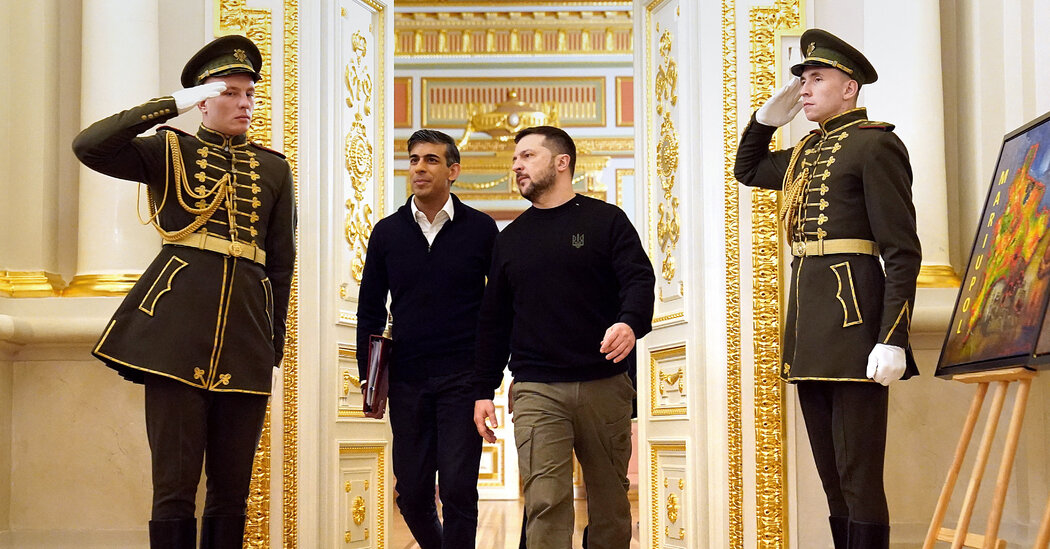
When Prime Minister Rishi Sunak recently announced 2.5 billion pounds ($3.2 billion) of additional aid for Ukraine, the Labour leader, Keir Starmer, instantly lent his support. Britain, the third-largest supplier of weapons after the United States and Germany, was the first major power to commit to new aid in 2024.
“We will remain united across our political parties in defense of Ukraine against that aggression from Putin,” Mr. Starmer said. On a visit to British troops deployed in Estonia, near the Russian border just before Christmas, he warned of the problems that fester “when politics goes soft on Putin.”
That political consensus mirrors public opinion in Britain. Some 68 percent of people favor military assistance to Ukraine, and 53 percent say that aid should flow there “for as long as it takes,” according to a British Foreign Policy Group survey in July.
Many Britons view the war in Ukraine — just over three hours away by plane — as almost on their doorstep, and their support reflects a fear that a Russian victory would pose an existential threat to the security of Europe and Britain. Addressing the Ukrainian Parliament earlier this month, Mr. Sunak described military aid as “an investment in our collective security” and said, “if Putin wins in Ukraine, he will not stop here.”
Britain’s army chief, Gen. Patrick Sanders, warned in a speech on Wednesday that Britons were now a “prewar generation,” who could be pressed into service to confront a military threat to Europe from an emboldened Russia. Downing Street later clarified that General Sanders was not opening the door to peacetime conscription.
There is ample precedent for Britain trying to steady a wavering United States in international conflicts. In 1990, when President George H.W. Bush was struggling to build a United Nations coalition to oppose Iraq after it invaded Kuwait, Margaret Thatcher famously told him, “Remember, George, this is no time to go wobbly.”
At other moments, Britain plays the role of America’s ready wingman. On Monday, it joined the United States in a second round of airstrikes against Houthi militants in Yemen, just hours after a phone call between Mr. Sunak and Mr. Biden, in which they agreed on the need to combat Houthi attempts to block commercial shipping in international sea lanes.
Malcolm Chalmers, the deputy director general of the Royal United Services Institute, a London think tank, said the British American cooperation on Yemen, and Britain’s prodding of Washington on Ukraine, captured the push-pull dynamic that has characterized the trans-Atlantic relationship for decades.

“People sometimes mischaracterize U.K. security policy as being a poodle of the U.S.,” he said. “The U.K. puts a very close value on its relations with the U.S., but that doesn’t mean we won’t push the U.S. if we feel it is not in the right place.”
The contrast between the allies on Ukraine has been especially stark, in part because both are entering election cycles in which such policies are easily held captive to broader political debates. Brexit-era populist figures like Nigel Farage still roam restlessly on the fringe. Mr. Farage, a conspicuous ally of Mr. Trump who shares his softer views of President Vladimir V. Putin, is backing a new anti-immigration party, Reform U.K., which some Tory lawmakers fear will siphon votes from them.
But the Conservatives, unlike the Republicans, do not have a “pro-Putinist wing” in their party, said Lawrence Freedman, emeritus professor of war studies at King’s College London. To the extent that any British leader might have sought an accommodation with Russia, he said, it would more likely have been the last Labour leader, Jeremy Corbyn.
Mr. Corbyn, after all, once said he would like to see NATO “ultimately disband.” Comments like that saddled Labour with the reputation for lacking in patriotism, something that Mr. Starmer has worked methodically to root out, along with the anti-Semitism that once contaminated its far-left ranks.
Banishing that history may be another reason Ukraine has not become a contentious issue. While Britain’s election is likely to be driven by economic rather than national security concerns, analysts said Mr. Starmer needed to inoculate Labour against charges that it is insufficiently patriotic. Security is one of the few issues on which polls show that voters still trust Labour less than the Tories.
“There is a thread in Labour history of being very patriotic,” said Jonathan Powell, a former chief of staff to a Labour prime minister, Tony Blair, who famously stuck with President George W. Bush through the Iraq War. “But Labour has had a problem convincing people again of its patriotism.”
Mr. Powell pointed out that traditional Labour strongholds, including Mr. Blair’s old district in northern England, had long been fertile recruiting grounds for the military. But in 2019, propelled by Mr. Johnson’s promise to “get Brexit done,” the Conservatives picked off many of these seats.
In a column last fall in the pro-Tory Daily Telegraph, Labour’s shadow defense secretary, John Healey, and shadow foreign secretary, David Lammy, argued that Britain’s nuclear-weapons deterrent, as well as its membership in NATO, were legacies of the post-World War II Labour government of Clement Attlee.
The Labour lawmakers accused successive Conservative-led governments of bleeding Britain’s armed forces through years of budget cuts imposed by fiscal austerity. “Over the last 13 years,” Mr. Lammy and Mr. Healey wrote, “our army has been cut to the smallest size since the days of Napoleon.”
Much of Britain’s support for Ukraine, of course, is rooted in cultural and national identity, which runs deeper than party politics. As Mr. Powell put it, “the notion of a plucky nation plugging away by itself is something we get.”
Britain has taken a hard line against Russia ever since Winston Churchill warned of an “Iron Curtain” after World War II. Its cynicism about Russian motives deepened in 2018, after the Kremlin was accused of poisoning a former Russian intelligence agent and his daughter in Salisbury, England, with a nerve agent. Britain blamed the operation on Russia’s military intelligence and expelled its diplomats.
But a succession of Conservative prime ministers has also discovered that backing Ukraine is an appealing strategy for a country groping for a post-Brexit role on the global stage. Without having to commit its own troops, or even to make a financial commitment beyond this year, Britain can look like a world leader at relatively modest cost.
“It’s not a great strain on the U.K. to take on this policy,” Professor Freedman said. “And if you’re the first mover, as the U.K. has been on a number of occasions, and now with security guarantees, you get credit for it.”