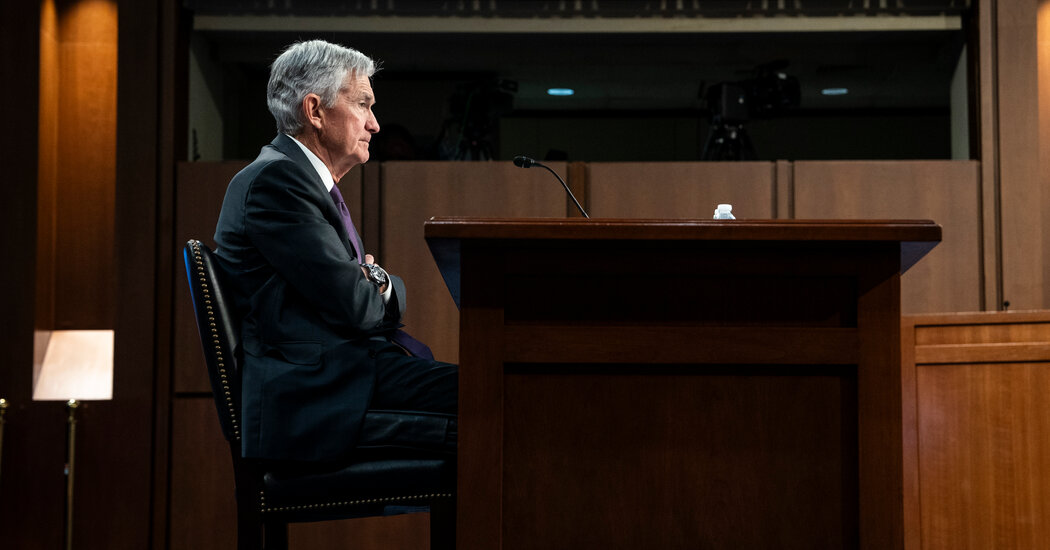

Just days after President Trump won the 2024 election, Jerome H. Powell, chair of the Federal Reserve, sidestepped a question about how the central bank would grapple with a toxic combination of high inflation, stagnating growth and rising unemployment.
“The whole plan is not to have stagflation,” Mr. Powell told reporters. “Knock on wood, we’ve gotten this far without seeing a real weakening in the labor market.”
Two months later, Mr. Trump’s aggressive tariff pronouncements, slash-and-burn cuts to the federal government and the resulting frenzy in financial markets have put the Fed in an incredibly uncomfortable spot.
Outright stagflation remains a remote prospect: The foundation of the U.S. economy is still solid, and it will take quite a big shock for it to crumble. But what once appeared to be a historic soft landing — with the Fed wresting control of rapid inflation while keeping the economy intact — looks increasingly vulnerable.
When the Fed wraps up its policy meeting on Wednesday, it is widely expected to hold interest rates steady at 4.25 to 4.5 percent. Mr. Powell recently downplayed the need for any imminent changes to borrowing costs, saying the central bank was focused on “separating the signal from the noise” when it came to the Trump administration’s policies. With the economy in a good place, he said, the Fed is “well positioned to wait for greater clarity.”
But if the economy starts to crack and inflationary pressures grow — a situation that consumers increasingly fear — the Fed’s policy decisions will take on an entirely new degree of difficulty. That risks putting the central bank more squarely in the cross hairs of Mr. Trump.
“The Fed certainly has a dilemma,” said Mahmood Pradhan, head of global macro at the Amundi Investment Institute, an asset manager. “The Fed has no control of this backdrop, no control of the policy uncertainty and no control of the volatility of this discussion on tariffs. It’s a very tough hand they’ve been dealt.”
Officials at the central bank have become deft at dodging questions about Mr. Trump and his policies. But the flurry of actions undertaken by the Trump administration in just the first two months of his second term has made that much harder to do.
The sheer volume of the tariff threats alone has exploded the range of possible outcomes for the economy. That has rattled even the most optimistic of economists about the outlook. They have also had to contend with the steep spending cuts undertaken by Elon Musk and his Department of Government Efficiency and the prospects that millions of immigrants could be deported.
Mr. Trump’s reluctance to rule out a recession, and a recent shift in tone from his top advisers about the amount of pain that may be necessary to achieve a promised economic boom, have amplified fears about how far the administration will go to push his agenda. Those fears were exacerbated last week as Mr. Trump dismissed warning signs, unnerving financial markets.
There is evidence that the uncertainty around tariffs is already starting to bite. Consumer sentiment plunged in March for a third straight month, according to a preliminary survey conducted by the University of Michigan and released on Friday.
Tariff talk has skyrocketed on corporate earnings calls, according to FactSet, with chief executives increasingly warning about slumping demand and rising prices. Optimism about the labor market has faded, too, with a growing share of consumers surveyed by the Federal Reserve Bank of New York now expecting higher unemployment and a worse financial situation in the year ahead.
“Consumption, which has been the key driver of the U.S. economy over the past several years, will no longer provide as much impetus,” said Marc Giannoni, a chief U.S. economist at Barclays, who formerly worked at the Fed’s regional banks in Dallas and New York.
Last week, Mr. Giannoni’s team lowered its growth forecast for the United States economy by almost a full percentage point, to 0.7 percent on a fourth-quarter-over-fourth-quarter basis. Economists at JPMorgan and Goldman Sachs also moved their estimates in a similar direction, citing tariffs and the expectation that heightened trade policy uncertainty will deter investment and hiring.

One troubling sign is that they did so while also raising their forecasts for inflation. Companies are bracing for higher prices from Mr. Trump’s tariffs, which will raise costs for imported goods. Many have warned that they are likely to pass along those increases to consumers.
Tom Madrecki of the Consumer Brands Association said the big food companies that his trade group represents, like PepsiCo, General Mills and Conagra Brands, could be hurt if the products they use that are not easily sourced domestically are hit with tariffs.
“There’s no winning in this situation,” he said. “There’s no way for grocery prices to not increase, and yet at the same time, consumers have clearly reached the breaking point.”
The group recently wrote to Mr. Trump asking for tariff exemptions on products like coffee, cocoa and oats, which are primarily sourced abroad.
Mr. Madrecki said an exemption would allow companies to avoid having to “eat a cost, which isn’t going to do anything in terms of increasing jobs or continuing to be able to invest in new facilities.”
Americans are already starting to expect higher prices. Inflation expectations have risen sharply — both for the year ahead and for a longer five-year horizon. Some economists downplay how much of a signal should be gleaned from those measures, in part because of the increasingly partisan nature of some of the responses. Market-based measures have also stayed steady even as survey-based ones have shifted.
But the widening range of responses about where inflation is headed itself is a cause for concern for others.
“There is enormous disagreement about what inflation can be, and what this means in practice is that inflation expectations are not anchored,” said Yuriy Gorodnichenko, an economist at the University of California, Berkeley. “It’s very easy to change the beliefs of people from one number to another, because everybody is so uncertain and so confused.”
How inflation expectations evolve will be critical to how the Fed outlines its policy path. The central bank has historically argued that it can avoid responding to tariff-induced inflation because those price pressures tend to be temporary. The Fed responded to growth concerns that emerged during the last global trade war in Mr. Trump’s first administration by lowering interest rates in 2019.
But the central bank is at risk of being more hamstrung in its response to a weakening economy because inflation is still stuck above its 2 percent target. Mr. Powell said this month that the Fed’s approach to navigating tariffs would ultimately depend on “what’s happening with longer-term inflation expectations and how persistent are the inflationary effects,” suggesting that the central bank’s focus remains predominantly on price pressures.
Jon Faust, who was a senior adviser to Mr. Powell as recently as last year, said: “The one thing that is unacceptable is inflation rising and inflation expectations rising with it, because that’s appropriately viewed as being the worst of all outcomes that ultimately you can’t let happen.”
An added complication is Mr. Trump’s penchant to test the Fed’s political independence. While the president has so far refrained from commenting as frequently as he did during his first term about Mr. Powell and the Fed’s policy decisions, he has attempted to more seriously encroach on the institution through executive orders.
“President Trump seems to be less constrained by conventions than he was the last time,” said Mr. Faust, who is now at the Center for Financial Economics at Johns Hopkins University. “It looks like the economic situation could easily become more fraught in terms of a slowing economy and potentially tariff-driven increases in inflation. That’s a prescription that is very likely to lead to a serious confrontation between the Fed and the administration.”