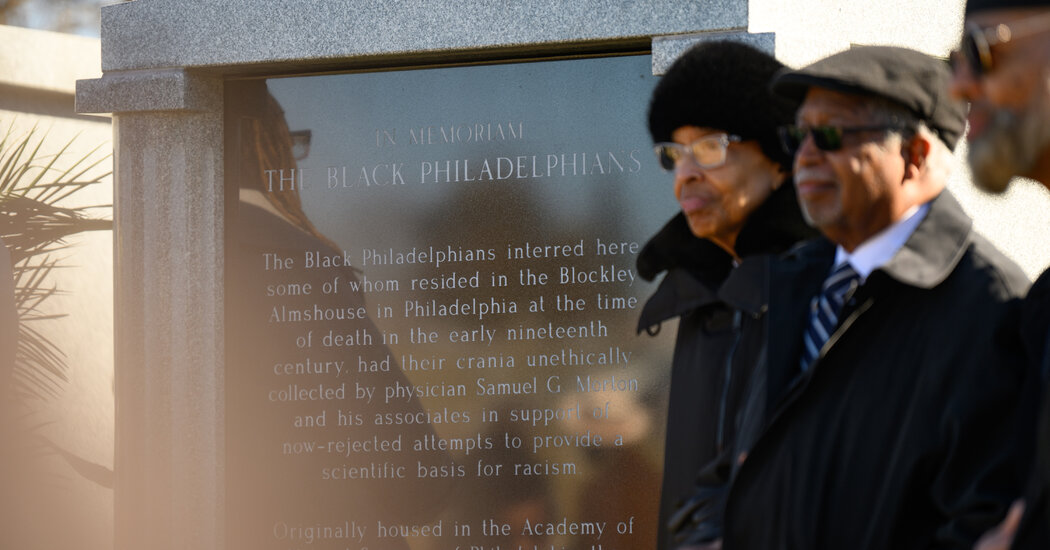

There was very little that could be said about the 19 people who were eulogized on Saturday morning in a service at the University of Pennsylvania. Their names were lost, and not much about their lives was known beyond the barest facts: an old age spent in the poorhouse, a problem with cavities. They were Black people who had died in obscurity over a century ago, now known almost entirely by the skulls they left behind. Even some of these scant facts have been contested.
Much more could be said about what led to the service. “This moment,” said the Rev. Jesse Wendell Mapson, a local pastor involved in planning the commemoration and interment of the 19, “has not come without some pain, discomfort and tension.”
On this everyone could agree.
The University of Pennsylvania Museum of Archaeology and Anthropology, like cultural and research institutions worldwide, has been grappling with a legacy of plunder, trying to decide what to do about artifacts and even human bones that were collected from people and communities against their will and often without their knowledge.
The museum plans to repatriate hundreds of craniums from all over the world, but the process has been fraught from the beginning. Its first step — the entombment at a nearby cemetery of the skulls of Black Philadelphians found in the collection — has drawn heavy criticism, charged by activists and some experts with being rushed and opaque.
“There are so many places dealing with this,” said Aja Lans, a professor of anthropology and Africana studies at Johns Hopkins University, who has criticized the Penn Museum’s handling of the Morton remains. “Anyone who works in human remains is paying attention to what’s happening at Penn. No one wants to replicate what’s happening.”
In the early and mid-19th century, Samuel George Morton, a Philadelphia physician and naturalist, amassed one of the largest known collections of human skulls in an effort to bolster an influential but scientifically bogus theory of racial hierarchy. Like many physicians and medical students of his time, he looted the cadavers of the poor and mentally ill from the city’s almshouse.
The collection continued to grow after Morton’s death in 1851 but was largely forgotten along with his odious theories. In 1966, the bones were transferred to the Penn Museum, where they remained for decades, some sitting on a classroom shelf, visible through a window to anyone waiting at the nearby bus stop.
The collection began drawing attention in recent years, fueled by research at Penn and the national calls for a reckoning with historical racism. In February 2021, a Ph.D. student, Paul Wolff Mitchell, wrote a report finding that the Morton collection included the skulls of at least 14 Black Philadelphians, some of whom were most likely born in slavery.
The museum, which had pledged to repatriate all the skulls in the Morton collection, formed a committee to arrange for the burial of these and six more craniums that also appeared to be from Black Philadelphians. In addition to university officials and local clergy, the committee included aAliy A. Muhammad, a community activist who was among the first to publicize that the museum was holding some bones of children killed in a notorious 1985 police-ordered firebombing.
Mx. Muhammad, who identifies as nonbinary, insisted that decisions about the remains should lie not with the museum but with the descendant community, people who have deep roots in Black Philadelphia. Along with Lyra D. Monteiro, a history professor at Rutgers University, Mx. Muhammad formed a group called Finding Ceremony, which demanded that the museum transfer the collection to the group and fund research into the identities of the hundreds of people whose craniums it had kept. Of the 20 people the museum planned to bury, only one — a porter named John Voorhees, who died of tuberculosis in 1846 — was known by name.
The fight between the museum committee and Finding Ceremony went to court, and in February of last year, a judge ruled in favor of the museum, ordering the interment to take place within a year. The committee planned to entomb the remains in a mausoleum at Eden Cemetery, a historic Black graveyard.
Having lost in court, Dr. Monteiro combed local archives. Finding names was a daunting task; many of the people whose remains ended up in the Morton collection were described in Morton’s records in only the crudest terms.
“It seems unlikely to me that all of these individuals will be identified,” said Christopher Woods, the director of the Penn Museum since 2021. Dr. Woods, who is the museum’s first Black director, pointed out that even if a person could be named, the person might have hundreds of descendants to consult. The process, he said, could take years.

“Institutions too often have used the claim of future research or more conclusive research as a tool of inaction,” he added. The remains were intentionally put above ground, in a mausoleum, he said, so they could be retrieved if ongoing research efforts turned up identities.
Then, in mid-January, Finding Ceremony announced a discovery. Dr. Monteiro had found in the city’s archives an 1846 interview with John Voorhees, in which he said that his mother was Native American. His cranium was thus covered by the federal law governing the remains of Native Americans. The one named person of the 20 to be interred was taken out.
To critics of the process, this was proof that the museum’s approach had been overly hasty. It also raised questions about how much the museum really knew about the 19 others.
“What does this suggest about the thoroughness of the research?” asked Dr. Mitchell, whose report first called attention to Black Philadelphians in the collection, and who is now a postdoctoral researcher at the University of Amsterdam. Dr. Mitchell said he welcomed Penn’s openness to returning human remains but contrasted it with what he saw as the more meticulous approach taken by some other institutions. “Frankly, how you carry out this process of repair is really important,” he said.
A spokesperson for the museum said that archival research into the identities was continuing, and that the museum was working with an independent genealogy expert.
Compounding the anger of the museum’s critics, word spread days before Saturday’s ceremony that the actual interment had taken place quietly on Jan. 22. “It was shocking,” said Mx. Muhammad, who like many had understood the Feb. 3 ceremony to involve the burial itself, as the website seemed to suggest.
Members of the museum committee said separating the physical burial from the public ceremony had always been the plan given the logistical complications of burial. The spokesperson said the museum had informed people about it beforehand in a release sent to the museum’s email list.
Beyond prayers, hymns and a drum procession, the event on Saturday was as much an act of atonement as a memorial. Several university officials, all of them Black, apologized for what the provost, John L. Jackson Jr., called the “sordid history” behind the Morton collection.
As attendees left the commemoration, many of them heading to a graveside service at the cemetery, people affiliated with Finding Ceremony stood outside the auditorium handing out fliers. The fliers questioned the museum’s claims about the identities of some of the 19 who had been entombed and gave crumbs of biography known about the others.
“She was born before 1760 and lived to the age of 80,” read one. “Wherever she was born, she was almost certainly enslaved for decades. By the time she died in Philadelphia, she was free.”