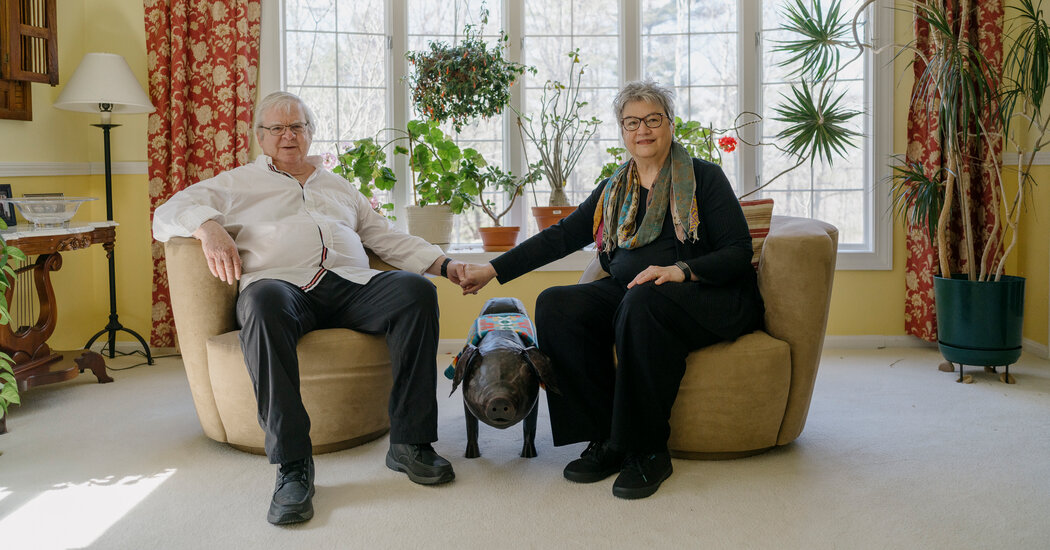

When it came to housing, Susan Apel and Keith Irwin thought they had planned adroitly for later life. They bought a four-bedroom house on two acres in Lebanon, N.H., 24 years ago, and “we made sure to pay off the mortgage before we retired,” said Ms. Apel, 71.
That way, the home equity they had built up — they estimate their house is now worth about $700,000 — would allow them to sell and downsize into smaller, more manageable quarters when they needed them.
That time has arrived. Ms. Apel, a retired law professor, is having trouble climbing stairs. Mr. Irwin, 71, previously an account manager for a local business, is wearying of yard work and snow shoveling, and finding workers to do those chores instead has become difficult.
“We’re seeing the writing on the wall,” Ms. Apel said. They have started shopping for “a nice two-bedroom condo with a little den, all on one floor.”
But they can’t find one. Local developers are putting up four-level townhouses with even more stairs. The few suitable one-floor homes available get instantly snapped up. City dwellers fleeing Covid helped pump up housing prices: One unit the couple saw recently cost $950,000 and needed work, Ms. Apel reported. Even “tiny shoeboxes” are selling for $600,000.
“We were very grateful to live in this lovely place and to have paid off our house,” Ms. Apel said. “It never occurred to us that it didn’t give us the ability to move out of it.”
About 80 percent of older adults live in homes they own. But the traditional notion that a house with a paid-off mortgage can serve as an A.T.M. to help fund retirement living is shifting, economists report. Homeownership no longer is an unqualified benefit for some seniors.
“Are they aging in place, or stuck in place?” asked Linna Zhu, a research economist at the Urban Institute. “Do we need to rethink this so-called American dream? It worked for previous generations, but does it still work today?”
The proportion of older adults with mortgage debt has been rising for decades. From 1989 to 2022, the share of homeowners aged 65 to 79 with mortgages climbed to 41 percent from 24, according to the Harvard Joint Center for Housing Studies. The amount they owed rose, too, to $110,000 from $21,000, adjusted for inflation.
David Turoff, 73, a veterinarian in Placerville, Calif., still carries a $180,000 mortgage on his two-bedroom home, for instance. He refinanced it to take out cash, a way to sustain his practice after the 2008 recession. “I’m glad I did it,” he said, but “it was definitely a risk.” Even among homeowners in their 80s, 31 percent have mortgages.
Larger mortgage balances and higher interest rates — along with higher property taxes, insurance and other costs — have helped make 43 percent of older homeowners with mortgages “cost burdened,” defined as spending 30 percent or more of their income on housing and related costs.
Of course, median home equity has also risen, jumping by $80,000 in just three years, to $250,000 in 2022. That’s largely why the Center for Retirement Research at Boston College recently reduced its estimate of the proportion of American households at risk of being unable to maintain their standard of living after retirement.
The center’s retirement risk index dropped to 39 percent in 2022 from 47 percent in 2019, an unnerving figure but the lowest it has been since the center started tracking it 20 years ago.
The center bases its calculations on older homeowners tapping their home equity with reverse mortgages, as Bart Windrum and Deborah Fink did in 2020. Through the Federal Housing Administration, they received a reverse mortgage on their townhouse in Boulder, Colo., with a credit line of up to $382,000.

“The reason was to protect our retirement funds for as long as possible,” said Mr. Windrum, 71, an author and speaker.
The credit line allowed them to pay off their existing mortgage, afford cataract surgery and complicated dentistry (neither one was covered by Medicare, in this instance), replace a 22-year-old car and upgrade their plumbing, all while keeping their retirement savings intact.
“When we sell this place, I anticipate a third of its value, in round numbers, will go to pay off the reverse mortgage,” Mr. Windrum said. Because federal legislation in 2015 brought tightened government underwriting and consumer protections, “we felt comfortable and confident in using the program,” he said.
Dr. Zhu agreed, calling a federal reverse mortgage “a very effective way to tap home equity.”
But taking a reverse mortgage or otherwise extracting home equity is something very few older homeowners actually do.
Jennifer Molinsky, who directs research on housing and aging at the Harvard center, cites a “dual idea of homeownership,” in which accumulating housing wealth represents “a nest egg, a cushion for later life.”
“But at the same time, nobody wants to touch it,” she added. “They want to leave it to their children. They want to save it for an emergency.”
Besides, accessing home equity isn’t always simple or possible. With federally insured reverse mortgages — officially Home Equity Conversion Mortgages, or H.E.C.M.s — the upfront costs are high (topping $17,000 for Mr. Windrum and Ms. Fink) and the paperwork substantial. In 2022, only 64,500 older applicants received reverse mortgages through the federal program.
Other ways to access home equity have also grown more difficult as extremely low interest rates returned to more typical levels. Cash-out refinancing by homeowners over age 65 dropped to 600,000 in 2022 from 941,000 loans in 2021. “It’s not as easy to get or as cost-effective as it was,” Dr. Molinsky said.
Older borrowers are denied refinancing loans more often than younger ones, in part because lenders consider income as well as assets, and income usually declines as workers retire. Home equity lines of credit, or H.E.L.O.C.s, are also more frequently denied to seniors and less attractive at higher interest rates. And maintenance costs rise over time as houses age along with their owners.
Moreover, as Ms. Apel and Mr. Irwin discovered, a dearth of suitable, affordable homes for older adults makes downsizing challenging even for those with considerable housing wealth. “You can get locked in when you’d like to move on,” Dr. Molinsky said.
Older Black and Hispanic homeowners are in particularly precarious positions because so much of their wealth is tied up in their houses, said Anthony Webb, a senior fellow at the New School for Social Research.
“There’s nothing wrong with having a mortgage on the liability side of the balance sheet, if it’s matched by funds on the asset side,” like retirement savings, investments and pensions, he said.
But minority homeowners have far fewer liquid assets than white homeowners, partly because of lower lifetime earnings. “This is a story of widening inequality,” Dr. Webb said. Many Black and Hispanic homeowners “have this asset,” he said, but “it’s going to be a struggle to keep it.”
Policymakers could increase older adults’ options by improving and streamlining the federal H.E.C.M. program, broadening the criteria for refinancing and H.E.L.O.C. loans, and encouraging the development of more housing, including homes and apartments suitable for older buyers and tenants.
Experts agree that homeownership, a potent wealth generator, still makes sense overall. Even with mortgages, older homeowners have greater protection against rising housing costs than renters and are less likely to be cost burdened. Home equity can help fund long-term care, too.
But Ms. Apel and Mr. Irwin, as they continue their search, feel frustrated. They don’t want to leave the community where they’ve lived for decades, but they are ready to relinquish their house.
“This would be a wonderful family home,” Ms. Apel said. “But we can’t free it up, because where would we go?”