
A reader asks:
Are there any studies supporting the success of trend following or momentum? Something showing that momentum can succeed for the retail investor, not just something that works for a few hedge funds. I’m pretty EMH and find it hard to deviate from my indexes.
I wouldn’t consider myself an efficient market hypothesis disciple. I’m more of a cost matters hypothesis John Bogle indexer.
Index funds were my first love in the markets. It just made sense to me from the beginning.
I’m a big believer in knowing what you own and why you own it. I was a late convert to trend-following and momentum investment strategies. Understanding the research and psychology behind these strategies helped me make sense of them.
Let’s nerd out.
I’ll start with trend-following.
AQR published a report called A Century of Evidence on Trend-Following Investing. They used historical data on stocks, bonds, commodities and currencies going all the way back to 1880.
The idea is basically to buy what’s in an uptrend and sell what’s in a downtrend. It worked for each of these asset classes over 100+ years of data, which suggests this isn’t some lucky pattern from the past few decades. They use long/short portfolios which aren’t relevant to most investors but the numbers tell a good story.
The whole idea of trend-following (and momentum) is to let your winners run and cut your losers short.
My introduction to my friend Meb Faber was his paper A Quantitative Approach to Tactical Asset Allocation.
The timing of this paper was immaculate. Meb published this in the spring of 2007, just five months ahead of the peak that led to the Great Financial Crisis.
The research tested a very simple rule: You hold an asset when its price is above its 10-month moving average and move to cash when it’s below the 10-month moving average.

This is a very simple rule but simple can be very effective in a severe stock market drawdown.
Here’s a chart from the paper (that was later updated post-GFC crash):
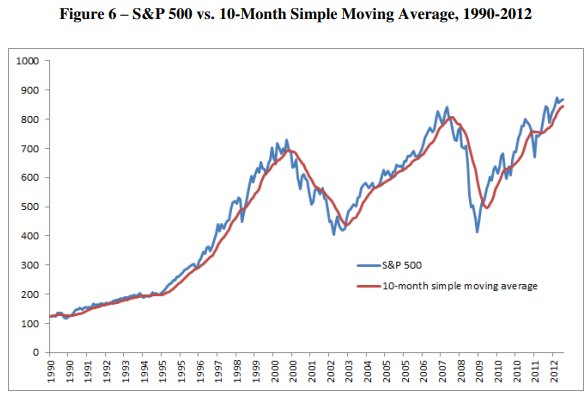
This rule is not infallible. There are false positives and whipsaws. But it is a nice insurance policy against the gigantic market crashes.
Meb also applied the rule across stocks, bonds, real estate, and commodities since the early 1900s. The asset classes delivered returns similar to a buy-and-hold strategy, but with much shallower drawdowns.
Another one of my favorite quants, Wes Gray, wrote a paper titled Avoiding the Big Drawdowns with Trend-Following Strategies that focuses on the behavioral benefits.
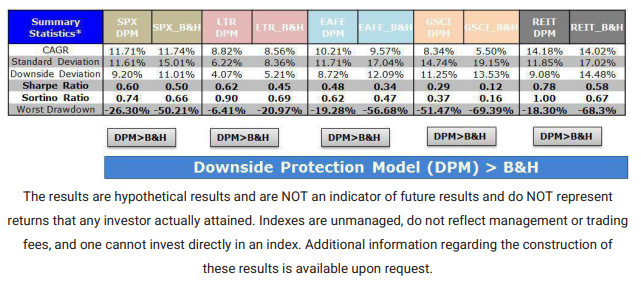
Wes used two different trend signals–a 12-month absolute momentum rule and a moving average rule–and blended them 50/50 to diversify the signal. He also tested these signals on U.S. stocks, bonds, foreign stocks, REITs and commodities.
You can see the returns are similar but with slightly lower volatility and a big improvement on the max drawdowns:
The math is interesting for spreadsheet geeks like me but I find the behavioral component even more relevant for most investors. Here’s what Wes wrote about this:
However, we believe there is a behavioral story underlying the success of trend-following systems. Consider the concept of dynamic risk aversion, which is the idea that human beings don’t stick to a set risk/reward behavior–their appetite for risk can change depending on their recent experience.
Trend-following is not perfect but it can act as a behavioral release valve, which many investors need in order to survive a big market crash scenario.
That’s some of my favorite research on trend-following. Now let’s move to momentum which is similar but also different.
Trend-following looks at the absolute direction of an asset class versus its own history.
If the trend is up, stay invested.
If the trend is down, go to something safer.
Momentum is a relative metric. You rank a group of stocks based on some lookback of performance — typically somewhere in the range of 3-12 months. Then you own the stocks that have gone up the most because they tend to keep going up…at least for a while.
This doesn’t work with every stock or all the time but a diversified basket of momentum stocks has been shown to be an effective strategy over the long run.
The OG momentum paper comes from Jegadeesh & Titman in 1993 — Returns to Buying Winners and Selling Losers. This research put momentum on the map in many ways.
They showed stocks that did well over the past 3-12 months tend to keep doing well over the next 3-12 months, and the losers keep losing. This makes no sense intuitively but once you consider the herding behavior exhibited by investors, momentum is a natural byproduct of human nature.
This research sparked a lot of follow-up research on the topic.
Five years later Rouwenhorst published International Momentum Strategies which tested the momentum factor outside of the United States. It worked across a dozen European stock markets.
The reason all of these researchers test across different markets and asset classes is that you want to make sure it’s not just some statistical anomaly. The fancy quant word here is robust.
Finally, since the person asking this question is a tried-and-true EMH proponent, it’s certainly worth reading Dissecting Anomalies by Eugene Fama and Ken French, the godfathers of the efficient market hypothesis.
In this paper, they stress-test a handful of factor strategies — momentum, accruals, net stock issuance, asset growth, and profitability — across firms of all sizes. Here are some quotes from the research:
The premier anomaly is momentum (Jegadeesh and Titman (1993)): stocks with low returns over the last year tend to have low returns for the next few months and stocks with high past returns tend to have high future returns.
Which anomalies are present in all size groups and produce returns that vary systematically from the low to the high ends of the sorts? Momentum satisfies both criteria.
Fama and French begrudgingly admit momentum works.
After reading through all of this research the big question you have to ask yourself is this:
Do you need trend-following or momentum strategies in your portfolio?
Just because there are investment strategies that “work” doesn’t mean they necessarily fit in your portfolio. You shouldn’t try to fit a square peg in a round hole.
The S&P 500 is already kind of the world’s largest momentum strategy. The quants take umbrage when I say this because it’s not the true momentum factor. It’s beta.
But any market cap-weighted index lets the winners run and cuts losers short by definition.
I am a huge proponent of diversification. To create a durable portfolio that can survive a wide range of market and economic environments, you should diversify by asset class, geography, market capitalization, and strategy.
I like the diversification benefits that momentum and trend-following can provide to a portfolio.
Many investors think it’s overkill to add these kinds of strategies to an investment plan.
You have to do what works for you.
Just don’t invest in something you don’t understand or don’t believe in.
I discussed this question on an all-new episode of Ask the Compound:
Bill Sweet came on again to discuss mega backdoor Roth conversions, how to account for a pension in your financial plan, Roth 401ks, how your job should impact your risk profile and where to save for a down payment.
Further Reading: