
President Trump’s rapidly escalating trade war with China has resulted in eye-watering tariffs on products exchanged between the countries and scrambled prospects for many global businesses that depend on the trade. And there is no end in sight.
The Trump administration has been waiting for the Chinese leader, Xi Jinping, to call Mr. Trump personally, but Beijing appears wary of putting Mr. Xi in an unpredictable and potentially embarrassing situation with the U.S. president.
With the two governments at an impasse, businesses that rely on sourcing products from China — varying from hardware stores to toymakers — have been thrown into turmoil. The triple-digit tariff rates have forced many to halt shipments entirely.
Mr. Trump has rapidly ratcheted up tariffs on Chinese products, from 54 percent on April 2 to 145 percent just one week later. The Chinese government has argued that the actions are unfair and closely matched his moves, raising its tariffs on American goods to 125 percent on Friday.
But on Friday night, the administration created a significant carve out to its tariffs on China when it exempted some electronics, including smartphones, laptops and televisions. Those products will still be subject to other tariffs that Mr. Trump has put in place, like a 20 percent fee he added to Chinese goods in response to the country’s role in the fentanyl trade.
Mr. Trump has said he would like to speak with Mr. Xi, but he has stopped short of requesting a phone call, believing that it is the Chinese government’s turn to ask for such a call, according to people familiar with the matter. Trump officials say that dozens of countries have reached out to the administration about negotiations since the levies were imposed. China did not, and instead responded with harsh words and tariffs of its own.
Across the Trump administration, some officials are concerned that the trade war could soon escalate into a national security crisis, potentially causing the Chinese to move up plans for a military invasion of Taiwan.
The Pentagon is assessing the impact of China potentially cutting off rare earth exports to the United States and possibly blocking certain critical components used in U.S. weapons systems, according to a person with knowledge of the preparations. The aim is to fully ascertain what harm the Chinese could inflict on America’s ability to produce and maintain certain weapons and ammunition.
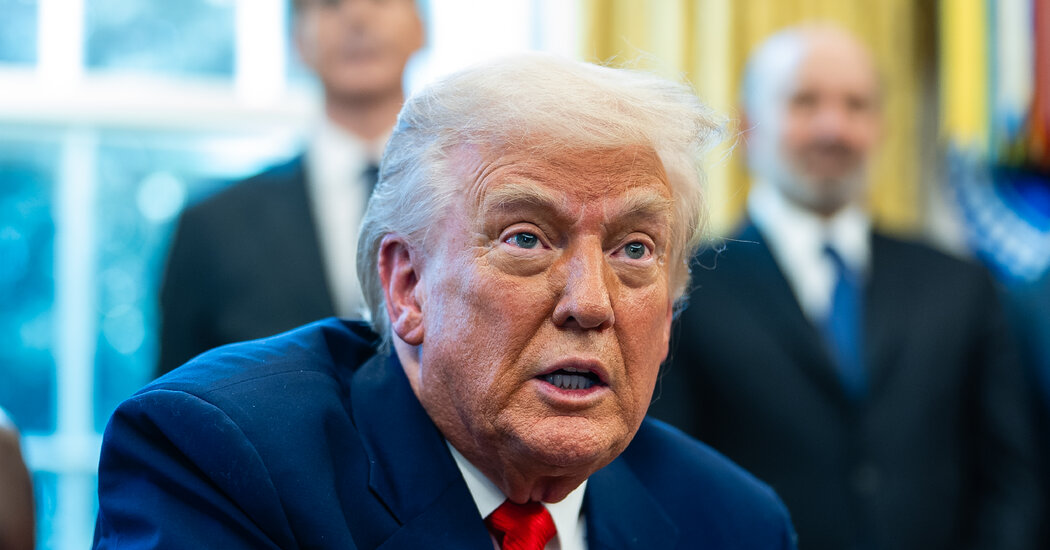
Mr. Trump continues to express optimism, saying that he has always gotten along with Mr. Xi and that “something positive” will come out of the relationship. But analysts have suggested that the situation may already have spiraled out of control.
Julian Evans-Pritchard, the head of China economics for the research firm Capital Economics, said the fact that the Chinese authorities had repeatedly matched U.S. tariff hikes suggested that they were in no rush to negotiate.
“A partial rollback of tariffs still seems likely at some point,” he said. “But it is hard to envisage a meaningful reset in the U.S.-China relationship.”
At a briefing on Friday, Karoline Leavitt, the White House press secretary, declined to say whether the countries were in communication.
“I’m not going to comment on communications that are happening, or may not be happening, or either way, we’ll leave it to our national security team to get these discussions underway,” she said. She said the president was optimistic, and that he had “made it very clear he’s open to a deal with China.”
Speaking last week at the White House, Mr. Trump said that “China wants to make a deal. They just don’t know how quite to go about it.” He added that the Chinese were “proud people.”

Mr. Trump’s moves have taken tariffs to a level far past what would be prohibitive for trade, creating crises for many American businesses that depend on imports from China.
Rick Woldenberg, who runs Learning Resources, an Illinois-based maker of educational toys, said the latest tariffs had already forced him to pause some shipments from China. He called the rates that Mr. Trump had imposed “a joke” and said that even concessions from his suppliers could not make a dent in the fees he would owe to the U.S. government.
Learning Resources contracts with factories in Taiwan, India, Vietnam and other countries to make its products, but China is by far its biggest supplier, as it is for most toymakers. China accounted for two-thirds of all imports of toys and sporting goods to the United States last year.
Learning Resources employs about 500 people, most of them in the United States. It had planned to hire more this year to keep up with its fast-growing business, but has now abandoned some of those plans.
“We’re being asphyxiated by our very own government,” Mr. Woldenberg said.
Mr. Woldenberg said he paid about $2.3 million in tariffs and duties in 2024. This year, he would end up paying more than $100 million if sales somehow kept up with his projections from before the trade war. That’s more than he could pay if he cut every expense in the company other than base payroll.
At this point, Mr. Woldenberg said, the number hardly matters — beyond a certain level, the tariff is simply no longer something anyone in his business can afford to pay.
“He could raise it to 100 billion percent — it doesn’t matter,” he said. “It’s like a legal ban.”
Christophe Lavigne, the president of Highfield, which manufactures boats in China and the United States, said he expected to be subject to 198 percent tariffs on some of his imports, and that he has decided to simply stop his shipments for now.
He said his entire company, and the jobs of his employees and his dealers, was on the line. The pace of change was too fast and unpredictable, he added.
“We cannot adjust our production lines quickly enough,” he said. “Converting our entire supply chain in just two months is not feasible.”
Major multinational corporations have been in a better position to source products from countries besides China, but they too are reeling. Hobby Lobby, the crafting retailer, told vendors on Thursday that it was delaying shipments from China as a result of the escalating trade war, according to correspondence viewed by The New York Times.
The retailer told vendors that the back-and-forth tariffs had resulted in “a rapidly shifting and unpredictable landscape” and that it hoped diplomacy between the United States and China would “yield a more stable and balanced outcome.”
The implications of disrupting business with one of the country’s biggest trading partners have ricocheted through the economy. The dollar fell to a three-year low on Friday, while Treasury yields continued to swing. A measure of consumer sentiment also tumbled, indicating that Americans were becoming nervous about how higher tariffs might affect them.
Mr. Trump abruptly announced on Wednesday a 90-day pause on the “reciprocal” tariffs that he had unveiled the previous week on countries around the world, and which had gone into effect just hours earlier. But the threat of those tariffs, and of retaliation against U.S. exports, continues to hang over the global economy.
It remains to be seen if the United States and China might try to reach some agreement soon. People familiar with the conversations said that members of the White House National Security Council were in touch with counterparts at the Chinese Embassy, and that Cui Tiankai, the former Chinese ambassador, had held meetings in Washington and New York over the past several weeks to discuss the relationship. But there has been little sign of communication between higher-ranking officials in the Trump administration and the Chinese government.
Early in Mr. Trump’s first term, Mr. Xi flew to his Mar-a-Lago estate in Florida to meet with Mr. Trump for hours, sharing what Mr. Trump later referred to as “the most beautiful piece of chocolate cake you’ve ever seen.” But that did not stop the countries from entering into a bruising trade war. And in his second term, Mr. Trump has been even more emboldened and unpredictable.
Mr. Trump has given few indications publicly of what he wants the Chinese to do. But Trump officials say the issues are well known. In an annual report released March 31, the Office of the United States Trade Representative detailed the trade barriers that U.S. businesses face when selling abroad, dedicating almost 50 of its nearly 400 pages to China.
In recent weeks, in addition to countering Mr. Trump’s tariff threats, China has added some U.S. companies to an unreliable entity list that essentially bars them from doing business in the country. It has also imposed licensing systems to restrict exports of rare earth elements, which are essential for electric cars and other products.
On Friday, as it announced its latest increase in tariffs on American products, the Chinese government said it would not raise the rate further because it was already so high that the number no longer made any difference.
China’s Ministry of Commerce said that the United States had used tariffs “for bullying and coercion” and had ultimately become “a laughingstock.”
“If the U.S. continues its tariff numbers game, China will ignore it,” it said.
China also ratcheted up pressure on U.S. companies as it issued new regulations on Friday that will subject semiconductors made by U.S. firms overseas to higher tariffs.
The move will put pressure on companies like Intel, Global Foundries and others that have U.S. chip factories. It may also encourage chip companies to shift manufacturing out of the United States to maintain access to the Chinese market, where the bulk of global electronics are made.
Paul Triolo, a partner at the business strategy firm DGA-Albright Stonebridge Group, said that electric vehicle companies and others were trying to find alternate supplies of rare earth minerals and magnets after the Chinese restrictions last week.
Some companies will have to stop production after 30 or 60 days, depending on stockpiles and how fast they consume those materials, he said. “It is like a game of musical chairs,” he said. “We are talking to clients scrambling to find alternatives, and there are few.”
Shawn McCreesh, Maggie Haberman, Karen Weise, Tony Romm and Jonathan Swan contributed reporting.