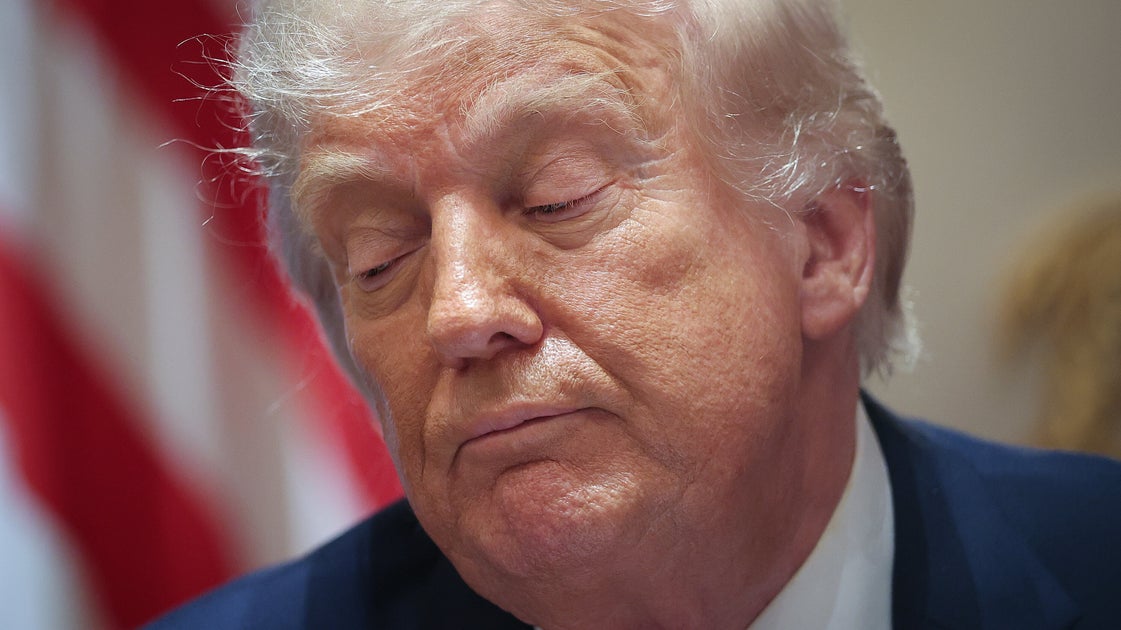

There’s a common refrain from many people lately as President Donald Trump makes decisions that affect the entire country, whether that’s buying Ultimate Fighting Championship stock ahead of a UFC fight hosted at the White House or starting a war in Iran without congressional authorization: “Is anyone going to stop him or do something?”
It can feel unreal that Trump is able to make so many unchecked decisions ― so much so that there’s a name for it: betrayal trauma.
According to Sandra Maurer, a licensed professional clinical counselor in Minnesota, many people filter life through the idea that things should be fair; we also expect situations that are unlawful to be treated as such. “And then we watch somebody … get away with horrible things without any real accountability. That is so hard for us,” Maurer explained.
This kind of emotion can come up over Trump and his decisions, but also when thinking about leaders who are supposed to protect the country from abuse of power.
“Betrayal trauma is a term that psychologists came up with for a particular kind of trauma when you have a reasonable expectation that you can trust someone, so a partner or a doctor or a person in position of authority,” Maurer said.
“Betrayals themselves can be very traumatic because there is a double hurt,” said Manahil Riaz, a psychotherapist in Houston and the owner of Riaz Counseling. We’re hurt not only by the action, but also by the loss of our ability to judge what is safe or not safe, or real or not.
There’s another layer to this, too: “When we think about the Trump administration, it’s not a person, it’s an administration,” Riaz said. “I want to introduce the idea of ‘institutional betrayal’ … harm that’s done in an institutional setting.”
We had a general faith in the institutions of our government, and we’ve watched them really just be hollowed out and fail in ways that I think a lot of us didn’t think could happen.
– Sandra Maurer, licensed professional clinical counselor
In the case of institutional betrayal or institutional trauma, an entity (or, in this case, an administration) fails to acknowledge harm or misconduct within its ranks, Riaz explained. “So, we’ve got harm that’s happening in an institution, and it can mirror the same thing as the betrayal we experience in relationships,” Riaz added.
Maurer noted that, as a society, Americans had some faith in our government institutions and systems.
“No one thought anything was perfect, but we had a general faith in the institutions of our government, and we’ve watched them really just be hollowed out and fail in ways that I think a lot of us didn’t think could happen … and that’s jarring to your psyche,” Maurer said.
This betrayal by Trump and the institutions surrounding him has created distrust in the government, noted Taryn Rothstein, a licensed clinical social worker in New York.

“It makes you feel as though they do not care about you, and that is a betrayal because we vote. That’s what a democracy is supposed to be — we vote, and you’re supposed to represent us and through that action we’re supposed to be counted and cared for and our voices are supposed to matter,” Rothstein said. “It does not feel that way anymore, and I think that’s a huge feeling of betrayal.”

Win McNamee via Getty Images
Betrayal by systems you thought you could trust creates a lack of safety.
Feelings of betrayal exist in people who voted for Trump and those who didn’t vote for him, Rothstein said.
“For people who didn’t vote for him, they’re seeing their rights being taken away, and public services being taken away and vulnerable populations really being politicized,” Rothstein explained. “These policies that are coming out are really making it so people do not feel safe here.”
Lack of safety and betrayal go hand-in-hand, she noted. “When you feel betrayed, you feel unsafe. The emotional impact is really that there is no longer this shared agreement in the populace about what truth is, what accountability is or even the rules themselves, and I think it’s very unsettling psychologically,” Rothstein said.
Those who did vote for Trump yet can now admit his shortcomings may be feeling disappointed by the current chaos and unpredictability or by his policy decisions themselves, which can lead to feelings of betrayal, betrayal trauma and institutional betrayal, Rothstein noted.
Of course, some folks may not be feeling this at all. If they voted for Trump and are happy with the way the world is going, they likely don’t feel betrayed by him or any of the systems in place, Riaz said.
But for Trump supporters who seem totally keen on the president’s decisions, there may be a level of “betrayal blindness,” Riaz added. “In institutional betrayal, we might want to turn a blind eye and say, ‘Oh no, Trump is doing great … he’ll get there, they’ll get there,’ and that itself is called ‘betrayal blindness,’ and that’s more of a survival mechanism where we’re almost in denial about what’s happening.”
So, what do we do about it?
Not everyone will feel this way about the Trump administration or our government, Maurer stressed. For some people, it may be disturbing but not traumatizing, while for others — like those who have been detained by Immigration and Customs Enforcement, lost a job due to unexplained government cuts or dealt with a loved one getting deported — it may be life-altering. That depends on your personal history, she said
If you do feel that you are suffering from betrayal trauma or institutional trauma, Maurer recommended seeking support from a trauma-informed therapist. You can find mental health professionals near you on the Psychology Today database.
“I would say it is important to not gaslight yourself, so connecting with other people, and also reminding yourself, validating for yourself that it makes sense to feel this distressed,” Maurer added.
Community is also important during times like this, according to Rothstein, “because when you feel betrayed, the people in your community are usually not the ones that are actually betraying you.” Lean on your community (especially if you’re in a marginalized group), help your community and do what you can to make little changes in your neighborhood that can, hopefully, ripple into larger changes.
Riaz added that “it’s important to understand and establish safety.” This will look different for everyone, but it could mean having a news-free day, creating boundaries around how much news you consume or restricting how much you doomscroll.