
When I was in the 9th grade, the religion teacher at my Catholic girls school handed out an exercise for us to tackle in small groups.
In this “real-life scenario,” we had to take on the roles of hospital administrators presented with a list of 10 or so patients. Everyone needed a kidney, but we only had three to give out. Our task was to decide, based on brief descriptions of each patient, who would receive a kidney — and who wouldn’t.
Unsurprisingly, given that we were still children ourselves, each of us gave the youngest patient the kidney, reasoning that she had the most life to live. No one argued that the elderly woman should get one. Or the addict — he was definitely out. But among the remaining patients, we couldn’t reach consensus. We just didn’t have enough information to rank the humanity of these strangers. Or maybe we were trying to measure something that simply wasn’t quantifiable.
At the end of the period, the teacher, who later that year would scar us all for life with her slideshow of genital lesions caused by STDs, explained that the “real” hospital administrators, in the end, decided that they could not determine the value of one’s person’s life over another’s, regardless of age or background or circumstance. So, they drew straws to distribute the kidneys. The old woman was selected. She gave up her spot, however, so that a younger person could have hers.
This wasn’t a satisfying solution for me. Those other people still deserved kidneys, and they still went without. How was that OK?
Aside from a few hundred viewings of “Steel Magnolias” — in which no one questions the motivation of a mother donating a kidney to her child — I probably didn’t think about the subject again until I was a senior in college.
Nisha, my best friend and roommate, was in kidney failure. No one knew what caused it. Her kidneys had been losing function for years, and by the time classes began that year, she knew that a transplant was on the horizon. Throughout the months that followed, we alternated gossip and our hot takes on movies and TV shows with discussion of her upcoming surgery.
Sometimes we got on each other’s nerves. I learned to squeeze the toothpaste from the end of the tube, not the middle, as Nisha demonstrated for me, and she learned that if she left a dish in the sink, I would rush to wash it and then make a passive aggressive comment about it later.
We inhabited a strange, liminal space between adolescence and adulthood. On the one hand, there were moments of feeling invincible. I smoked cigarettes and didn’t care what they might be doing to my body. We sat out on fire escapes and ledges, not worrying that we might fall. On the other hand, we could see beyond the innocence of childhood to the terror of the world. We were in New York City on September 11, and climbed onto the roof of our dorm and saw the smoke from all the way downtown. We watched as a president we didn’t vote for waged a deadly war on innocent people.
The cruel randomness of the world was horrifying — and, confusingly, it was sometimes also a little bit exhilarating to glimpse the blank expanse of our futures laid out before us.
Thousands of Afghani children would die that year, but Nisha would not. Her dad was going to give her a kidney. She prepared for surgery. I prepared to tape class lectures for her while she was in the hospital.

One afternoon shortly before the procedure, Nisha’s mom was driving us back into the city after one of our weekends at their New Jersey home. I was sitting in the back seat, looking pensively at the post-industrial scenery, when Nisha, sitting in the passenger seat, asked her mom how long her new kidney would last.
This was a question I had never dared to articulate.
When Nisha’s mother gently explained that a donated kidney wouldn’t last as long as a regular one, and might give her 20 years, Nisha said precisely what I was thinking:

“That’s not long enough. I need more time.”
I pushed back against a wave of panic by telling myself that when the time came, I could give her another kidney. Otherwise, we would find someone else to do it.
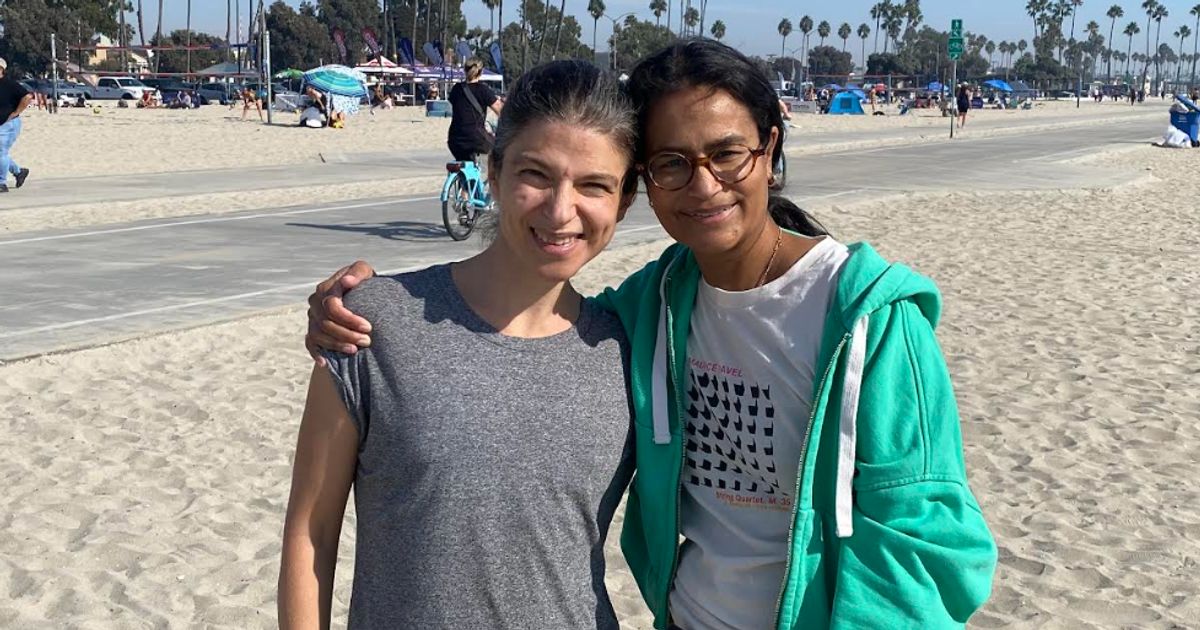
Nisha’s mother’s estimate was generous, given the data available in 2002, but it turned out to be correct. Over the course of the next 20 years, Nisha earned a Ph.D., got married, taught hundreds of students and gave birth to a child. We lived on separate coasts, so she told me over the phone when she started going into kidney failure again. I unearthed the reply that I’d been holding in for 20 years and let her know that this was something I was ready and willing to do.
Figuring out that I was a match was as simple as confirming my blood type. Getting approved to actually go through with the surgery required completing a number of bizarre and challenging quests. I had to collect an entire day’s worth of my own pee and deliver it in an enormous jug to a laboratory. During one appointment, a phlebotomist drew 23 vials of blood from my flimsy, uncooperative vein. I also had to convince a coordinator, multiple doctors, a social worker and a psychiatrist that I was doing all of this willingly and that I understood what the procedure entailed. Each time, I retold the story of the car ride and explained that this was a decision I had made long ago, and from which I had never wavered.
I had to fly from New York to Los Angeles a couple of times to be examined. There was a lot of waiting in different exam rooms. It all felt both vaguely exciting, like being chosen to participate in some kind of bizarre reality show competition, and at the same time incredibly tedious, like standing in a really long, slow-moving line at the post office.
It was a complete thrill, and a total relief, when the hospital committee finally approved me to go through with the surgery. We had to postpone the whole thing once because Nisha got ill, and as the new date approached I felt increasingly anxious that I would stumble into some dumb obstacle and derail everything. When one of my kids came down with a cold, I panicked, but luckily I didn’t get sick.
I arrived in Los Angeles on Oct. 28 and immediately took a COVID test, which was negative. The next day was my 44th birthday, and Nisha made me waffles with whipped cream for brunch. That evening, her husband dropped us off at the hospital’s hotel, where we had been given a three-night stay. There was a gift basket waiting for me: nuts, chocolates, socks, Tylenol, stool softeners and a mug declaring me an “Everyday Hero,” which we thought was funny since a kidney donation is a one-time-only event.
We effortlessly slipped back into roommate mode, showered, got into our pajamas and lay in our separate beds, talking about everything and nothing all at once. I told Nisha how a few months earlier I had to get into my locked apartment by climbing down the fire escape from the floor above. As an adult, I’m strangely afraid of heights, and looking down to the sidewalk, palms sweating and arms trembling, I steeled myself with the thought, You can’t let this kidney go to waste.
Eventually, we let the conversation slide into silence, though I’m not sure either of us actually slept.
Early the next morning, we walked together to the hospital, where Nisha’s parents and her husband met up with us. Before we went into pre-op, Nisha’s mom anointed us both with some holy water she had managed to procure from some distant place. Then we had to swab ourselves head to toe with thick, antibacterial wipes, and clean the insides of our nostrils with iodine swabs. I took out all my earrings and my contact lenses, and then a group of people I’d only met that morning wheeled me into surgery. My last thought was that I wished the sedative they’d given me had packed a bit more of a punch.

Then time collapsed, and when I opened my eyes I saw Nisha’s parents peeking in at me from behind a blue curtain to wave hello. I knew then that everything had gone well. The pain was minor, and after only one dose of something stronger than Tylenol, I spent the next two weeks taking just over-the-counter painkillers.
I’m not a stoic person by any means. I howled in agony through the births of both my children, but the incisions for removing a kidney are relatively small, and I’d rate the whole experience as easy in comparison to labor. Also, afterwards, I got to sleep and watch TV, instead of being charged with keeping a shrieking, ravenous infant alive.
I was discharged the following day, and the next morning our friend Amanda, who had lived one floor above us in college, arrived to keep me company while I recuperated in Nisha’s parents’ apartment. I was uncomfortable for a couple of days because of the air they’d pumped into me to make space to remove the kidney. It felt a little bit like being stuffed full of balloon animals. I had to sleep propped up on pillows, but quickly got more mobile as the days went by.
Then Nisha was discharged, too, and we all fell into the old rhythm of our college days, sharing meals and watching TV and chatting. It felt like taking a vacation back to our youth.
Six days later came the presidential election. I’d mailed in my absentee ballot weeks earlier, but since I was on leave from work, I had nothing to do other than read the news and wring my hands all day. That evening, as the results started coming in, we ate a quiet dinner together, subdued by a feeling of foreboding.
I went to bed early, hanging on to a small shred of hope.
I spent the next day scrolling through the news, trying to make sense of how this had happened to our country — again. It was disorienting to go from the joy of the surgery’s success to staring down the dark tunnel of our next four years. I struggled to untangle the temporal proximity of these two events. How could humans who dedicate themselves to saving lives and Donald Trump exist on the same plane of reality? Were we, as a species, sacred or doomed? How could both things be true?
Nisha and Amanda and I talked some about the election, but also about other — happier — things, like where Nisha and her family would go on their next vacation. We watched wonderfully ridiculous reality TV shows and ate delicious food that people brought us, because everybody wanted to help in some way.

On my last evening in LA, I sat outside and watched Nisha’s 7-year-old son playing in a very kid-specific goofy manner with random objects in the driveway, and it occurred to me that people would say I had done this for him — so that he could have more years with his mother in good health.
While this isn’t untrue, neither is it the whole truth. I did this for Nisha — because I love her, and for everyone else who loves her, too. I would’ve also done it if she didn’t have a child, and she didn’t need to earn my kidney by being a good person (although she is).
I gave my kidney in order to fulfill a promise to my 21-year-old self, the one who’s still sitting in the backseat of that car, looking out at the bleak landscape and wondering if there might be some broken piece of the world that she could help heal.
I did this not only for Nisha’s son but my own children, to show them one thing that a person can do in the face of something awful. We can’t set right all of life’s injustices — but sometimes we have the power to overturn one bad thing. And when the opportunity arises, it’s worth taking the time to savor it.
Marie Holmes is the former parenting reporter at HuffPost. Her work has appeared in Scary Mommy, Good Housekeeping, Cosmopolitan, The Washington Post and other publications. She lives with her wife and their two children in New York City.
Go Ad-Free — And Protect The Free Press
Already contributed? Log in to hide these messages.
Do you have a compelling personal story you’d like to see published on HuffPost? Find out what we’re looking for here and send us a pitch at [email protected].