
Television commercial breaks are the bane of every N.F.L. fan. They interrupt a game already riddled with stoppages, bombard viewers with come-ons and force fans and players in the stadium to stand around for about two and a half minutes, sometimes in the freezing cold.
Yet commercials are the lifeblood of the N.F.L. Without them, broadcasters could not afford to pay the league billions of dollars for rights fees, money that goes to paying players’ salaries and much more.
Most games have 18 commercial breaks. A few timeouts, like at the end of the first and third quarters and at the two-minute warnings, are fixed. The league and networks avoid taking breaks if a team’s opening drive of the game ends quickly, because they want fans to settle into the broadcast. If all goes well, the last commercials run at the two-minute warning in the fourth quarter.
Most commercial breaks, though, are chosen in real time as league executives, network producers and officials on the field look for natural breaks in the action. Finding them is more art than science because every game unfolds differently, with long drives, three-and-outs, injury timeouts and coaches’ challenges.
“Our fans know that the commercial breaks are coming,” said Mike North, vice president of broadcast planning and scheduling at the N.F.L. “The whole idea from where we sit is to try to use those breaks to cover downtime: resetting the field after a score; if there happens to be an injury, hopefully a minor one; or an instant replay review when the referee goes to the sideline.”
Their decisions will be seen on Sunday by more than 100 million viewers watching the Super Bowl and, advertisers hope, the 30-second commercials, some of which cost more than $8 million. The ads are so valuable that networks — Fox this year — add two extra breaks during the game, bringing the total to 20.
The league, networks and officials on the field call a minimum of four commercial breaks a quarter, but they try to balance between taking too many breaks that interrupt the flow of the game and waiting too long and risk having to cram in breaks as the game clock ticks down.
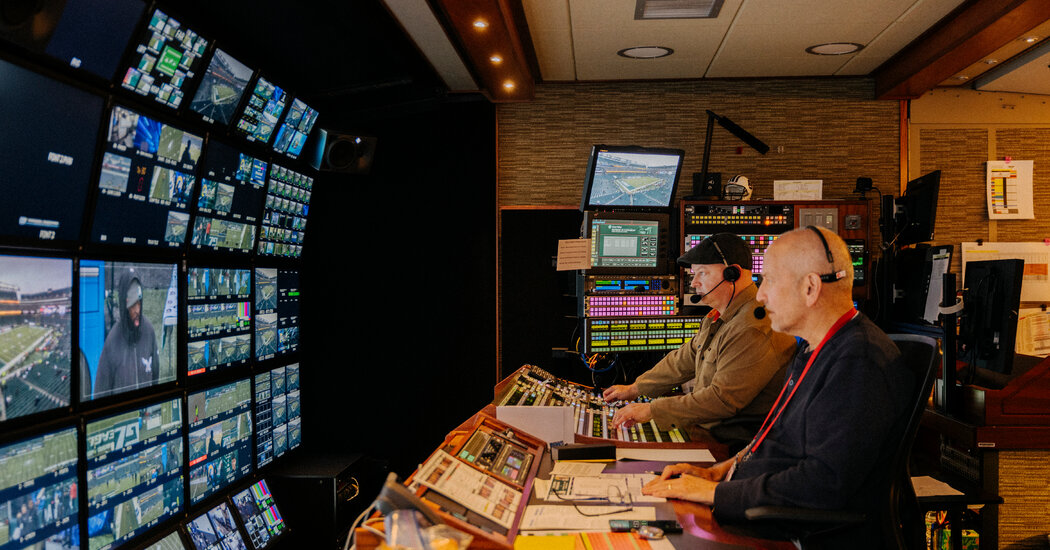
The logistics of determining when to call television timeouts require an intricate phone tree over a three-hour game. The referee, who controls when a game starts and stops and can overrule a request for a break, communicates with the back judge, who is in constant contact with two sideline officials standing near the 20-yard line. One of them wears a green hat and represents the league. The other has on orange gloves and works for the network.
They speak with Mr. North and other league officials in the press box and producers in the production truck outside the stadium. Sometimes, the decision to go to commercial is obvious, like after a score. At other times, the league and network take a break after an injury or a coach’s challenge. The official wearing the orange gloves will cross his arms in an “X” to signal that the network wants to go to break. The referee will then blow the whistle and stretch his arms out to form a T, meaning play is stopped for about 2 minutes and 20 seconds.
Sometimes, the green hat official will hold up a sign with “:30” printed on it to indicate that the network wants to take a 30-second timeout, not a full 2:20 break. When breaks end, the referee twirls his arm above his head three times, and the game clock restarts. If a team calls a timeout but the network does not want to go to commercial break, the official with the orange gloves will spin his arm in a circle above his head.
Some commercial timeouts are based on hunches. Early in the divisional round playoff game between the Los Angeles Rams and the Philadelphia Eagles, the Rams’ coach, Sean McVay, challenged a call of an incomplete pass on third down. The officials ruled that the receiver had dropped the ball, but the replays were inconclusive, so Mr. North and NBC went to commercial because they bet the review would not be quick. When the break ended, the call was overturned and the Rams’ drive continued. Mr. North felt good they could use a break seamlessly.
“As a producer, one of your No. 1 responsibilities is to create the best flow possible for the viewer at home,” said Fred Gaudelli, a longtime producer of prime-time N.F.L. games at ABC, ESPN and NBC. “I produced games for 35 years, and I never did a game when all commercials didn’t get in. They’re going to get in. So don’t sweat it. Let’s do what’s best for the viewer.”
Once or twice a season, a referee will restart the game during a break, forcing the network to cut away from the commercials. If networks are unable to play every commercial, they will make it up to an advertiser later in the season. There is no such option with the Super Bowl, because it is the final game of the year.
For decades, networks took timeouts whenever they wanted. But since the late 1990s, the N.F.L. has regulated their length, frequency and placement. The N.F.L. standardized breaks to include four 30-second commercials and 10 or so seconds for networks to run promotions for other shows or for the announcers to discuss elements of the game.

In 2016, to address complaints from viewers — including Commissioner Roger Goodell, who watches games closely — the league undertook a comprehensive look at how commercial breaks affected the experience of viewers and players and fans in the stadium.
It found that the need to cram in 20 or 22 breaks per game led to unnatural stoppages. For instance, networks routinely took commercial breaks after an extra point, returned to the stadium for the kickoff and then went back to commercial. If there was a punt with a few seconds left in the first quarter, the league determined there was no need to take a commercial at the change of possession because there is always a break at the end of the quarter.
So in 2017, the N.F.L. cut one of the five in-game breaks taken each quarter, but increased the length of breaks to 2 minutes 20 seconds.
“These changes are meant to give you more of what you want: a competitive game with fewer interruptions and distractions from the action,” Mr. Goodell wrote in a letter to fans explaining the moves.
Fewer breaks, it turned out, increased attention on commercials. Networks also introduced “double boxes” that show an advertisement on one side and a shot of the stadium in the other box. The league tried to improve the flow of the game by, among other things, not going to break during late comebacks and game-winning drives and allowing referees to review calls on a tablet as opposed to large screens on the sideline.
When a full break feels too disruptive, networks may introduce an analyst to discuss a controversial call or a sideline reporter to provide updates on a player’s injuries.
“You’re sort of using natural downtime anyway, so people are never standing around with ‘Why aren’t we playing?’” said Hans Schroeder, the executive vice president of media distribution at the league. “That’s great for people in the stadium and it’s great for people watching at home.”