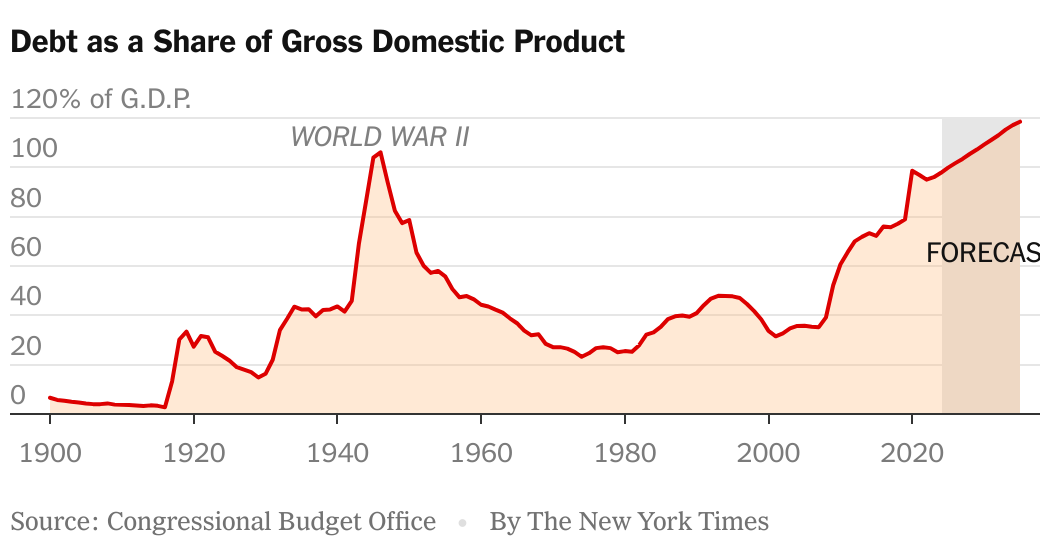

The 119th Congress began, as it so often has in recent years, with calls from Republican politicians for wrestling down the national debt, which is near a record level relative to the size of the economy.
But this time, the G.O.P. had company: Progressive economists and budget wonks, who have often dismissed finger-wagging about debt levels as a pretext for slashing spending on programs for the poor, are starting to ring alarm bells as well.
What’s changed? In large part, long-term interest rates look unlikely to recede as quickly as had been hoped, forcing the federal government to make larger interest payments. And the Trump administration has promised to extend and expand its 2017 tax cuts, which will cost trillions if not matched by spending reductions.
“I find it easier to stay calm about this threat when I think the interest rate is low and steady, and I think in the past year or so that steadiness has been dented,” said Jared Bernstein, who led the Council of Economic Advisers in the Biden administration. “If one party refuses to raise revenues, and the Democrats go along more than is fiscally healthy, that’s also a big part of the problem.”
To be clear, conservative warnings on the debt have generally been met with little action over the past two decades. A paper by two political scientists and an economist recently concluded that after at least trying to constrain borrowing in the 1980s and 1990s, Republicans have “given up the pretense” of meaningful deficit reduction. Democrats and Republicans alike tend to express more concerns about fiscal responsibility when their party is out of power.
Historically, the stock of debt as a share of the economy has risen sharply during wars and recessions. It peaked during World War II. In the 21st century, Congress has not managed to bring the debt back down during times of peace and economic growth.
Deficit-financed tax cuts under President George W. Bush decreased revenues by trillions of dollars and were only partly repealed under President Barack Obama, who also oversaw hundreds of billions in stimulus spending after the financial crisis. Major benefit expansions like Medicare Part D, which funded more prescription drugs for seniors, added to entitlement spending.
At the same time, the issue of debt had receded in the public consciousness, according to polling by Gallup. And in the depths of the Covid-19 crisis, members of both parties agreed: Debt was a far-off concern relative to rescuing the American economy.
Prominent economists were sanguine about it as well, writing about how previous worries were overblown, at least in the United States. Low interest rates meant that the federal government could spend more than it took in indefinitely, with little economic cost — especially compared with austerity budgets after the Great Recession that forced painful cuts in government services and investment. Across the first Trump administration and the Biden administration, Congress provided $4.6 trillion to keep businesses and consumers afloat through the pandemic.
“When this recession hit, there was kind of a bipartisan consensus that we had to do a lot to make sure we got back to full employment quickly, and we did, which is quite a large win,” said Michael Madowitz, principal economist at the Roosevelt Institute, a left-leaning think tank.
But now, with the debt having tripled as a share of economic output over the past 25 years and interest rates on the 10-year Treasury yield at 4.5 percent, there’s not much “fiscal space” — a nebulous term that basically equates to Washington’s willingness to spend money without courting disaster — in the event of another downturn.
“Everybody wants to make sure that we can re-enact this recovery the next time we have a recession,” Mr. Madowitz said. “We don’t want to be in a position where we are too worried about fiscal space and don’t do enough again.”
But wait a minute — what exactly is the bad outcome that policymakers fear could result from the federal debt burden?
One version of the concern is that as the government borrows more and more, it may need to offer a higher rate of return on Treasury bonds. If investors would prefer to lend to the government than lend to companies, that could undermine growth.

Over the past year, there are signs of that. It shows up in the rising “term premium” — the extra bit of interest that investors demand to buy long-dated public debt. It’s not clear why it’s rising, or that it’s sucking up private investment at the moment. If it were, it could be hard to spot definitively.
But the main concern, says Danny Yagan, an economist at the University of California, Berkeley, is a tipping point that forces a sudden and catastrophic adjustment.
He cites a 1998 paper that likened the deficit not to a long term drag on growth — such as a termite infestation that gradually erodes the foundations of a house — but rather to a risky gamble, like not buying home insurance. If the fiscal house catches fire, perhaps because investors lose confidence in the government’s ability to pay back its debt, the options are not good: They include defaulting, forcing banks to hold more Treasuries, running inflation high so the debt recedes, or cramming down spending, all of which could cause a recession.
The reason that gamble looks increasingly risky is that large deficits could be starting to push up interest rates (“r” in economics lingo) while growth (“g”) remains steady. The Congressional Budget Office forecasts that debt will continue to increase, which forces higher interest payments, creating an upward spiral.
“Under C.B.O.’s projections, that’s going to slowly increase r relative to g until about 2040, when r is greater than g, and then debt starts to explode on its own,” said Dr. Yagan, who served in the Biden administration’s Office of Management and Budget and co-founded the Budget Lab at Yale. “That’s what people are worried about.”
While concern about the debt is now widespread, prescriptions for dealing with it differ radically. Republicans have come up with a long list of potential spending reductions, including cuts to Medicaid, the health insurance program for the poor. Progressives like Senator Elizabeth Warren of Massachusetts have proposed some targets for savings, such as defense contracting and the prices that Medicare pays for prescription drugs.
But mostly, Democrats say, the government simply needs more revenue to support the increasing number of people who are becoming eligible for retirement benefits. That category — known as mandatory spending because it is authorized by law and not subject to congressional appropriation — makes up nearly two-thirds of outlays, and is responsible for most of the increases. Discretionary spending, which includes defense and all other functions of government, has been fairly flat as a share of economic output.
“When people conjure this image of spending getting out of control, what I would say is, it’s not really profligate spending, it’s that it costs more to do the same,” said Bobby Kogan, senior director of federal budget policy at the Center for American Progress.
If the tax cuts passed in the 2017 Tax Cuts and Jobs Act currently scheduled to expire were extended, the Congressional Budget Office calculates, total deficits would grow by $3.7 trillion over the next 10 years.
“We used to have a system where yes, these things were going to get more expensive, but we had a tax system that was going to keep up with them,” Mr. Kogan said. “Then we cut taxes and now we no longer have a system that keeps up with them.”