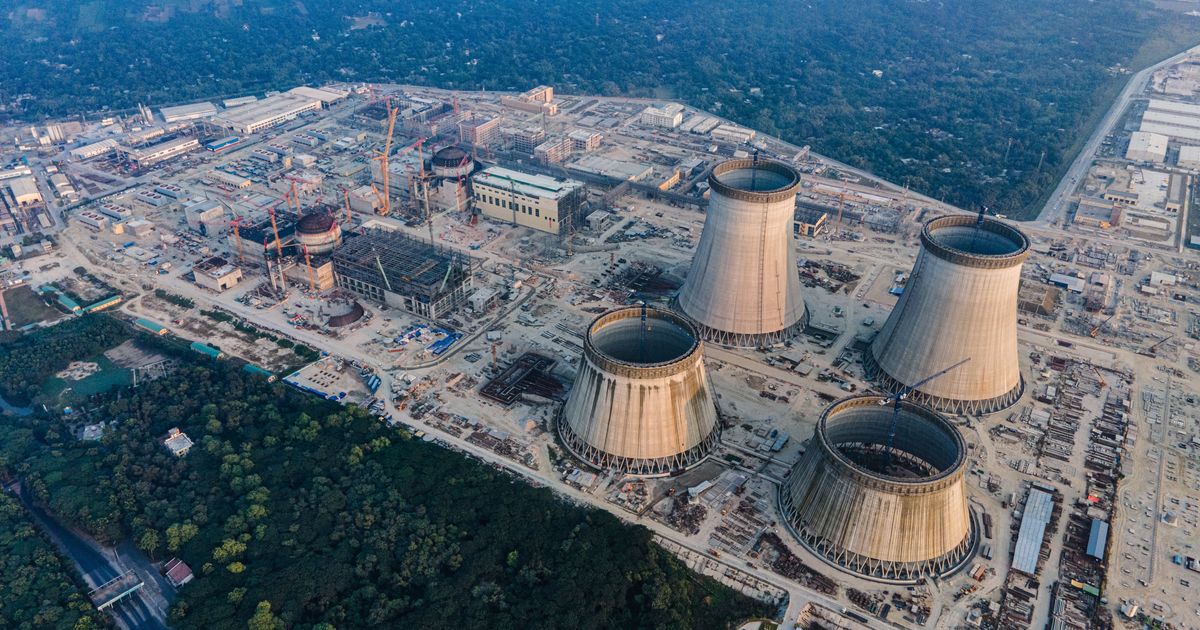

Nuclear plants are cheap to operate, last decades longer than other power sources, and generate unrivaled volumes of zero-carbon electricity rain or shine on relatively tiny slivers of land. Yet despite growing demand, few investors are willing to take a risk on new atomic energy stations as they’re expensive and difficult to build. The United States hasn’t built more than two from scratch in decades, and similar projects in Europe have gone billions of dollars over budget and taken years to complete.
Of the nearly five dozen reactors under construction worldwide, the majority are funded by the Chinese or Russian governments, with the Kremlin financing virtually every debut project underway in countries like Bangladesh, Egypt and Turkey. Unlike buying Russian gas or Chinese-made solar panels, a nuclear power station is not a one-off purchase. Given the maintenance and fuel these plants require, the relationships forged between the buyer and the authoritarian exporter are expected to last as long as a century between construction, a typical lifetime of operation and final decommissioning.
A new campaign launched this week aims to rally support behind a potential alternative, HuffPost has learned: a global bank backed by the world’s biggest nuclear-powered democracies and dedicated to building nuclear power plants around the world.
The idea for the International Bank for Nuclear Infrastructure has been circulating for a few years. But a global team of 15 lawyers, financiers and regulatory experts officially incorporated a new Washington, D.C.-headquartered nonprofit in hopes of persuading Congress to put up to $7 billion toward getting the new lender off the ground. It’s the first of what the organization envisions as a globe-spanning network of nonprofits promoting IBNI.

MD MARUF HASSAN via Getty Images
With a goal of raising an initial $25 billion to start the bank, IBNI would ― at least for now ― cut out Russia and China in favor of establishing a new multilateral institution akin to the World Bank or the International Monetary Fund with atomic allies such as Canada, France, the United Kingdom, Japan, South Korea and the United Arab Emirates. IBNI could then provide financing for projects in would-be newcomer nations like Ghana, Indonesia or the Philippines, reducing the risk for other lenders and lowering the cost of choosing American, European or South Korean technology over cheaper Russian exports.
“It will be a playing field leveler in the international competition for nuclear technology,” said Daniel Dean, the Vienna-based American investment banker who serves as the new nonprofit’s chief executive. “This bank will enable these countries and stakeholders to select technology independent of which country is providing a full financing package.”
Dean stressed that IBNI is “geopolitically neutral,” and said that while present global tensions make forming a new group with Russia and China untenable, the organization would not be fundamentally designed to exclude anyone.
While cost estimates vary, the price of Russian reactors is typically less than half of what nuclear plants built by Americans or Europeans cost, and about 40% cheaper than those constructed by South Korea, currently the leading atomic exporter in the democratic world.
China, which is building more reactors at home than any other country, is developing novel reactor designs and is widely expected to begin exporting its technology in the next decade. In the meantime, Russia is the main game in town. The state-owned Rosatom offers a one-stop-shop for technology, construction, maintenance, fuel and financing, making Moscow the vendor of choice for most countries building their first nuclear power stations.
The U.S., by contrast, struggled until earlier this year to complete the only two new American reactors started this century, and ― with a notable exception ― depends on a privatized network of companies to build, run, fuel and finance its own atomic fleet.
In practice, that model has yielded limited progress in recent years. Centrus Energy, the U.S. uranium enricher spun out from federal government ownership in the late 1990s, last year started fabricating a special type of nuclear fuel over which Russia has a monopoly, but still can’t produce enough to keep the American fleet going and needed a special exemption to continue importing Russian fuel. Terra Power, the Bill Gates-backed developer of next-generation reactors, broke ground just last month on what could be the first of a new kind of technology anywhere in the democratic world, the likes of which China not only completed but hooked up to its grid last December.
The federally owned Export-Import Bank of the U.S. has put up $3 billion to fund construction of Poland’s first nuclear power plant with American reactors, a project Warsaw has pitched as a strategy to cement its alliance with Washington. Even there, however, Poland wanted U.S. companies to buy equity stakes in the station to help make the project look less risky — a demand at which American firms have so far balked.
“The traditional financing mechanisms are not even close to ready to help support nuclear,” said Todd Moss, a former assistant U.S. Secretary of State who now runs the think tank Energy for Growth Hub, which researches ways to build climate-resilient energy systems in developing countries. “Something like IBNI is an obvious solution to fill that financing gap.”

The picture hasn’t been much rosier in Europe, where flagship French and British plans for new reactors at home and elsewhere on the continent have cost billions more than initially planned and taken years longer. South Korea, which generates much of its electricity from atomic fission, has fared better, successfully building the United Arab Emirates’ first nuclear plant last year and winning a $17 billion contract last month to construct a new plant in Czechia. But the previous government in Seoul tried to destroy the domestic nuclear industry, and a country the size of South Korea can only do so much overseas to meet the goal the Biden administration set at last year’s United Nations climate summit to triple global atomic energy output by 2050.

Other international lenders could help close the financing gap on nuclear reactors. The World Bank, for example, has refused to fund nuclear projects since a single investment in Italy’s now-defunct atomic sector in 1959. Pressure is now mounting on the World Bank to lift its ban on nuclear plants. In February, the U.S. House of Representatives proposed legislation earlier this year to push the World Bank and other regional lenders to commit as much as $100 billion in annual financing for nuclear projects.
Of the 189 countries that act as shareholders in the World Bank, just eight openly oppose nuclear power ― including Germany, Austria and Luxembourg ― with another 100 either operating reactors or publicly supporting the technology.
“It’s a tyranny of the anti-nuclear minority,” Moss said. “The World Bank is one of the most important financiers of infrastructure, but it’s probably the most important adviser to their borrowing countries on a whole set of infrastructure-planning issues.”
Right now, countries like the Philippines or Ghana are making decisions about their future energy mix, weighing whether nuclear makes sense, and what types of nuclear facilities make sense and where, he said.
“The World Bank is completely absent from those conversations, where the World Bank is involved in every nook and cranny of what these governments are doing,” Moss said. “That strikes me as willful ignorance. It’s not doing the World Bank or their borrowing clients any good by acting ignorant.”
As a first step, he said, the World Bank should hire internal experts to help consult its borrowers on nuclear power.
That may do little to dampen demand for another lender like IBNI.
The trouble is that some Western lending institutions, including the World Bank, are designed to fund projects primarily in developing countries, meaning that nuclear projects in North America, Europe or East Asia might not qualify for financing.
“Even if the World Bank changes its policy tomorrow, you’re going to be competing against a lot of other projects that are easier to finance,” said Elina Teplinsky, an attorney at the Washington, D.C.-based law firm Pillsbury Winthrop Shaw Pittman who handles international nuclear deals and is working on the side to launch IBNI. “If you have a choice between financing wind and solar or financing nuclear, even if your politics are for financing nuclear, you’re going to go with financing new wind and solar.”
“IBNI’s entire focus would be to scale nuclear, so it would be able to come in upfront and … move on lots of different projects, with the idea that the entire purpose of this financing is to scale hundreds of gigawatts of nuclear power.”
– Elina Teplinsky, nuclear lawyer at Pillsbury Winthrop Shaw Pittman
By targeting IBNI specifically at nuclear projects, the bank would be prepared to deal with issues and timelines specific to fission energy.
“IBNI’s entire focus would be to scale nuclear, so it would be able to come in upfront and would be able to move on lots of different projects,” Teplinsky said, “with the idea that the entire purpose of this financing is to scale hundreds of gigawatts of nuclear power instead of looking at projects just on a case by case basis.”
IBNI would also help set international financing standards for rating the value of nuclear investments, Dean said, helping to open more funding from so-called ESG investors concerned over the environmental and social impact of dealmaking.
If IBNI already existed, convincing Congress to give it more money might not be such a tall task. But critics of the proposal say it’s hard enough to get political support for funding entirely U.S.-owned institutions like the Ex-Im Bank that are dedicated to financing projects for American exports overseas. For much of the past decade, conservative think tanks and pundits have argued in favor of defunding the Ex-Im Bank entirely, and experts expect the fight to begin anew next year when Congress begins debating reauthorizing the bank before its charter runs out at the end of 2026.
Putting up more funding for a new institution that might end up financing French or South Korean technology on projects where a U.S. company loses the bid would be a tough sell in Washington, according to a high-ranking source involved in reauthorizing the Ex-Im Bank who requested anonymity to speak candidly on a sensitive topic. The source worried IBNI might be an “unnecessary distraction” from more realistic goals, like reforming the World Bank.
But Dean said his meetings with officials from the Ex-Im Bank, the U.S. Treasury and Congress have so far been positive, and noted the support for nuclear energy across the American political spectrum. Discussions with lawmakers and counterpart agencies in Canada, Europe and Asia went similarly well, he said.
The next step, he said, will be promoting IBNI in November at the back-to-back United Nations climate summit in Azerbaijan and the G20 conference in Brazil.
“The simple answer is that IBNI is the best use of every dollar of public money that can be devoted to scaling nuclear,” he said. “We don’t want to compete with what the U.S. Ex-Im Bank is doing, what the Canadians are doing, what the French are doing … At the end of the day, for every dollar of tax money that’s provided by these countries, IBNI will provide the most bang for the buck.”