
One of the messages that helped propel the far-right National Rally to the brink of power in France’s parliamentary elections on Sunday — a once-unthinkable shift — is a common refrain in U.S. politics: It’s the economy, stupid.
Both the National Rally and a coalition of left-wing parties called New Popular Front won large gains in part by tapping into anger over a cost-of-living crisis and a sense that President Emmanuel Macron had grown out of touch and did not understand their struggles. Voting happens in two rounds, and candidates who reached certain thresholds will move on to the next round on Sunday.
A two-year streak of high inflation has left low- and middle-income French families grappling to pay for basics like energy, gas and food, while wages, in some cases, have failed to keep pace. Polls show that worries over “purchasing power” were a top concern of voters, alongside immigration and security. Blue-collar workers turned out in droves to vote for the National Rally, which is promising to aid households and curb immigration. The New Popular Front came in second with promises to raise wages and lower the retirement age.
Left unclear is how each party will pay for the pledges. Economists say many of the funding proposals are not credible, raising risks for a heavily indebted France. But the final results are hard to predict: If France winds up with a hung Parliament in next Sunday’s vote, legislative gridlock could also spook investors.
What are the National Rally’s economic plans?
As part of a “France first” economic policy, the National Rally would reserve first dibs for certain jobs and social benefits for French citizens. In a bow to the working classes, people who started working before age 20 could retire at 60 instead of the country’s official retirement age of 64. Pensions would be indexed to inflation. But making such changes would require amending the Constitution.
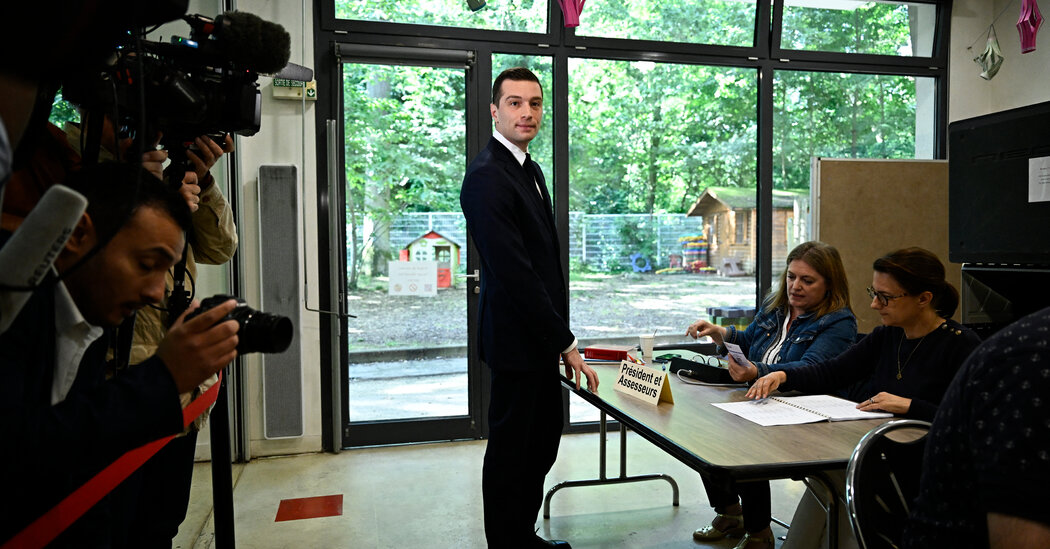
By putting pocketbook issues out front, Jordan Bardella, the party’s president and a protégé of Marine Le Pen, sought to normalize his party’s long-taboo brand of nationalist and anti-immigrant politics. But the heart of his platform links immigration to economic uncertainty.
“He talks about improving purchasing power for the French,” said Lisa Thomas-Darbois, deputy head of research at the Institut Montaigne, an economic think tank in Paris. “In reality, the party’s promises of prosperity are based on fighting immigration, linking immigration to jobs and crime, and expelling illegals.”
One of Mr. Bardella’s biggest draws is a pledge to put more money into voters’ pockets by cutting taxes on electricity, energy and gas to 5 percent from 20 percent. Vowing to be the “prime minister of purchasing power,” he would encourage businesses to raise wages 10 percent for people earning less than 5,000 euros a month (about $5,350) with no additional tax for employers.
He blamed Mr. Macron in a victory speech Sunday night for high inflation and a ballooning national debt and deficit — a legacy of Mr. Macron’s efforts to stabilize the economy during pandemic lockdowns and an energy crisis. Saying he would be fiscally responsible, Mr. Bardella vowed to “restore order” to France’s finances. (The European Union recently reprimanded France for breaching the bloc’s fiscal rules.)
How would the party pay for its program?
The National Rally’s platform is short on actual budget figures, but Mr. Bardella has said he can save billions of euros annually by reducing immigration and cutting welfare payments for foreign nationals. Part of those savings involve denying access to free medical treatment for undocumented people, except during emergencies.
Mr. Bardella would also cut €2 billion from France’s annual payments to the European Union — a requirement for countries that are members of the bloc. He said he could save at least €65 billion more by fighting tax evasion and welfare fraud — and would order an audit of France’s finances to find billions of additional euros in “unnecessary” spending that could be redirected to improve the lot of middle- and low-income earners.
Is it realistic?
Not necessarily. Those pledges would cost nearly €38 billion a year, an assessment by the Institut Montaigne showed. Barring immigrants from health care, for instance, would save just €700 million a year, but slashing energy taxes would cost more than €11 billion, while indexing pensions to inflation would cost €27 billion.
In recent days, Mr. Bardella has backpedaled on some of the most costly ideas — like eliminating income taxes for workers under 30 — after some estimates put the cost of the National Rally’s whole program at close to €100 billion.
He also swung closer to Mr. Macron’s economic platform in a bid to capture centrist voters, vowing to make France, already Europe’s biggest nuclear energy provider, a “paradise” for nuclear power. He pledged lower production taxes for the industry and said he would review the mandate of the European Central Bank to focus it on employment rather than inflation.

How different is the New Popular Front’s economic plan?
The left-wing coalition is pushing a heavy tax-the-rich and spread-the-wealth agenda inspired by the far-left France Unbowed party. By unleashing a Keynesian spending program and increasing wages, the thinking goes, the government can get consumers to start spending more and lift the overall economy.
The key plank consists of raising the monthly after-tax minimum wage to €1,600 from €1,398. The New Popular Front would also freeze prices for food, energy and fuel. The state would pay households all costs associated with their children’s education, including meals at cafeterias, transportation and extracurricular activities.
France’s official retirement age, which Mr. Macron raised by decree last year to 64, setting off nationwide protests, would be lowered to 60. On immigration, undocumented workers would be granted legal status under certain conditions in sectors with labor shortages.
How would the party pay for it all?
The program would cost an estimated €125 billion to €187 billion annually, and the New Popular Front said it could come up with €150 billion by taxing wealthy individuals.
That includes bringing back a wealth tax that Mr. Macron had abolished, increasing the inheritance tax and putting an exit tax on wealthy people who move their tax residence abroad. The party would create 14 new tax brackets, with income above a certain level taxed at higher rates, with the highest being 90 percent.
French companies would also see a new tax imposed on above-average profits, while a variety of tax breaks and credits for businesses would be scrapped.
Is it realistic?
Some say the program is outlandishly expensive and risks driving French finances beyond the brink, spooking international investors who recently pushed up France’s borrowing costs — not to mention multinational companies that had been attracted by Mr. Macron’s pro-business policies.
“The financial situation of France is already a disaster,” said Nicole Bacharan, a political scientist who teaches at Sciences Po University in Paris. “This will make things worse.”
Others, including the French economist Thomas Piketty, said the need for investment in health care, training, research and infrastructure would require major resources. “And that means taxing the richest,” he said in an interview with the newspaper La Tribune.
When energy prices shot up after Russia’s invasion of Ukraine, Mr. Macron’s government worked to cap electricity bills and rising food prices by negotiating with producers.
“But people feel that prices remained high anyway, so he didn’t get much credit,” said Eric Heyer, chief economist of the French Economic Observatory.
On the campaign trail, Mr. Macron’s prime minister, Gabriel Attal, is pledging to again help with the cost of living, but is mostly sticking with fiscal conservatism and promises to not raise taxes.
The party would reduce electricity bills by 15 percent starting in February, expand a so-called Macron bonus that encourages businesses to pay workers up to €10,000 a year without additional employer taxes and increase social benefits for the poorest households by around €5 billion a year.
How would his Renaissance party pay for its program?
Of all the parties, it has the lowest cost, around €17.6 billion per year, according to Institut Montaigne estimates. Before the snap elections, the government was looking to slash spending by up to €20 billion to curb the debt and deficit. So keeping new spending low remains a priority.
What happens next?
If Mr. Bardella’s party gains enough seats in Parliament, he could become prime minister, name cabinet members and derail much of Mr. Macron’s domestic agenda. But if France winds up with a hung Parliament in which neither the far right nor the united left has a majority, creating legislative gridlock, economists warn that there could be a debt crisis if a paralyzed government cannot rein in France’s finances.