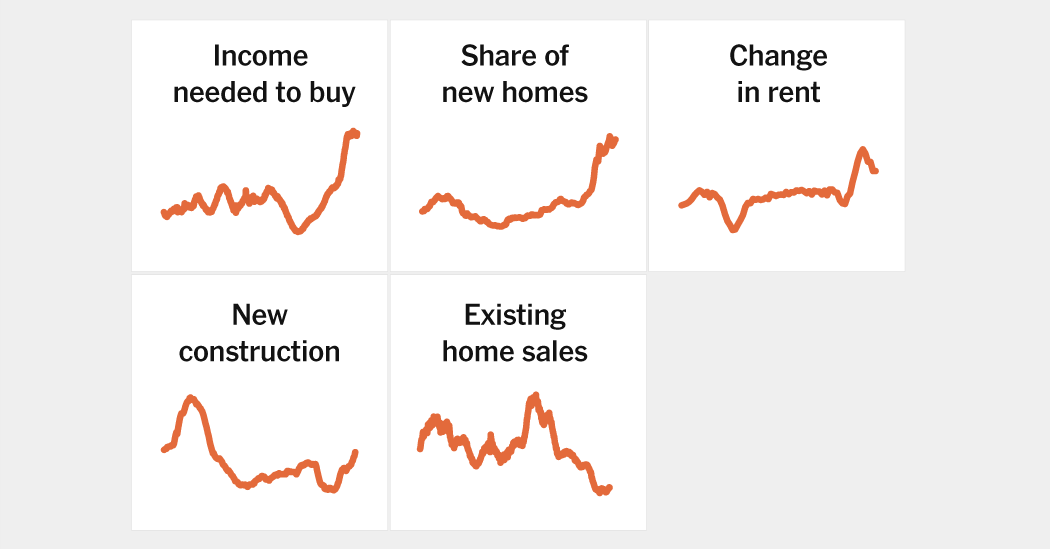

Home prices have held up better than expected amid high interest rates. But that doesn’t mean the housing market is healthy.
When the Federal Reserve began raising interest rates in 2022, most economists thought the housing market would be the first to suffer the consequences: Higher borrowing costs would make it more expensive to buy and to build, leading to reduced demand, less construction and lower prices.
They were right — at first. Construction slowed, but then picked up. Prices hiccuped, then resumed their upward march. Higher rates made homes harder to afford, but Americans still wanted to buy them.
The result is a housing market that is different, and stranger, than the one described in economics textbooks. Parts have proved surprisingly resilient. Other parts have seized up almost completely. And some seem perched on a precipice, at risk of tumbling if rates stay high too long or the economy weakens unexpectedly.
It is also a market of stark divides. People who locked in low rates before 2022 have, in most cases, had their home values soar but have been insulated from higher borrowing costs. Those who didn’t already own, on the other hand, have often had to choose between unaffordable rents and unaffordable home prices.
But the situation is nuanced. Homeowners in some parts of the country face skyrocketing insurance costs. Rents in some cities have moderated. Builders are finding ways to make new homes affordable for first-time buyers.
No one indicator tells the full story. Rather, economists and industry experts say understanding the housing market requires looking at an array of data shedding light on different pieces of the puzzle.
1. It’s hard to find a home to buy.
The rapid rise in interest rates pushed down demand for housing, by making it more expensive to borrow. But it also led to a big drop in supply: Many owners are holding onto their homes longer than they would otherwise because selling would mean giving up their ultralow interest rates.
This “rate lock” phenomenon has contributed to a severe shortage of homes for sale. It isn’t the only factor: Home building lagged for years before the pandemic, and retired baby boomers have been choosing to stay in their homes rather than moving to retirement communities or downsizing to condominiums as many housing experts had expected.
Many economists argue that the lack of supply has helped keep prices high, particularly in some markets, although they disagree about the magnitude of the effect. What is certain is that for anyone hoping to buy, finding a home has been extremely difficult.
2. Homes are unaffordable.
Home prices, already high, soared during the pandemic, rising more than 40 percent nationally from the end of 2019 to mid-2021, according to the S&P CoreLogic Case-Shiller price index. They’ve risen more slowly since then, but they haven’t fallen as many economists expected when the Fed started raising interest rates.
Rising interest rates have put those prices even further out of reach for many buyers. Someone buying a $300,000 house with a 10 percent down payment could expect to pay about $1,100 a month on a mortgage in late 2021, when interest rates on a 30-year, fixed-rate loan were about 3 percent. Today, with rates at about 7 percent, that same house would cost about $1,800 a month, an increase of about 60 percent in monthly costs. (That doesn’t even take into account the rising cost of insurance or other expenses.)
Economists have different ways of measuring affordability, but they all show pretty much the same thing: Buying a house, particularly for first-time buyers, is further out of reach than at any point in decades, or maybe ever. One index, from Zillow, shows that the typical household buying the median home with 10 percent down could expect to spend more than 40 percent of their income on housing costs, well above the 30 percent that financial experts recommend. And in many cities, such as Denver, Austin and Nashville — never mind longtime outliers like New York and San Francisco — the numbers are much worse.
3. New homes are filling (some of) the gap.

Perhaps the most surprising development in the housing market over the past two years has been the resilience of new-home sales.
Developers typically struggle when interest rates rise, because high borrowing costs drive away buyers while also making it more expensive to build.
But this time around, with so few existing homes available for sale, many buyers have been turning to new construction. At the same time, many big builders were able to borrow when interest rates were low, and have been able to use that financial firepower to “buy down” interest rates for customers — making their homes more affordable without needing to cut prices.
As a result, sales of new homes have held relatively steady even as sales of existing homes have plummeted. Developers have especially sought to cater to first-time buyers by building smaller homes, a segment of the market they all but ignored for years.
It isn’t clear how long the trend can continue, however. Many builders pulled back on activity when rates first rose, leaving fewer new homes in the pipeline to come to market in the years ahead. And if rates stay high, it may get harder for builders to offer the financial incentives they have used to attract first-time buyers. Private developers in May broke ground on new homes at the slowest rate in nearly four years, the Commerce Department said on Thursday.
4. Rents are unaffordable, too.
Rents skyrocketed in much of the country during the pandemic, as Americans fled cities and sought space. Then they kept rising, as the strong labor market increased demand.
Rising rents helped fuel an apartment-building boom, which has brought a flood of supply to the market, particularly in Southern cities like Austin and Atlanta. That has led rents to rise more slowly or even to fall in some places.
But that moderation has been slow to work its way through the market. Many tenants are paying rents negotiated earlier in the housing cycle, and the new construction has been concentrated in the luxury market, which doesn’t do much to help middle- or lower-income renters, at least in the short term.
All of that has produced a rental affordability crisis that keeps growing worse. A record share of renters are spending more than 30 percent of their income on housing, Harvard’s Joint Center for Housing Studies found recently, and more than 12 million households are spending more than half their income on rent. Affordability is no longer just a problem for the poor: The Harvard report found that rent is becoming a burden even among many households earning more than $75,000 a year.
5. A shift may be underway.
For much of the past two years, the housing market — especially for existing homes — has been stuck. Buyers can’t afford homes unless either prices or interest rates fall. Owners feel little pressure to sell, and aren’t eager to become buyers.
What could break the logjam? One possibility is lower interest rates, which could bring a flood of both buyers and sellers back to the market. But with inflation proving stubborn, rate cuts don’t appear imminent.
Another possibility is a more gradual return to normal, as owners decide they can no longer put off long-delayed moves and become more willing to cut a deal, and as buyers resign themselves to higher rates.
There are signs that may be beginning to happen. More owners are listing their homes for sale, and more are cutting prices to attract buyers. Builders are finishing more new homes without a buyer lined up. Real estate agents are sharing anecdotes of empty open houses and homes that sit on the market longer than expected.
Hardly anyone expects prices to collapse. The millennial generation is in the heart of the home-buying years, meaning demand for homes should be strong, and years of under-building mean the country still has too few homes by most measures. And because most homeowners have plenty of equity, and lending standards have been tight, there isn’t likely to be a wave of forced sales as there was when the housing bubble burst nearly two decades ago.
But that also means that the affordability crisis isn’t likely to resolve itself soon. Lower rates would help, but it will take more than that for homeownership to feel achievable to many younger Americans.