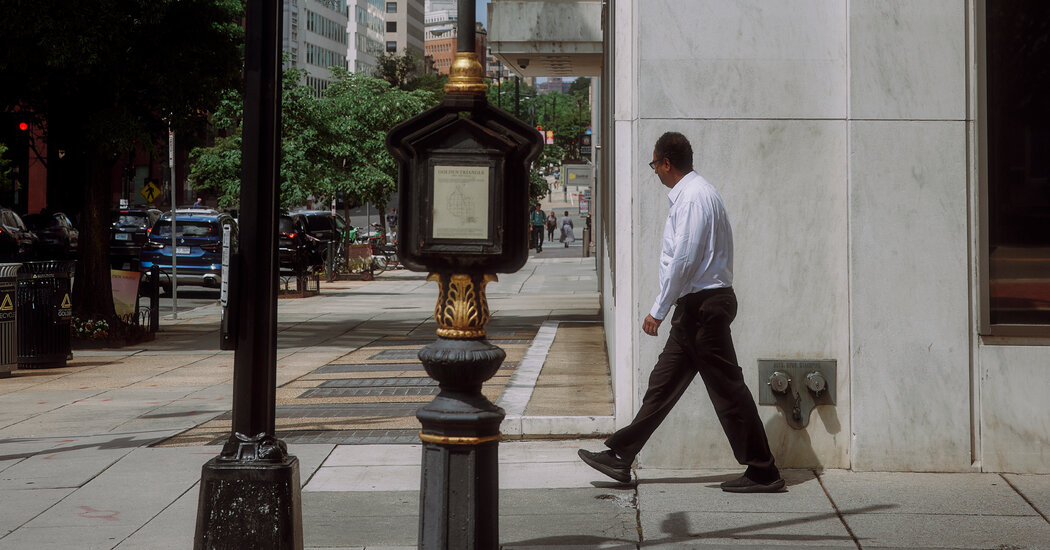

Kostas Fostieris grew wistful as he remembered the workday crowds that once flocked to Greek Deli & Catering, a small restaurant a few blocks from the White House that he has operated for 35 years. At lunch, the line would stretch down the block, Mr. Fostieris said. But then the coronavirus pandemic swept the nation, and the lunch crowds vanished. They have yet to return.
“It’s like the day and night,” Mr. Fostieris lamented as he sat against a wall adorned with signed photographs of the current and former presidents as well as a plethora of framed reviews — some faded, all glowing — from newspapers, magazines and guidebooks.
When asked if business on certain weekdays was especially slow, Mr. Fostieris answered quickly: “Every day.”
But unlike the other two, Seattle and San Francisco, Washington is not a technology hub but a company town that relies on a single employer to a degree not seen elsewhere. The local economy is powered by about 160,000 federal workers in the district, who are only now slowly returning to their workplaces from their suburban home offices. Last fall, an annual survey of 625,568 federal workers found that more than two-thirds were still working remotely some of the time.
Nina Albert, the district’s deputy mayor for planning and economic development, said working with the federal government to persuade workers to return to the office was a “challenge.”
“We would like the federal government to make a more concerted effort to have people return to office because we think it’s better for the federal government — as well as better for us,” she said.
Those dynamics have put real estate companies and local businesses at odds with the federal government. The businesses said the thousands of federal workers still sitting in their suburban home offices were hastening Washington’s fiscal and social decline.
“The federal government is now a drag rather than a benefit to the district,” said Steven Teitelbaum, a former real estate lawyer who now teaches at American University.
A collapse of the commercial real estate market — vacancy rates climbed above 20 percent in Washington at the end of 2023 — would affect not only landlords and developers but also the district itself. As buildings lose value, tax revenue could decline: Last year, the city’s chief financial officer projected Washington could stand to lose $464 million from 2024 to 2026.
Executive branch agencies have issued return-to-office plans, but, in a town with strong worker protections, those directives can be difficult to enforce. Each agency has its own return-to-office rules. In September, the Department of Justice told its 115,000 employees (about 20 percent of whom work in Washington) that they were expected to work in the office for six days every two weeks. But the notice made it clear that managers could issue exceptions to the new rule. And it was unclear how the six-day minimum would be enforced.
In January, Jeff Zients, the White House chief of staff, issued a memorandum calling for “concrete plans” from agency heads to bring workers back to the office.
“Return to office is a priority for President Biden,” Mr. Zients said in an email to The New York Times.
Jacqueline Simon, the policy director for the American Federation of Government Employees, a union that represents some 750,000 federal workers, disputed suggestions that productivity was dropping. She also challenged the argument that Washington’s civic fortunes depended on union members’ office attendance.
“The federal government’s mission is not to provide customers for restaurants and stores,” Ms. Simon said.

Still, the city’s lack of office workers is pervasive and pronounced. The Public Buildings Reform Board, a federal agency created to help offload some of the government’s vast real estate holdings, used cellphone location data to track workers’ office attendance at several federal agencies. The board’s findings, published in March, revealed that those agencies were using only 12 percent, on average, of their 90 million square feet of office spaces in the Washington region.
The board called for the sale of some federal property so that the city could find new uses for it and “avoid the worst effects of its deepening economic crisis.”
Stephen Buschbom, the research director at Trepp, a firm that analyzes real estate financing, told Bloomberg in December that Washington had surpassed San Francisco for the highest share of office buildings with loans that were at risk of default, and that Washington “could be the new ground zero for office distress.”
Washington’s recovery is also complicated because the city has few live-work neighborhoods like Lower Manhattan, where some office towers were turned into apartments after the Sept. 11, 2001, terrorist attacks. Even before the pandemic, the district had a higher ratio of daytime workers to city residents, said Tracy Hadden Loh, an urban affairs scholar at the Brookings Institution.
Muriel E. Bowser, the mayor of Washington, has a plan to invest $400 million to increase the downtown population by 15,000 as a way to resuscitate the city. The plan calls for a more pedestrian-friendly streetscape, and for easing regulations for small businesses and housing developers.
Building owners are also getting creative. A vacant building on M Street was recently the site of an art fair.
But absent what Nathan J. Edwards, a senior real estate analyst at Cushman & Wakefield, called “a serious capital infusion,” he estimated that half of Washington’s unwanted office stock was headed for a date with the wrecking ball as soon as interest rates fell, making new construction more feasible.
Some blue-chip tenants are continuing to reduce their footprints or move their offices out of the city. The mortgage giant Fannie Mae said in January that it would end its lease early at Midtown Center, a gleaming new tower it has occupied since late 2017. The consulting firm Chemonics International said in March that it was preparing to sublease 153,000 square feet, or about half the space it leases in a New Jersey Avenue building. And the real estate data giant CoStar Group is moving its headquarters and about 500 employees to Arlington, Va., from downtown Washington.
“We are in a long and slow transition process,” said Stijn Van Nieuwerburgh, a professor of real estate at Columbia University, speaking broadly about the office sector. “The demand is very weak and continues to weaken.”
George Marinakos sees this pain on a daily basis. His bar, the Exchange Saloon, is near the White House and opposite the Consumer Financial Protection Bureau on G Street. He pointed to the agency’s windows, almost uniformly dark early on a recent Friday afternoon.
“It’s been brutal,” Mr. Marinakos said. “I think with the days that they do come in, they’re just leaving early.”
Before the pandemic, he said, he served 200 lunches on an average day. Now, he dishes out 40 on the best days. Mr. Marinakos said he wished that federal employees saw the remote work debate as more than a personal cost-benefit calculation.
“It’s not just me struggling,” he said.