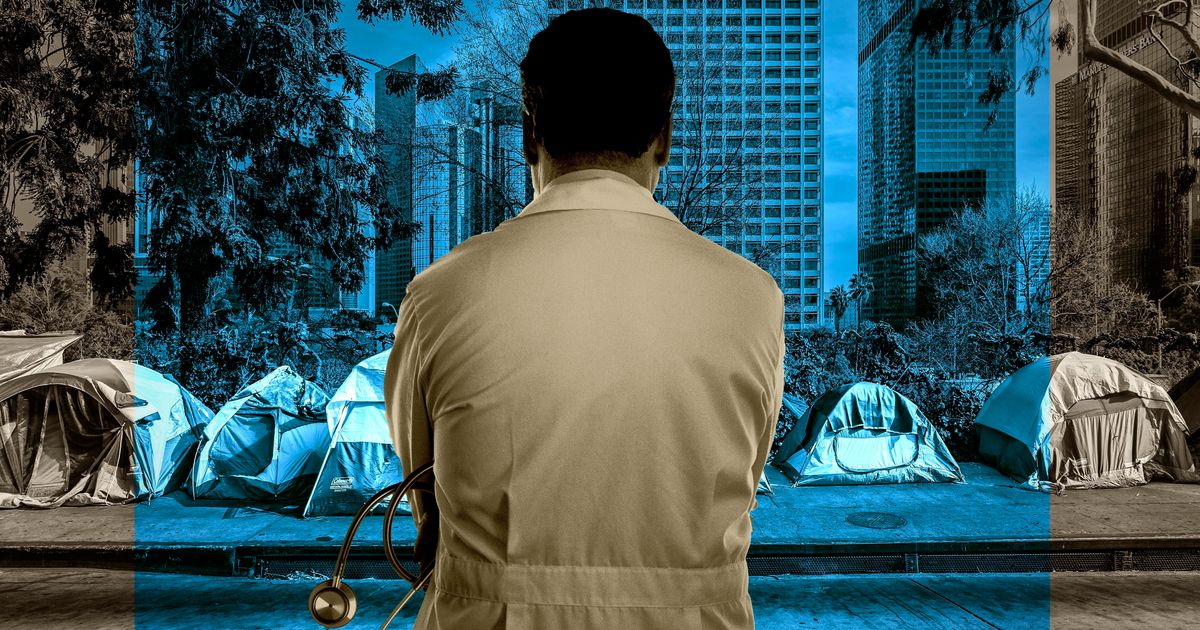

Jacob, a young homeless man with hearing loss, recently walked into one of the free clinics that my colleagues and I had organized at his shelter. He sat down with me and described how severe hearing loss had impacted his life. During a previous job interview, he had been unable to properly hear the interviewer, forcing him to ask his potential employer to speak louder and repeat himself multiple times.
He was not offered the job. Jacob told me that he was feeling depressed, and that he was losing faith in his ability to provide for himself.
Unfortunately, his story is not unique. As an ear, nose and throat physician who has practiced in Chicago for the last 20 years, I’ve met countless individuals like Jacob who are housing-insecure and whose health issues prevent them from improving their circumstances.
And yet, as you might imagine, I have never had a homeless person call to make an appointment with my office. The stark reality is that health care remains out of reach for most of the homeless population in the U.S. due to societal neglect and systemic barriers pertaining to technology, transportation and cost.
To address this disparity, we initially began visiting local shelters with the goal of providing on-site care, but soon realized that this mobile care model limited our impact significantly. Being on-site in the shelters meant that we couldn’t provide certain medical services, and we were ultimately unable to see everyone that needed to be seen.
So we realized that we’d have to bring the patients to us.
The Center for the Underserved at Rush ENT — or CURE — initiative was founded in 2022 with a mission to improve access to compassionate and high-quality care in the medically underserved community of Chicago’s West Side. Our program provides a direct avenue for care and features a free, weekly ENT clinic where homeless and migrant individuals can come to be diagnosed and treated. We use ride-sharing apps to transport patients to and from the clinic, and we offer a free meal to all, along with the highest quality of care.
The clinic, a labor of love and an effort of hope, is staffed entirely by physicians, nurses and medical students who volunteer their time. These colleagues show up in the evening, week after week, to take care of people who would otherwise be deprived of the care they deserve. As a result of their dedication, commitment and perseverance, we are finally beginning to confront this massive blind spot in our health care system.
What we’ve found most troubling is the degree to which certain patient demographics are being overlooked. In response to a great need, we began offering care to the migrant community last November, assembling a team of providers to visit the police stations and shelters where migrants were living. From telemedicine visits at shelters to in-person consultations, we have shaped our services to minimize potential barriers to access and provide care to those who need it most.
In Chicago alone, more than 12,000 migrants — we see patients from places like Venezuela, Guatemala, Brazil and occasionally India — are currently residing in shelters, facing issues of access and an inability to pay. Regardless of our political beliefs regarding immigration, we have to acknowledge that migrants are here now in our cities, seeking safety. And if we fail to help them access quality care, their health — and that of our communities — will suffer.
As physicians, we bear the responsibility to care for a human being regardless of their race, country of origin, or financial status, treating each one with the same dignity, respect and compassion that they are entitled to. And in a health care system experiencing tremendous financial strain, everyone in the medical field needs to focus on developing solutions for homeless and migrant people. From what I’ve learned during this process, the first step is acknowledging every factor that prevents homeless and migrant people from getting health care.
Most homeless and migrant individuals don’t have access to a doctor they’ve seen more than once. Most don’t have insurance. If they do, it is usually a government-subsidized plan that only covers a sliver of the costs.
Others simply avoid seeking treatment due to their mistrust of medical professionals. Those who do seek out care often go to hospital emergency rooms — where they can receive care regardless of their ability to pay. However, these visits place a huge financial burden on our health care system, and this financial burden will only worsen as the migrant population continues to grow. So ultimately, the void we’re trying to fill by providing people care before it becomes an emergency is not just beneficial to at-risk populations — but to everyone.
Rather than investing vast financial resources in emergency care, funds would ideally be directed toward less costly preventive care measures delivered via unique models like CURE’s. Everything we have seen during the past two years has shown us that this model is working.

We’ve seen an increasing number of patients come to us for not only acute but also follow-up care, which is monumental. Furthermore, we have broadened our services to include orthopedic foot and ankle care, and we intend to continue expanding, with the long-term goal of offering fully comprehensive specialty services to those in need.
Having observed these trends within our own clinic, we believe in earnest that the CURE model can serve as a blueprint for health care systems in other American cities where providers are struggling to care for their most vulnerable.
We have had hundreds of patients come through our clinic in a position similar to the one that Jacob was in. In Jacob’s case, my audiology colleagues were able to perform a hearing test and subsequently fit him with new hearing aids. At one of his recent follow-up visits, he joyfully shared with me that he had been offered a job. The hearing aids had made all the difference.
Jacob’s story is a powerful reminder of the dignity and opportunities that access to equitable and compassionate care can provide. If we hope to one day offer high-quality care to everyone in Jacob’s position, our health care system will require transformative solutions and a lot of creativity. But it’s possible — and we want everyone to see how fruitful this change can be.