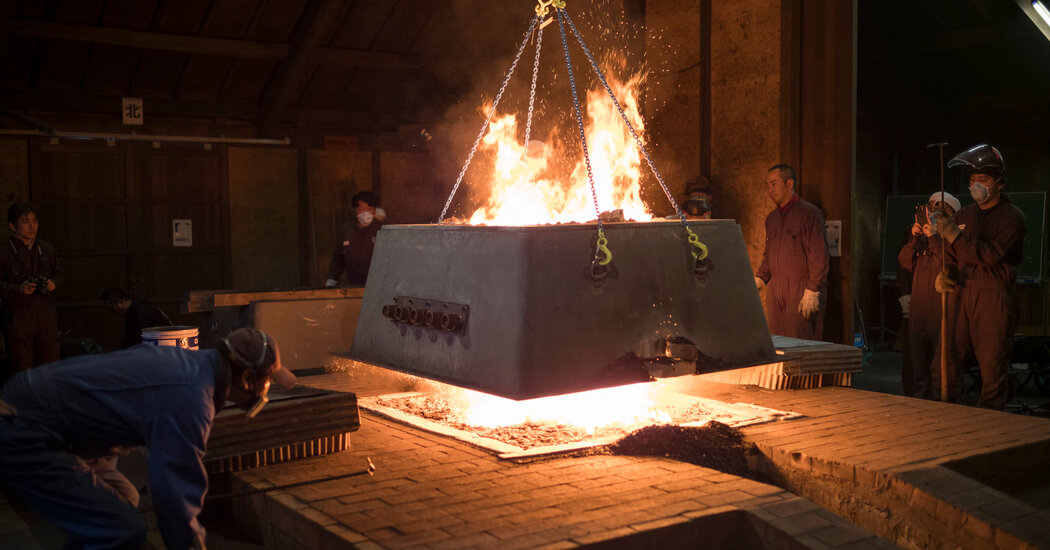

This past October, I found myself in Yoshida Village standing before a tatara, a giant open-top furnace that was filled with charcoal and raging with such controlled ferocity that it could have been a set piece in Lucifer’s bedroom.
Deep within the belly of those orange flames sat a growing and mangled ingot that contained some exceptionally high-quality steel called tamahagane, or jewel steel, from which Japanese swords have been made for much of the country’s history. The presence of a usable ingot seemed unlikely, and if true, downright alchemic. All we had been doing for the last 20 hours was gently shaking iron sand and fresh charcoal onto the flames at timed intervals.
Yoshida is nestled back in the mountains of Shimane Prefecture in central Japan, abutting the ever-turbulent Sea of Japan. For nearly 700 years, workers around Yoshida made jewel steel in places called tatara-ba (literally “furnace spots”) on a grueling schedule — one that reshaped mountains and rivers, that seared the brows of generations of sooty men shoveling charcoal in loincloths. Then, at the start of the 20th century, production all but ceased. Other methods were cheaper and more efficient.
At the height of its steel prowess, Yoshida swelled to nearly 15,000 people. Today, the population hovers around 1,500. As with many towns in the Japanese countryside, a mix of aging population, low birthrates and loss of industry has emptied its streets.
Recently, though, in a Colonial Williamsburg sort of way, 24-hour re-enactments of the old iron-smelting traditions began to be performed in Yoshida. The firings are managed by a man named Yuji Inoue, who works for Tanabe Corp., which owns the furnace. “We consider the tatara a symbol and a pillar of town development,” he told me, standing next to the flickering furnace. Mr. Inoue and Tanabe Corp. were trying to remake Yoshida into a kind of tatara village, which he hoped would create self-sufficiency, expand the population and revitalize the town.
And so with this notion of countryside regrowth in mind, a few times a year they fire up their furnace, invite tourists and birth an ingot weighing about 250 pounds.
The open-top blazing furnace was set on a concrete plinth in the center of a room. Flanking its longer sides were air intakes tubes, feeding the furnace, kicking it up to around 2,500 degrees Fahrenheit. Around it all hung Shinto purification ropes. Just before the fire was lit, a priest had blessed the whole place, for luck and safety.
Safety was paramount because around the flames, at various stations, milled a team of some 20 excited tourists, a mix of both Japanese and a few foreigners, all dressed in very hip dark gray jumpsuits. These were people paying roughly ¥200,000, or about $1,500, for the chance to be a worker in a tatara-ba for a day and night. (They would get to keep the jumpsuits and a small piece of raw steel as souvenirs.) Their faces and hands were streaked by charcoal.
Jewel steel is produced by sprinkling iron sand — alluvial (river-deposited) sand saturated with iron — slowly over a charcoal pit. The tourists spent hours chopping the pine charcoal to precise sizes. They used scoops woven from bamboo to gather heaps of charcoal and dump them atop the furnace.
Off to the side stood a man named Noriaki Yasuda. He was the designated conductor — called a murage — of this slow dance between heat, charcoal and dampened iron sand. Dressed in an electric blue jumpsuit, he stood out in beautiful, almost poetic, contrast to the licking orange flames.
Monitoring the airflow, the color of the fire and the height of the charcoal with paternal concern, Mr. Yasuda scowled and watched, sometimes retreating to sit in his dark alcove, his arms crossed, still scowling and watching. To produce steel using the tatara technique, it turns out, you spend a lot of time watching.
Outside the all-encompassing warmth of the tatara-ba, the October mountain air felt like prickles on the skin. The sky was abundant with shooting stars. Shimane Prefecture truly is in Japan’s hinterlands. You can take trains to Shimane, but from Tokyo it’s a fairly arduous journey. So it’s easier (and cheaper) to fly there. Of course, I rode the trains. The 500-mile trip took about seven hours.
The area is best known for its astounding Izumo Shrine, a foundational place in Japanese cultural mythology. Still, Shimane was one of the least visited prefectures in 2019. Only a sliver of all inbound tourists made their way that year. In contrast to sites like Gion in Kyoto, which is now overwhelmed by visitors, Shimane reminded me of Covid-era Japan when international tourism was effectively banned.
“Steel is just iron with a little bit of carbon,” Mr. Yasuda explained to me. When I finally built up the courage to talk with him, his face lit up in a wide smile from behind his mask. (Everyone was wearing masks, less out of Covid concerns and more because of the charcoal dust.) He casually led me to a blackboard in the back of his resting space and sketched out the basic chemical formulas of what was happening in the furnace, how charcoal serves two purposes. First, it burns much hotter than wood. And second, its carbon atoms are essential to the formation of steel; embedded between iron atoms, they increase the strength of the metal.

As I stood and watched that giant burning thing, I thought back to Akihira Kawasaki, the master Japanese swordsmith I had visited a few days earlier. I explained how I had never before held a Japanese sword, had never carefully looked at one up close. He nodded and removed one of his gleaming works from its scabbard and placed it on a piece of red felt.
I picked it up, and it felt like holding a black hole, as if light were disappearing into the ridge line of the blade, as if light was being flipped and flopped onto and into itself. My eyes couldn’t get a purchase on the thing. It glimmered and reflected like a mirror and simultaneously seemed to inhale the world. Held up to the lights, the blade seemed to glow as if lit from within.
I was mesmerized. It was a thing of extraordinary beauty: delicate yet strong, and terrifying in sharpness. An atavistic choir in the subcortical corner of my brain was screaming, “Stay away from that edge!” When I placed it back on the felt — warily, delicately, with great focus — I still accidentally sliced off a corner of the mat.
The gap between the smelting process and the end product of the sword was enough to make a thinking person faint. All this charcoal and sand, this heat, this sootiness, this periodic removal of slag — impurities that come out like molten lava, scooped up with shovels and carted away in beaten-up old wheelbarrows to be dumped outside in a smoldering heap — from the bottom of the furnace. That this process of utter rawness could result in a Japanese blade so pregnant with artistry and violence was a miracle of the highest order.
Back inside the tatara-ba, after 20 hours of feeding the furnace, the sand ran out and the process ended. A crowd of some 30 villagers, including several children, squeezed inside the furnace’s building. The concrete outer shell of the furnace was gingerly lifted with the help of a winch. The full force of the heat hit us all immediately. Inside still burned a mass of charcoal. Below the bed of charcoal was a floor of liquid slag. And in the middle of it sat what looked like a mauled rock — the ingot all this work had produced.
The crowd cheered. The ingot was brought onto the dirt floor, and we all gathered around it to take a family portrait.
Can you revitalize a town through steel-making in 2024? I don’t know. But Japan is dotted with this kind of history, culture and craft. The countryside is disappearing, but efforts like this are a worthwhile way to look back and honor what was — and to build something sustainable and future-facing.
There’s a practical element to it all, too: Tamahagane can’t be made any other way. “It seems that modern steel-making cannot produce the same thing,” Mr. Inoue told me when I asked why it was worth all the effort. “The tamahagane is right there, as the highest-quality pieces of the ingot,” he said. Those pieces will be broken off and shipped to a handful of swordsmiths across the country, and also to the museum shop in Yoshida. It turns out that tamahagane also makes amazing golf putters.
Craig Mod is a writer and photographer based in Kamakura and Tokyo. You can follow his work on Instagram: @craigmod. His previous book, “Kissa by Kissa,” chronicles a 435-mile walk along the Nakasendo Highway from Tokyo to Kyoto. His forthcoming book, “Things Become Other Things,” will be published by Random House in the spring of 2025.
Follow New York Times Travel on Instagram and sign up for our weekly Travel Dispatch newsletter to get expert tips on traveling smarter and inspiration for your next vacation. Dreaming up a future getaway or just armchair traveling? Check out our 52 Places to Go in 2024.