
Japan’s economy has rocketed into the headlines this year as inflation returns for the first time in decades, workers win wage gains and the Bank of Japan raises interest rates for the first time in 17 years.
But there’s another, longer-running trend happening in the Japanese economy that could prove interesting for American policymakers: Female employment has been steadily rising.
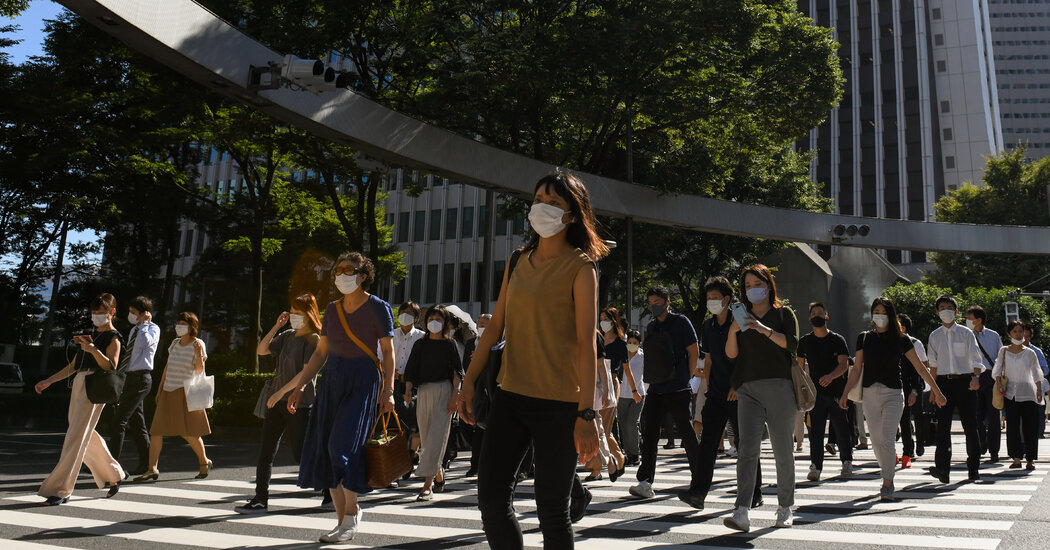
Working-age Japanese women have been joining the labor market for years, a trend that has continued strongly in recent months as a tight labor market prods companies to work to attract new employees.
The jump in female participation has happened partly by design. Since about 2013, the Japanese government has tried to make both public policies and corporate culture more friendly to women in the work force. The goal was to attract a new source of talent at a time when the world’s fourth-largest economy faces an aging and shrinking labor market.
“Where Japan did well over the recent decade is putting the care infrastructure in place for working parents,” Nobuko Kobayashi, a partner at EY-Parthenon in Japan, wrote in an email.
Still, even some who were around when the “womenomics” policies were designed have been caught off guard by just how many Japanese women are now choosing to work thanks to the policy changes and to shifting social norms.
“We all underestimated it,” said Adam Posen, the president of the Peterson Institute for International Economics, who advised the Japanese government while it was instituting the policies meant to bring on more female workers. Mr. Posen thought at the time that they might be able to get perhaps 800,000 women into the labor market, far fewer than the roughly three million who have actually joined (albeit many of them are part time).
It’s a surprise that could serve as an important reminder to economic officials around the world. Economists often try to guess how much a nation’s labor force can expand by extrapolating from history — and they tend to assume that there are limits to how many people can be lured into the labor market, since some are likely to stay home as caretakers or for other reasons.
But history has served as a poor guide in Japan over the past decade as social standards, marriage rates and fertility rates have shifted. And the lesson provided by the Japanese experience is simple: Women may be a bigger potential labor force than economists typically count on.
“Clearly, women in Japan wanted to work,” Mr. Posen said. “It raises questions about what is a reasonable expectation for female labor force participation.”
That message could be a relevant one for the United States’ central bank, the Federal Reserve.
How much room the U.S. labor market has to expand is a key question for the Fed in 2024. Over the past year, inflation has come down in the United States and wage pressures have moderated even as hiring has stayed strong and the economy has expanded rapidly. That positive outcome has been possible because the nation’s supply of workers has been expanding.
Labor force growth has come from two big sources in recent years: Immigration has picked up, and labor force participation has been recovering after falling during the pandemic. That is especially true for women in their prime working years, between the ages of 25 to 54, who have been participating in the job market at record or near-record rates.
Now, economists are asking whether the expansion can continue. Immigration into the United States does appear to be poised to persist: Economists at Goldman Sachs said the United States could add about one million more immigrants than normal this year. The question is whether participation will continue to pick up.

For the moment, it appears to be leveling off on an overall basis over the past year or so. Given that the population is aging, and older people work less, many economists say the overall number could stay steady and even fall over time. Given those trends, some economists doubt that the improvement in labor supply can continue.
“Further rebalancing of the labor market will need to come from slower growth in labor demand rather than continued rapid growth in worker supply,” one analysis from the Federal Reserve Bank of San Francisco concluded this year.
But in the late 2010s, economists also thought that the American labor market had little room to add new workers — only to find themselves surprised as people kept coming back from the sidelines.
And while female prime-age working rates have held fairly steady since last summer, the Japanese experience raises the question: Could American women in particular end up working in bigger numbers?
The United States once had higher female labor force participation for working-age women than other advanced economies, but it has now been surpassed by many, including Japan as of 2015.
These days, about 77 percent of prime-age women in the United States have a job or are looking for one. That number is about 83 percent for Japanese women, up from about 74 percent a decade ago and about 65 percent in the early 1990s. Japanese women now work in shares that are about on a par with Australia, although some nations like Canada still have higher working-age female labor force participation.
Those changes came about for several reasons. The Japanese government made some important policy moves, for one thing, such as increasing child care center capacity.
The nation’s changing attitudes toward family also played a role in freeing up women for work. The average age of people marrying for the first time has been steadily rising, and fertility rates are at record lows.
“Delaying marriage, delaying childbearing years, not getting married at all — that’s the big societal backdrop,” said Paul Sheard, an economist who has long been focused on the nation.
But there have been limits. There is still a tax penalty for second earners in the nation, and the quality of jobs women hold is not great. They are often lower-paid and for limited hours. Women are also largely absent from leadership ranks in Japanese companies.
Kathy Matsui, the former vice chair of Goldman Sachs Group’s Japan unit and the woman who spearheaded womenomics as an idea, has said the effort needs continued work.
Still, Japan’s experience could offer hints at what lies ahead in the United States. Fertility and marriage rates are also down in America, for instance, which could create space for working rates among young and middle-aged women to keep rising in the near term, although it does plant the seeds for a smaller population and economy down the road. Remote or hybrid work arrangements could also make it easier for caretakers to work.
And some of the more family-friendly policies that Japan has used could be a model for the United States, experts said.
“Where Japan did well over the recent decade is putting the care infrastructure in place for working parents,” Ms. Kobayashi at EY-Parthenon said, noting that children on the nursery center waiting lists decreased to 2,680 this year from 19,900 five years earlier.
But Japan could learn from the United States’ more flexible work culture, said Wendy Cutler, vice president at the Asia Society Policy Institute. That allows women to avoid dropping out of the job market and disrupting their career paths when they do have children.
“Looking at the quality of these jobs is going to be more and more important,” Ms. Cutler said.