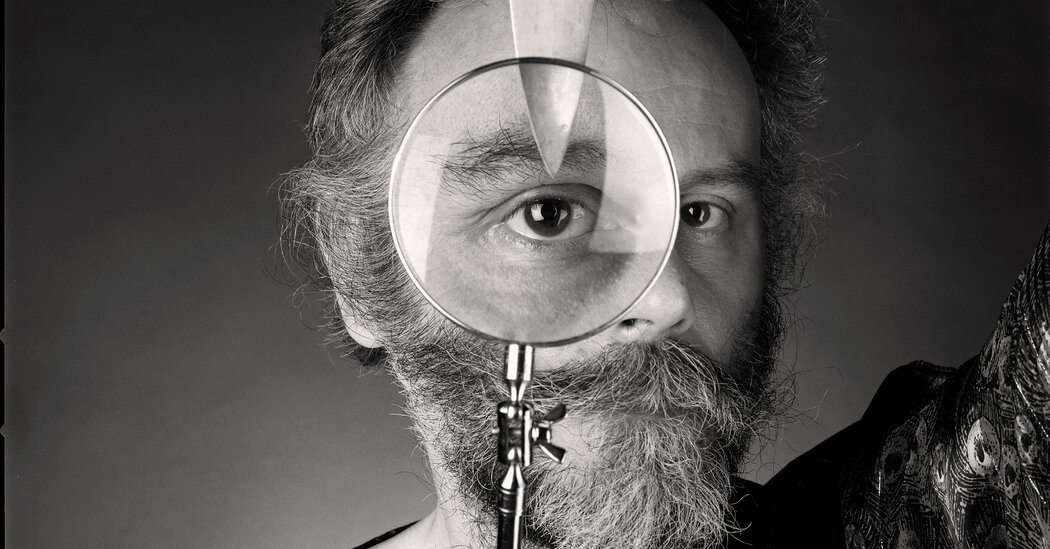

Lucas Samaras, who sang the song of self louder and in more keys than perhaps any other postwar visual artist, creating a wildly diverse body of work in which his own lithe body, bearded face and personal effects took center stage in countless shape-shifting guises, died on Thursday at his home in Manhattan. He was 87.
His death, from complications of a fall, was announced by Arne Glimcher, the founder of Pace Gallery, which represented Mr. Samaras for more than five decades.
Emerging in the late 1950s amid a generation of artists, among them Claes Oldenburg, Allan Kaprow and Carolee Schneemann, who propelled the American art world in daring new directions after the strictures of Abstract Expressionism, Mr. Samaras (pronounced suh-MARE-us) was a wild card even within a rabble-rousing crowd.
Smudgy cartoonlike pastels coexisted with raw plaster works and jewel boxes bedecked elaborately with wool, glass, straight pins, knives and sometimes taxidermized birds — animistic objects that resembled little else being made in the 1960s.
In 1964, after he had to move out of his childhood home in West New York, N.J., at the age of 28, he meticulously recreated his cluttered bedroom studio as a work of art. Staged inside the Green Gallery in Midtown Manhattan, the room was a poignant display of place and loss in the form of deadpan conceptual art.
“It is my past, complete — a piece of biography — the realest thing I could do,” Mr. Samaras told a reporter from The New York Times, who noted that the bedroom, priced at $17,000, had “no nibbles” from collectors during the exhibition. (Most of the furniture later went to the Salvation Army and the rest to Mr. Samaras’s new apartment.)
From then on, Mr. Samaras’s inward gaze sought only further horizons. In a series of “autointerviews” he conducted in the early 1970s, he asked himself what was already the most pertinent question about his work: Why are you so interested in yourself? He answered: “I use myself and therefore I don’t have to go through all the extraneous kinds of relationships like finding models and pretending artistic distance or finding workers or finding some symbol of geometry. I use myself also because it is still unorthodox to use one’s self.”
He pressed himself: Do you call that narcissism? To which he responded: “Call it what you will. I get things done.”
Lucas Samaras (his family name means “saddle maker” in Greek) was born on Sept. 14, 1936, in Kastoria, in the Western Macedonia region of Greece, and grew up amid the devastation of World War II and the Greek civil war. When he was an infant, his family home was heavily damaged by artillery fire, which killed his grandmother.
His father, Damianos, a furrier, left for several years to work in New York. Mr. Samaras became very close to his mother, Trigona, and to two aunts who were seamstresses and allowed him to cut patterns with paper. In 1948, the entire family emigrated to the United States, settling in New Jersey.
In his teens, Mr. Samaras worked briefly for his father in the fur trade. That experience shaped an intense feeling for materials, partly through a hatred of fur that the job engendered.
“Fur’s a soft, smelly, sweaty, pliable thing,” he once said. “And then I end up using pins: a hard, brilliant, sharp substance.”
In 1955, he won a scholarship to Rutgers University as it was becoming a crucible of the American avant-garde under the professorships of Mr. Kaprow, Robert Watts, Geoffrey Hendricks and later Roy Lichtenstein.
Along with students and friends like Robert Whitman, George Brecht and George Segal, he helped sow the seeds of conceptual art, Pop Art and what would become known as performance art, based on a philosophy of demolishing artificial barriers between art and everyday life.

At the artist-run Reuben Gallery in the East Village, Mr. Samaras was a lead performer in Mr. Kaprow’s “18 Happenings in 6 Parts,” a landmark 1959 event that employed chance, absurdity, cheap materials and mundane actions in ways that repurposed early-20th-century Dada for the Cold War era.
Mr. Samaras, who was studying acting around this time at the Stella Adler Conservatory, also participated in pioneering art performances by Mr. Whitman and by Mr. Oldenburg, who said that Mr. Samaras helped set the terms of the new form.
“When I started doing these performances, I wasn’t too clear about what I wanted them to be,” Mr. Oldenburg once said. “Lucas sort of defined them for me.”
But Mr. Samaras’s theatrical days were short-lived. His own performance-related fantasies, he explained, were too elaborate to carry out with other people, and so he began channeling those impulses into sculptural work and writing. “I was, in a sense, doing Happenings, but they were only for myself,” he said in an interview with Artforum magazine in 1966.
During a two-year period at Columbia University studying art history under Meyer Schapiro, he plunged headlong into making art, often in long-term, recurring series. (His box sculptures, which became a trademark of his work, were numbered beginning in 1962.)
While he had some affinities with artists like Joseph Cornell, who began making Surrealist-influenced assemblage boxes in the 1930s, and with the shambolically colorful Funk artists of the Bay Area, Mr. Samaras sailed defiantly against prevailing trends and movements, seeming at times almost like an outsider artist.
In 1969 he discovered the Polaroid instant camera, which became a magic lantern in his hands, opening avenues of experimentation that continued for the rest of his life.
Working in the modest confines of a one-bedroom apartment on West 71st Street, he created hybrid photograph-paintings, often naked self-portraits overlaid with dots and swirls. He also took advantage of a manufacturing quirk that left some Polaroid prints vulnerable to temporary manipulation beneath their Mylar protective layer, seizing the opportunity to shape phantasmagoric scenes he called “Photo-Transformations,” in which his body or parts of it appeared amid maelstroms of color and swirling forms.
Writing about these images in the 1988 book “Lucas Samaras: Objects and Subjects, 1969-1986,” the art historian and critic Thomas McEvilley observed that Mr. Samaras “often presents himself in monstrous and threatening guises as a kind of wolf man or nightmare apparition, both offering his nakedness and snarling at those who might want to approach it.”
Mr. Samaras himself said that he was always after a quality of “seducing-repelling,” presenting viewers with stark choices and dreading nothing more than ambivalence. In the late 1980s, after what he called “a pseudo-transformative sort of epiphany,” he radically narrowed what had already been a tight social circle around himself.
Reducing contact with friends and relations, he became almost a recluse in a new apartment and studio on the 62nd floor of a 1980s high-rise in Midtown Manhattan, where he lived alone, tended to keep the curtains drawn and ate the same meal, soup, almost every day.
“You can’t live in a constant state of ecstasy,” he explained of his decision. “You need so many pounds of pain, so many pounds of disappointment, so many pounds of dissatisfaction and so on.”
But despite this cloistering, his work remained highly visible in the art world, which admired Mr. Samaras although it never quite seemed to know what to do with him. He received several retrospectives over the years focusing on various aspects of his work, examples of which reside in major public collections around the world.
He is survived by his sister, Carol Samaras.
In 2009, he represented his native Greece at the Venice Biennale, showing a piece, “Ecdysiast” (H.L. Mencken’s grandiose, Greek-influenced euphemism for a striptease artist), in which he recorded the reactions of friends and colleagues as they watched a distorted video of him, at the age of 73, undressing.
In the early self-interviews and writings, Mr. Samaras returned frequently to the question of how his reflexive isolation and solipsism could function alongside his equally instinctual exhibitionism and visual extroversion.
“I was my own Peeping Tom,” he wrote. “Because of the absence of people I could do anything.” He added: “I formulated myself, I mated with myself and I gave birth to myself. And my real self was the product” — the art.