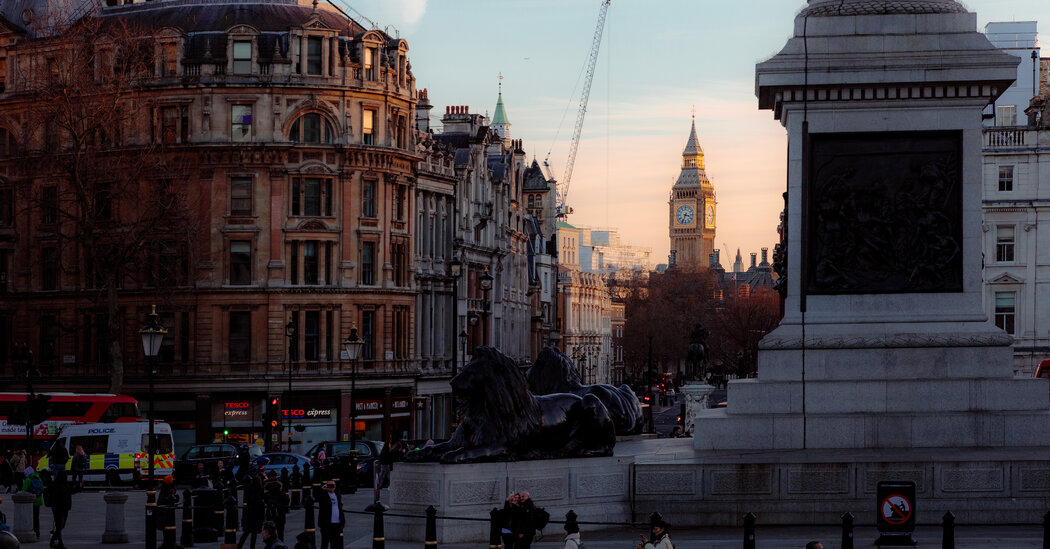

At least once a year, Britain’s top financial official stands up in Parliament to lay out his — it has always been a his to date — tax and spending plans that are normally intended to bolster economic growth and keep a check on the nation’s debt. This year, Jeremy Hunt, the chancellor of the Exchequer, had to consider another priority: the upcoming general election.
And so on Wednesday, Mr. Hunt announced that he would cut taxes for nearly 30 million workers. Beginning next month, the rate of National Insurance, a payroll tax paid by workers and employers that funds state pensions and some benefits, will be cut by two percentage points for employees and self-employed workers. It will save the typical employee about 900 pounds ($1,145) a year, Mr. Hunt said.
How did the markets react?
A year and a half ago, tax cuts and a plan to turbocharge economic growth sent shock waves through financial markets and ultimately pushed Liz Truss out of her job as prime minister. This time, the British pound and government bonds hardly budged.
That’s because the tax cuts announced by the Conservative Party are smaller and, crucially, offset partly by some other tax increases. And Mr. Hunt didn’t announce much additional spending.
The policy changes were also accompanied by forecasts of their economic and fiscal impact by the Office for Budget Responsibility, an independent watchdog.
Will the cuts help the Conservative Party’s prospects?
Less than four months ago, Mr. Hunt cut the National Insurance tax rate. It didn’t do much to help the Conservative Party’s position in the polls, where it is lagging far behind the opposition Labour Party. There’s hope that additional cuts will curry favor with voters as the government waits for the broader economic outlook to improve. Lower inflation is expected to help workers benefit more from wage increases, and the Bank of England is projected to cut interest rates later this year, which should ease the squeeze on household budgets.
What does the British public want?
Britons would prefer that the government focus on funding public services over tax cuts, according to recent polling by YouGov. But what they want even more is for the government to spend money on easing the cost of living, such as measures to reduce food or energy bills. (The polls didn’t specify what these measures would be.)
There’s a clear sense of frustration over public services, with eight in 10 Britons believing they are in a bad state, the YouGov polls showed.
Economists say the government urgently needs to increase investment, which has been weakened in an effort to keep public debt down. Over the next five years, public sector net investment as a share of gross domestic product is expected to decline, according to forecasts by the Office for Budget Responsibility.
How bad is it really?
Public services are under huge pressure: More than seven million patients are waiting for National Health Service treatment, and dentists aren’t taking on patients. Last year, schools were ordered to close because of crumbling concrete, and prisons have been allowed to release some people early because of overcrowding. Another sign of the strain is in local government, where several councils — the local government bodies that fund services like care for children and adults, and waste pickup and recycling — have recently declared themselves essentially bankrupt.
Even as more government money has been set aside for councils, many are still having to announce sweeping cuts. While some councils have made poor financial decisions, they have been compounded by a long-term decline in funding from the national government.
On Tuesday, Birmingham City Council, one of England’s largest, signed off on sweeping cuts, including plans to end all its arts funding as part of a plan to save £300 million over the next two years.
What’s stopping the government from doing more?
The chancellor’s budget choices are bound by three fiscal rules Mr. Hunt has set himself, which have recently come under criticism. The rule deemed most flawed is that debt as a percentage of G.D.P. must fall by the fifth year of the economic forecasts.
Not only does the rule rely on long-term projections that can change, it also means some policies and programs will be stopped to make sure debt falls in that final year, fueling frustrations about short-term thinking in economic policymaking.

The National Institute of Economic and Social Research “has long argued that the fiscal framework needs an overhaul,” said Stephen Millard, its deputy director. “By discouraging public investment, the current framework acts as a constraint on growth.”
The chancellor stuck to his rule.
For the next four years, so-called underlying debt will rise, according to the Office for Budget Responsibility. But it will fall in the fifth and final year of the forecast — allowing Mr. Hunt to meet his fiscal rule.
But “these forecasts rest on fiscal fantasies,” according to Michael Saunders, an economist at Oxford Economics and a former Bank of England rate setter. The forecasts assume an increase in fuel taxes, even though they have been frozen for 14 years and almost no one expects them to go up, he said. And they rely on “a painful public spending squeeze,” he added, for which there is not a “credible plan” to deliver.
What will happen to public spending?
The government has detailed day-to-day spending by departments only until next March, with very little information thereafter.
The government has set a few specific priorities: It will keep defense and overseas aid spending constant as a share of G.D.P., increase child care funding, provide more money for the N.H.S. and leave spending on schools unchanged after adjusting for inflation.
But that means everything else — so-called unprotected government departments, such as the courts, prisons and local government — is facing steep cuts. Spending would have to decline more than 2 percent a year after the election, according to the Office for Budget Responsibility. Spending, per person, on public services wouldn’t grow over the next five years, once adjusted for inflation, the watchdog said.
Economists have said that because of the poor state of some public services, such steep cuts seem impossible to deliver.
The Resolution Foundation, a think tank, estimates unprotected public services will face £19 billion in cuts after the election. The idea that will happen is a “fiscal fiction,” said Torsten Bell, its chief executive.
A challenge for the next government.
The tax cuts create a difficult choice for whichever party wins the election: Keep the existing spending plans and further scale back public services, or find more money, which will probably mean raising taxes.
“Whoever is chancellor at the time of the next spending review,” said Paul Johnson, the director of the Institute for Fiscal Studies, “might wish they’d chosen a different line of work.”