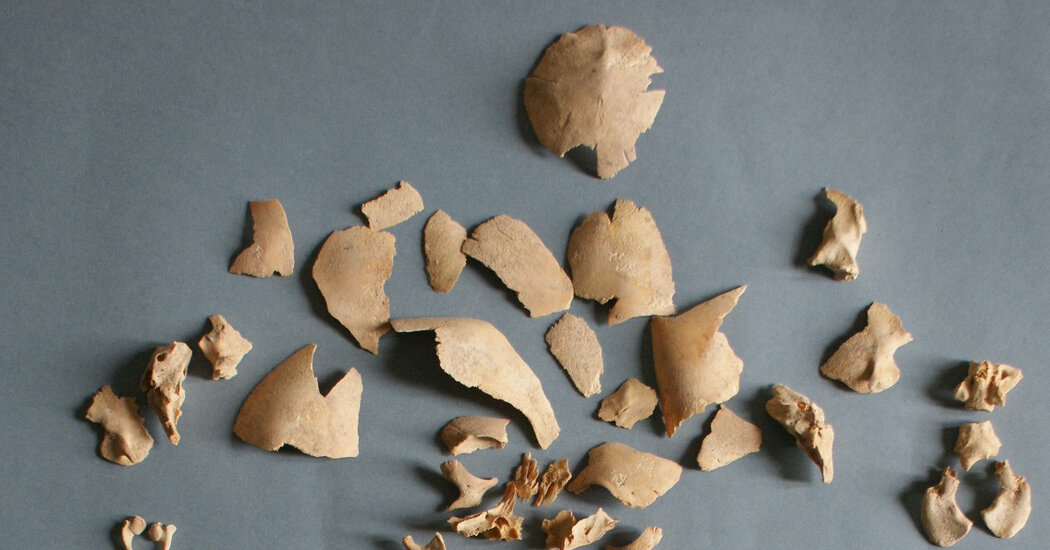

Scientists have diagnosed Down syndrome from DNA in the ancient bones of seven infants, one as old as 5,500 years. Their method, published in the journal Nature Communications, may help researchers learn more about how prehistoric societies treated people with Down syndrome and other rare conditions.
Down syndrome, which occurs in 1 in 700 babies today, is caused by an extra copy of chromosome 21. The extra chromosome makes extra proteins, which can cause a host of changes, including heart defects and learning disabilities.
Scientists have struggled to work out the history of the condition. Today, older mothers are most likely to have a child with the condition. In the past, however, women would have been more likely to die young, which might have made Down syndrome rarer, and the children born with it would have been less likely to survive without the heart surgery and other treatments that extend their lives today.
Archaeologists can identify some rare conditions, such as dwarfism, from bones alone. But Down syndrome — also known as trisomy 21 — is a remarkably variable disease.
People with it may have different combinations of symptoms, and they may have severe or milder forms. Those with the distinctive almond-shaped eyes caused by Down syndrome may have relatively ordinary skeletons, for example.
As a result, it’s hard for archaeologists to confidently diagnose ancient skeletons with Down syndrome. “You can’t say, ‘Oh, this change is there, so it’s trisomy 21,’” said Dr. Julia Gresky, an anthropologist at the German Archaeological Institute in Berlin who was not involved in the new study.
By contrast, it’s not tricky to identify Down syndrome genetically, at least in living people. In recent years, geneticists have been testing their methods on DNA preserved in ancient bones.
It’s been challenging, however, because the scientists can’t simply count full chromosomes, which fall apart after death into fragments.
In 2020, Lara Cassidy, a geneticist then at Trinity College Dublin, and her colleagues used ancient DNA for the first time to diagnose a baby with Down syndrome. They were examining genes from skeletons buried in a 5,500-year-old tomb in western Ireland. The bones of a 6-month-old boy contained unusually high amounts of DNA from chromosome 21.
Since then, Adam Rohrlach, a statistician then at the Max Planck Institute for Evolutionary Anthropology in Leipzig, Germany, and his colleagues have developed a new method to find the genetic signature, one that they can use to look quickly at thousands of bones.
The idea came to Dr. Rohrlach when he talked with a scientist at the institute about its procedures for searching for ancient DNA. Because high-quality DNA sequencing is very expensive, it turned out, the researchers were screening bones with a cheap test, called shotgun sequencing, before picking out a few for further investigation.
If the bone still preserved DNA, the test turned up many tiny genetic fragments. Very often, those came from microbes that grow in bones after death. But some bones also contained DNA that was recognizably human, and those with a high percentage were flagged for additional tests.
Dr. Rohrlach learned that the institute had screened almost 10,000 human bones in this way, and the results of all the shotgun sequencing were stored in a database. It occurred to Dr. Rohrlach and his colleagues that they could scan the database for extra chromosomes.
“We thought, ‘No one’s ever checked for these sorts of things,” Dr. Rohrlach said.

He and his colleagues wrote a program that sorted fragments of the recovered DNA by chromosome. The program compared the DNA from each bone to the entire set of samples. It then pinpointed particular bones that had an unusual number of sequences coming from a particular chromosome.
Two days after their initial conversation, the computer had their results. “It turned out our hunch was right,” said Dr. Rohrlach, who is now an associate lecturer at the University of Adelaide in Australia.
They discovered that the institute’s collection included six bones with extra DNA from chromosome 21 — the signature of Down syndrome. Three belonged to babies as old as a year, and the other three to fetuses who died before birth.
Dr. Rohrlach also followed up on Dr. Cassidy’s 2020 study. He used his program to analyze the shotgun sequencing for the Irish skeleton and found that it also bore an extra chromosome 21, confirming her initial diagnosis.
In addition, Dr. Rohrlach found another skeleton with an extra copy of chromosome 18. That mutation causes a condition called Edwards syndrome, which usually leads to death before birth. The bones came from an unborn fetus that had died at 40 weeks and were severely deformed.
The new survey doesn’t let Dr. Rohrlach and his colleagues determine how common Down syndrome was in the past. Many children with the condition probably died before adulthood, and the fragile bones of children are less likely to be preserved.
“There’s so much uncertainty in the sampling, and in what we could and couldn’t find,” Dr. Rohrlach said. “I think it would be a very brave statistician who would try to make too much out of these numbers.”
But Dr. Rohrlach did find it significant that three children with Down syndrome and the one with Edward syndrome were all buried in two neighboring cities in northern Spain between 2,800 and 2,400 years ago.
Normally, people in that culture were cremated after death, but these children were buried inside buildings, sometimes with jewelry. “It was special babies that were being buried in these homes, for reasons we just don’t understand yet,” Dr. Rohrlach speculated.
Dr. Gresky didn’t think the evidence made it possible to rule out chance instead for the cluster of cases.
“Maybe the bones there were so well preserved,” she said. “Maybe the archaeologists were so good and well-trained that they took all of them out. Maybe they were buried in a way that made it much easier to find them.”
Still, Dr. Gresky considered the new study an important advance. For one thing, it may allow archaeologists to compare remains genetically identified with Down syndrome and discover some hidden set of features common to all their skeletons.
And Dr. Gresky hoped that other researchers would use ancient DNA to illuminate the hidden histories of other rare diseases: “You just have to look for them, and you have to talk about them. Otherwise, they will stay invisible.”