
Notoriously, in the winter of 1969 the Metropolitan Museum of Art opened its first exhibition devoted to African American culture, but with a show devoid of art. Called “Harlem on My Mind: Cultural Capital of Black America, 1900—1968,” it was a photomural-with-texts affair of a kind found in ethnology museums.
As a student in town on a visit, I wandered into the galleries, and even with scant knowledge of Black history, I knew something was off. I soon learned I wasn’t alone. The show was being slammed by pushback.
A cohort of Black contemporary artists, some living and working in Harlem, calling themselves the Black Emergency Cultural Coalition, had been picketing the museum, and directing their protest to other museums, lighting a fuse that would eventually detonate in the multicultural wave of the 1980s, with its demands for inclusion, and its affirmation of cultural identity, in art as in life, as a force.
This week, more than half a century on, the Met opens its second survey of Black art, this one called “The Harlem Renaissance and Transatlantic Modernism,” and it’s a whole other thing. It’s all art: more than 160 paintings, sculptures and photographs, many quite fabulous. The museum isn’t framing the show as an institutional correction, though how can it be viewed otherwise? At the same time, it’s more than just that. It’s the start — or could be — in moving a still-neglected art history out of the wings and onto the main stage.
That history, from roughly 1918 through the 1930s, has complications. The Harlem Renaissance wasn’t a “thing” in the sense of being a structured movement, though it did have its architects, notably two sparring Black public intellectuals, W.E.B. Du Bois and Alain Locke. Nor was it confined to Harlem, or even New York City. Many of the artists closely associated with it lived and worked elsewhere — Chicago, Philadelphia, Paris. Finally, it wasn’t strictly, or even chiefly, a visual art phenomenon. It was initially defined in terms of new directions in Black literature — Langston Hughes and Zora Neale Hurston were emergent stars — and music, particularly jazz.
What it was, was a kind of atmospheric condition, a transcontinental and transatlantic vibe, an ideal of racial pride embodied in the term “New Negro,” a concept given instant currency through essays written by Locke and published in the progressive political journal “Survey Graphic,” which devoted its March 1925 issue to the theme of “Harlem: Mecca of the New Negro.”
Locke’s ideal, shaped by the Great Migration and World War I, of a new cosmopolitan Black aesthetic blending Western classicism, European modernist innovation, African art and Black folk culture, dominates the show, organized by Denise Murrell, a Met curator at large. And a painted portrait of Locke by the German American artist Winold Reiss is the first thing we see before being plunged into the hubbub of Harlem itself.
One of the guides Murrell has assigned us is the supreme photographer of the neighborhood, James Van Der Zee. In one of his pictures he takes us to tea at a beauty salon run, out of her home, by the hair-care entrepreneur Madam C.J. Walker, sometimes credited as America’s first female self-made millionaire. In the company of her genteel clientele, Du Bois, who had conservative tastes in culture, would surely have felt at home.
By contrast, he would probably not have relished time spent in Jacob Lawrence’s watercolor “Pool Parlor,” a Cubistic crazy quilt of ricocheting lines from 1942, or in Archibald J. Motley Jr.’s 1933 picture titled “The Plotters,” which has us sitting in a backroom somewhere with a huddle of tough guys who seem to be exchanging secrets we’re better off not hearing.
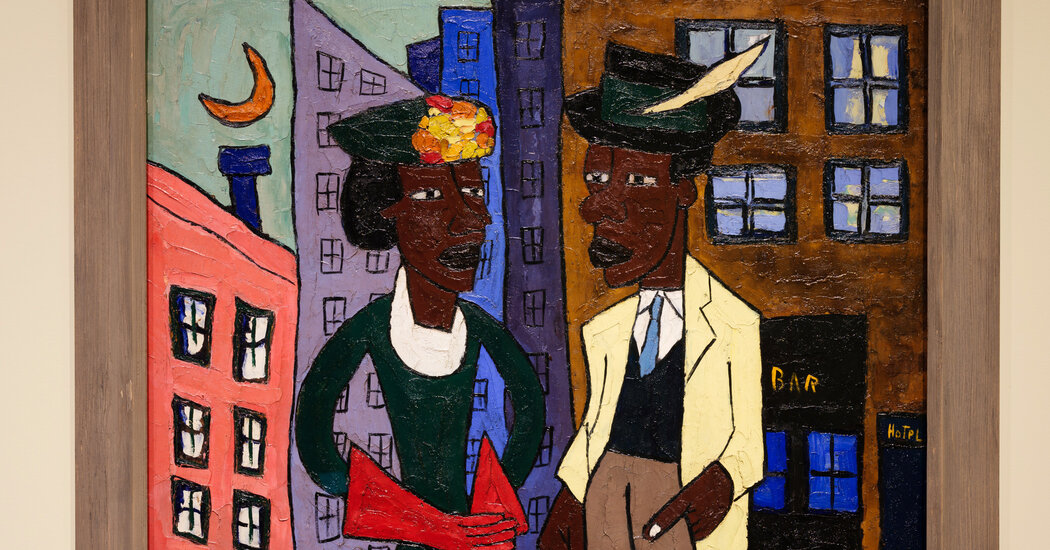
Back out on the street we encounter marching bands, and funeral homes, and, in “Street Life, Harlem,” a painting by the great William Henry Johnson — a highlight of this show and an amazement in any show he’s in — of a spectacularly dapper Harlem couple stepping out for a stroll beneath a tangerine slice of a moon.
In a large adjoining gallery devoted to portraiture we see Black individuals up close and rich in stylistic diversity. The self-taught painter Horace Pippin’s delightful, limner-style likeness of his wife Jennie Ora Fetherstone Wade Giles, wearing the equivalent of 1970s aviator glasses, sits across the room from one, done in virtuosic academic mode, by the underknown Philadelphia artist Laura Wheeler Waring of a pensive young woman cradling a pomegranate, which in turn sits close to a portrait of another young woman in red, this one by the Harlemite Charles Henry Alston, with a face resembling an African mask.
The exhibition includes a cluster of thematic micro-shows, all ripe for future elaboration, though sketchy here. One picks up the African thread in Harlem Renaissance art, taking an abstract Afro-Deco copper mask by the San Francisco artist Sargent Claude Johnson as evidence. Others suggest, in their shorthand way, Euro-American exchanges of influence. The political-painter-to-be Hale Woodruff creates modern impressionist landscapes; Henri Matisse, who hung out in Harlem on trips to New York, paints Black models.
More dynamic by far, are the show’s concentrations on works by individual artists. A nooklike arrangement of four side-by-side figure-packed paintings of Parisian streets and nightclubs by Motley, done on a stay there in 1929, really jumps. A spacious, enclosed hanging of seven monumental history paintings by Aaron Douglas generates a mood different from everything else, with its chapel-like quiet. And the source of some of the Douglas work is of interest in itself: three of the painting are on loan from the still little-studied collections of historically Black colleges and universities (H.B.C.U.s), namely Fisk University in Nashville (where Douglas taught for almost three decades) and Howard University in Washington, D.C. (A major traveling exhibition, “African Modernism in America,” drawn from these and other H.B.C.U. collections, is at the Taft Museum of Art in Cincinnati through May 19.)
But it’s in three displays at the end of the show that specific political themes of the New Negro era are finally touched on. One section addresses the pervasiveness of colorism — social exclusion based on skin tone — within the Black community. Waring’s 1920s painting “Mother and Daughter,” of two women, one light-skinned, one darker, seen in overlapping profiles, coolly alludes to this.

Sexual politics could also be a minefield. The Harlem Renaissance “was surely as gay as it was Black,” Henry Louis Gates, Jr. once wrote. Locke was gay, as were the sculptor Richmond Barthé and the painter Richard Bruce Nugent. An installation with a sampling of their work, along with Beauford Delaney’s rainbow-hued nude portrait of the teenage James Baldwin, confirms this reality, though you have to go to the catalog to learn about the homophobia shared even by progressive Black thinkers of the time, including Du Bois — one of the shortcomings of the show.
A concluding small display, “Artist as Activist,” asserts the risks inherent simply in being Black in America, risks that no effort at social uplift — even the current one — can mitigate. The illustrative material, at a glance, looks unsurprising: a photo of Marcus Garvey by Van Der Zee, a drawing of the Scottsboro Boys by Douglas, a print of a picket line by Roy DeCarava. But in a case in the center is a small sculpture of a female figure who seems to be rising from flames. Created in 1919 by Meta Vaux Warrick Fuller and titled “In Memory of Mary Turner As a Silent Protest Against Mob Violence,” it was made in response to the death of a young pregnant Black woman who was lynched and torched in Georgia the previous year. And once you know the story, Fuller’s figure radiates like an emergency flare that won’t go out.
Like several other pocket-size displays, this one could serve as a rough draft for bigger, deeper shows to come. And it underscores, as everything in Murrell’s mind-prodding survey does, the functional value of what is now often referred to — with increasing disdain in the mainstream art world — as an art of “identity politics,” that is, an art that asserts, actively or incidentally, some measure of anti-assimilationist cultural solidarity.
What Locke wanted for a new Black art was the same visibility that white art has always had in the public consciousness, in the market, in the history books. But he also insisted that, in this new art, a Black identity be foregrounded, maintained and nurtured, to create a fresh and distinctive cosmopolitanism. That’s a dynamic evident in the Met show, and it was also the bottom-line goal of the radical, and now undervalued, multiculturalist thinking of the late 20th century, which was a renaissance of its own and feels ripe for reassessment.
The Harlem Renaissance and Transatlantic Modernism
Opens to members Feb. 22 and to the public Feb. 25, through July 28, Metropolitan Museum of Art, 1000 Fifth Ave., (212) 535-7710; metmuseum.org.