
Naturalists have been trying for centuries to catalog all of the species on Earth, and the effort remains one of the great unfinished jobs in science. So far, researchers have named about 2.3 million species, but there are millions — perhaps even billions — left to be discovered.
As if this quest isn’t hard enough, biologists cannot agree on what a species is. A 2021 survey found that practicing biologists used 16 different approaches to categorizing species. Any two of the scientists picked at random were overwhelmingly likely to use different ones.
“Everyone uses the term, but no one knows what it is,” said Michal Grabowski, a biologist at the University of Lodz in Poland.
The debate over species is more than an academic pastime. In the current extinction crisis, scientists urgently need to take stock of the world’s biological diversity. But even some of the best known species on Earth may not be what they seem.
Take the giraffe.
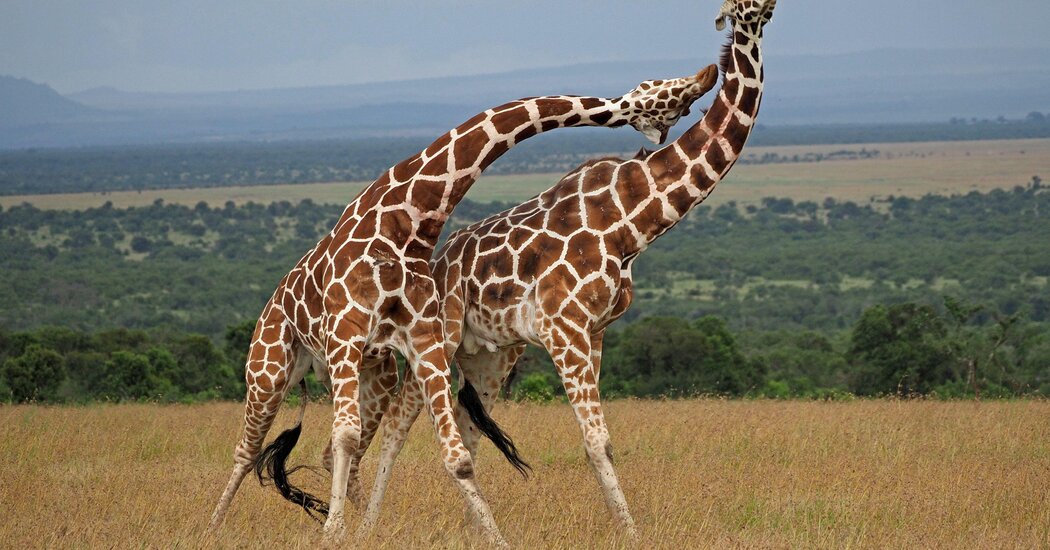
In 1758, the Swedish taxonomist Carl Linnaeus described a single species of giraffe: Giraffa camelopardalis. Although the species has declined in recent decades, 117,000 giraffes still survive across Africa, prompting an international conservation group to designate the species as vulnerable, rather than endangered.
But some conservation biologists argue that giraffes are in great peril, because what looks like one species is actually four. Genetic studies have found that giraffe DNA falls into four distinct clusters: the Northern giraffe, the reticulated giraffe, the Masai giraffe and the Southern giraffe.
The Northern giraffe, which lives in pockets from Niger to Ethiopia, has suffered catastrophic losses from civil wars, poaching and the destruction of its wild habitat. If the Northern giraffe were considered a separate species, it would be “one of the most threatened large mammals in the world,” said Stephanie Fennessy, the executive director of the Giraffe Conservation Foundation, a nongovernmental conservation organization.
For Linnaeus, species were divinely created forms of life, each with its own distinctive traits. A century later, Charles Darwin recognized that living species had evolved, like young branches sprouting off from the tree of life. That realization made it harder to say exactly when a new group became a species of its own, instead of just a subspecies of an old one.
In the 1940s, Ernst Mayr, a German ornithologist, tried solving this problem with a new definition of species based on how animals breed. If two animals couldn’t breed with each other, Mayr argued, then they were separate species.
The biological species concept, as it came to be known, had a huge influence on later generations of researchers.
In recent years, Christophe Dufresnes, a herpetologist at Nanjing Forestry University in China, has used this concept to classify different species of frogs in Europe.
Some of the groups of frogs interbred a lot, whereas others had no hybrids at all. By analyzing their DNA, Dr. Dufresnes found that groups with a recent ancestor — that is, those that were more closely related — readily produced hybrids. He estimates that it takes about six million years of diverging evolution for two groups of frogs to become unable to interbreed — in other words, to become two distinct species.
“This is very cool,” Dr. Dufresne said. “Now we know what the threshold is to deem them species or not.”

Dr. Dufresne’s method for finding new species takes a lot of work in the field. Other researchers have looked for more efficient ways to identify species. One popular method is to sequence DNA from organisms and observe the differences in their genetic code.
This search can yield a lot of surprises, as illustrated by the giraffes in Africa. Dr. Grabowski’s team has discovered an even more dramatic diversity hiding among European crustaceans, a group of aquatic creatures that includes lobsters, shrimp and crabs. The researchers have shown that animals that look identical to each other and appear to belong to a single species may actually be dozens of new species.
For example, a species of common freshwater shrimp called Gammarus fossarum split 25 million years ago into separate lineages that are still alive today. Depending on how researchers classify their DNA differences, the single species of Gammarus fossarum might in fact be 32 species — or as many as 152.
“For us, it’s mind-blowing,” Dr. Grabowski said.
As scientists gather more genetic data, fresh questions are emerging about what seem, on the surface, to be obviously separate species.
You don’t have to be a mammalogist to understand that polar bears and brown bears are different. Just one look at their white and brown coats will do.
The difference in their colors is the result of their ecological adaptations. White polar bears blend into their Arctic habitats, where they hunt for seals and other prey. Brown bears adapted for life on land further south. The differences are so distinct that paleontologists can distinguish fossils of the two species going back hundreds of thousands of years.
And yet the DNA inside those ancient bones is revealing an astonishing history of interbreeding between polar bears and brown bears. After the two lineages split about half a million years ago, they exchanged DNA for thousands of years. They then became more distinct, but about 120,000 years ago they underwent another extraordinary exchange of genes.
Between 25,000 and 10,000 years ago, the bears interbred in several parts of their range. The exchanges have left a significant imprint on bears today: About 10 percent of the DNA in brown bears comes from polar bears.
Beth Shapiro, a paleogeneticist at the University of California, Santa Cruz, said that the interbreeding most likely occurred when swings in the climate forced polar bears down from the Arctic and into brown bear territory.
But the exchange of DNA did not blur the bears into one species. Some of the traits that benefit polar bears in their own environment can become a burden for brown bears, and vice versa.
“They clearly demand separate strategies for conservation management,” Dr. Shapiro said. “It makes sense to me to consider them distinct species.”
The uncertainties about what makes a species have left taxonomists with countless conflicts. Separate groups of ornithologists have created their own lists of all the bird species on Earth, for example, and those lists often clash.
Even a common species like the barn owl — found on every continent as well as remote islands — is a source of disagreement.
The conservation group BirdLife International recognizes barn owls as a species, Tyto alba, that lives across the world. But another influential inventory, called the Clements Checklist of Birds of the World, carves off the barn owls that live on an Indian Ocean island chain as their own species, Tyto deroepstorffi. Yet another recognizes the barn owls in Australia and New Guinea as Tyto delicatula. And a fourth splits Tyto alba into four species, each covering its own broad swath of the planet.
Some ornithologists are trying to resolve these conflicts with a low-tech approach: voting.
In 2021, the International Ornithologists’ Union formed a working group to replace the four leading bird checklists with a single catalog. Nine experts are working their way through the lists and voting on more than 11,000 potential species.
“The discussions can get very heated,” said Leslie Christidis, the group’s chair. Some of the experts tend to lump species together, while others split them. “We’re just trying to negotiate a peaceful system.”
Thomas Wells, a botanist at the University of Oxford, is concerned that debates about the nature of species are slowing down the work of discovering new ones. Taxonomy is traditionally a slow process, especially for plants. It can take decades for a new species of plant to be formally named in a scientific publication after it is first discovered. That sluggish pace is unacceptable, he said, when three out of four undescribed species of plants are already threatened with extinction.
Dr. Wells and his colleagues are developing a new method to speed up the process. They are taking photographs of plants both in the wild and in museum collections and using computer programs to spot samples that seem to cluster together because they have similar shapes. They’re also rapidly sequencing DNA from the samples to see if they cluster together genetically.
If they get clear clusters from approaches such as these, they call the plants a new species. The method — which Dr. Wells calls a “rough and ready” triage in our age of extinctions — may make it possible for his team to describe more than 100 new species of plants each year.
“We don’t really have the luxury of agonizing over, ‘Is this a species, or is this a subspecies?’” he said. “We need to make decisions quickly and as accurately as possible, based on the evidence we have at hand.”