
“What if museums give back so much art that they have nothing left to display?” As a scholar of the debates about returning cultural objects to the countries from which they were stolen, I have, over the years, heard many variations of that question. “Museums have lots and lots of stuff,” I usually answer, fighting the urge to roll my eyes. “It’s not like they’re just going to shut down.”
But in December, the Metropolitan Museum of Art announced it would return a substantial proportion of its Khmer-era works to Cambodia, which is claiming still more, including nearly all the museum’s major Cambodian pieces. Last month, the American Museum of Natural History indefinitely closed two of its halls in response to new federal regulations about the display of Native American sacred and burial artifacts. Now Manhattan’s Rubin Museum of Art, which features art from the Himalayas, has announced that it will close later this year. The museum says the decision is unrelated to issues of cultural repatriation, but it comes after the museum faced many accusations of cultural theft and returned some prized pieces.
Clearly, I need to change my answer.
When stolen artifacts go back to their rightful owners, it is now clear, some display cases will indeed empty out, some galleries will shut their doors, and entire museums may even close. But it’s worth it. Repatriating these precious items is still the right thing to do, no matter the cost.
Why? Museums are supposed to educate us about other ways of being in the world. But looted artifacts alone — removed from their original context, quarantined in an antiseptic display case — cannot do this. Unlike, say, Impressionist paintings or Pop Art sculptures, ritual objects were not meant to be seen in a gallery at a time of the viewer’s choosing. Used alongside music, scents and tastes, these holy relics are tools to help participants in rituals achieve a transcendent experience. Imagine looking at a glow stick necklace and thinking it could teach you what it’s like to greet the sunrise dancing ecstatically with hundreds of strangers.
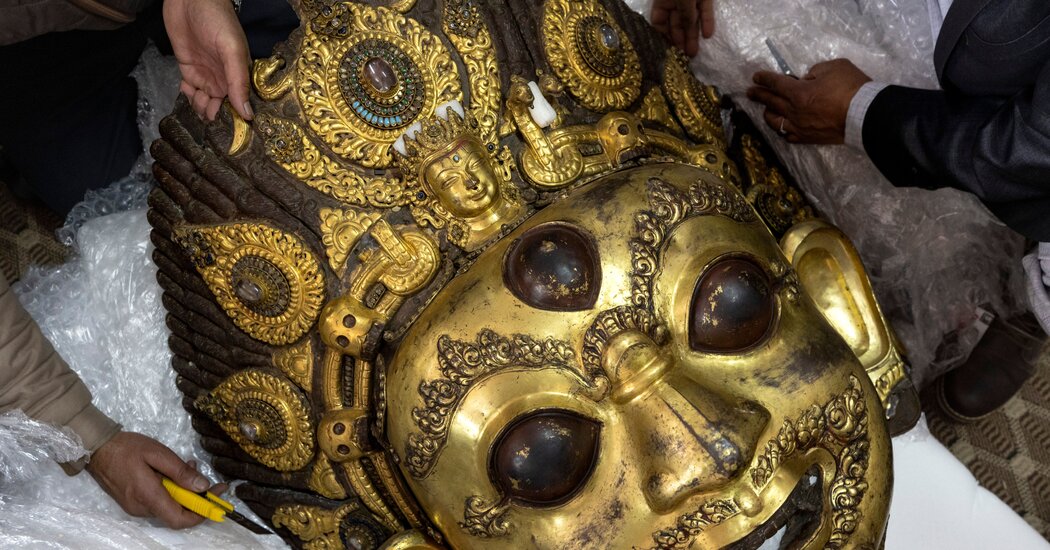
The Rubin Museum, which displays art from Tibet, Nepal and elsewhere in the Himalayan region, returned two stolen objects to Nepal in 2022 and last year surrendered another, a spectacular 16th-century mask depicting one of Shiva’s manifestations. By chance, I heard the news about the Rubin’s closing while I was looking at photographs from the mask’s homecoming ceremony.
The mask was one of a nearly identical pair depicting the snarling deity with golden skulls and snakes twining through blood-red hair. For centuries, they had been featured in an annual ceremony, in which worshipers sought blessings by drinking rice beer from the masks’ lips. In the mid 1990s they were both stolen from the home of the family that was entrusted to care for them when the ceremony was not underway.
The masks were sold several times, including at a Sotheby’s auction. One ended up in the collection of the Rubin Museum, whose founders, Donald and Shelley Rubin, began collecting Himalayan art in the 1970s. That was a time when collectors weren’t asking a lot of questions about the sources of the works they bought. Some even thought they were helping rescue artifacts from what they saw as neglect in modernizing countries. After evidence emerged to prove the mask, along with two carved wooden relics, had been stolen, the museum relented and sent them back to their home.
Like many other sacred artifacts in Nepal, the masks are considered living deities. My favorite photograph from the homecoming ceremony in Kathmandu shows an elder of the family that lost the masks three decades ago firmly holding the mask’s edge, as you might squeeze the hand of a lost child you have finally found. Propped up on a conference table at Nepal’s Department of Archaeology, the masks are already surrounded with signs of worship, including offerings of flower petals and silk scarfs. No longer are they merely artworks. They are once more fierce protectors of their community.
This photograph alone tells you more about the living cultural tradition in which the mask played a part before its theft, and will soon rejoin, than the mask itself did when on display and out of reach half a world away. I don’t think New Yorkers are losing out when Nepal or other communities regain their sacred artifacts, because I don’t think keeping them here tells us much about what was so important about them in the first place.
When I first went to Kathmandu, I saw how many Nepalis not only participate in major ceremonies, but still begin their days with a trip to the neighborhood shrine to worship images of the gods, many of them centuries old.
The stolen ritual artifacts that made their way into American collections once brought together families and communities. They once comforted people for the sorrows of their past and inspired them to hope for their future. Americans have crammed our museums full of other people’s treasures without capturing any of their real value. Keeping these artifacts in our museums will not help us experience more meaningful connections. But helping bring them back home just might.
The process of returning cultural artifacts can help us connect. Museums can display replicas alongside videos of repatriated artifacts in use. They can include voices from the communities that made the artifacts. They can commission work from contemporary artists working in long-lasting traditions. They can even follow the example of the Rubin Museum itself in offering assistance to communities that ask for training in conserving and displaying their treasures.
Maybe repatriation will empty some of our museums. There is less and less sacred art on view in American museums, especially from Asia, and the process is only now beginning. But repatriation can make an opening rather than leave a hole. Museums can become even better spaces for education, cross-cultural inspiration, and joy if they take more creative approaches to repatriation than deciding just to turn off the lights.

Erin L. Thompson is a professor of art crime at John Jay College of the City University of New York.
The Times is committed to publishing a diversity of letters to the editor. We’d like to hear what you think about this or any of our articles. Here are some tips. And here’s our email: [email protected].
Follow the New York Times Opinion section on Facebook, Instagram, TikTok, X and Threads.