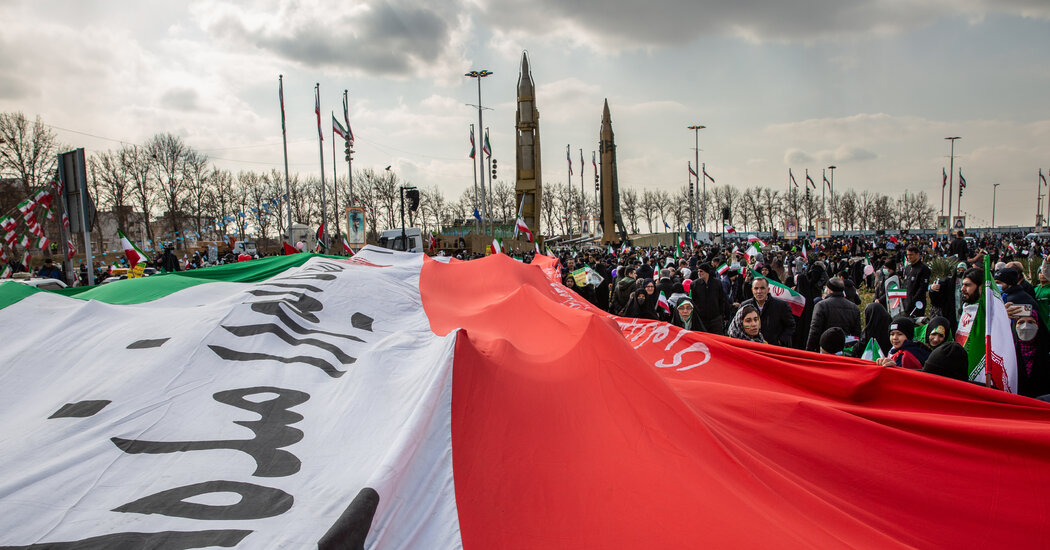

As Iran and the United States assessed the damage done by American airstrikes in Syria and Iraq, the initiative suddenly shifted to Tehran and its pending decision whether to respond or take the hit and de-escalate.
The expectation in Washington and among its allies is that the Iranians will choose the latter course, seeing no benefit in getting into a shooting war with a far larger power, with all the risks that implies. But it is not yet clear whether the varied proxy forces that have conducted scores of attacks on American bases and ships — and that rely on Iran for money, arms and intelligence — will conclude that their interests, too, are served by backing off.
In response to a drone attack by an Iran-backed militia that killed three American soldiers on Jan. 28, the United States hit back against that group and several other Iran-backed militias on Friday night with 85 targeted strikes. In the aftermath, American officials insisted there was no back-channel discussion with Tehran, no quiet agreement that the U.S. would not strike directly at Iran.
“There’s been no communications with Iran since the attack,” John Kirby, a spokesman for the National Security Council, told reporters in a call on Friday night after the retaliatory strikes were completed.
But even without direct conversation, there has been plenty of signaling, in both directions.
Mr. Biden is engaged in a military, diplomatic and election-year gamble that he can first restore some semblance of deterrence in the region, then help orchestrate a “pause” or cease-fire in Gaza to allow for hostage exchanges with Israel and then, in the biggest challenge of all, try to reshape the dynamics of the region.
But it is all happening in an area of the world he hoped, just five months ago, could be kept on the back burner while he focused on competition with China and the war in Ukraine, and in the middle of a campaign where his opponents, led by former President Donald J. Trump, will declare almost any move a sign of weakness.
For their part, the Iranians have been broadcasting in public that they want to lower the temperature — on the attacks, even on their quickly advancing nuclear program — though their ultimate objective, to drive the U.S. out of the region once and for all, remains unchanged.
Their first response to the military strikes on Saturday morning was notably mild.
“The attack last night on Syria and Iraq is an adventurous action and another strategic mistake by the American government which will have no result other than increasing tensions and destabilizing the region,” said Nasser Kanaani, a spokesman for Iran’s Foreign Ministry.
Until Friday night, every military action by the U.S. has been calibrated and cautious, the hallmark of Mr. Biden’s approach. The deaths of the American soldiers forced his hand, though, administration officials said.
He had to make clear that the United States would seek to take apart many of the capabilities of the groups that call themselves the “Axis of Resistance.” That’s a reference to the one concept that unites a fractious, often undisciplined group of militias — opposition to Israel, and to its chief backer, the United States.
And the strikes, Mr. Biden’s advisers quickly concluded, had to aim at facilities used by Iran’s Revolutionary Guards force.
But the president made the decision to strike largely at facilities and command centers, without aiming to decapitate the force’s leadership or threatening Iran directly.

There was no serious consideration of striking inside Iran, one senior administration official said after the first round of strikes was complete. And the telegraphing of the hit gave Iranians and their proxies time to evacuate senior commanders and other personnel from their bases, and disperse them in safe houses.
To Mr. Biden’s critics, this is too much calibration, too much caution.
“The overriding intellectual construct of Biden foreign policy is avoidance of escalation,’’ said Kori Schake, a former defense official in the George W. Bush administration who directs foreign and defense policy studies at the American Enterprise Institute.
“They are not wrong to be worried about escalation,” she said. “But they don’t take into account that it encourages our adversaries. We often seem more worried about fighting wars we can win, and that encourages them to manipulate our fear.”
For Ms. Schake, who was an early leader of the “Never Trump” camp of Republican national security officials, there is a middle ground between attacking Iran and focusing on the proxy groups, like Kataib Hezbollah and the Houthis, who have struck American forces. Mr. Biden could make clear, she said, that officers of the Revolutionary Guards forces “are targets anytime they set foot outside of Iran.”
Mr. Biden’s decision to mount the strike with B-1B bombers that took off from the continental United States carried its own message, of course: While Pentagon officials said the B1’s were the best bomber available for the complexity of these strikes, they were also the same warplanes that would be used in any attack on Iran’s nuclear facilities, should Tehran decide to make a final sprint for a nuclear weapon. Nothing reminds Tehran of the reach of American power more than a strike next door, one official said on Saturday morning.
What seems overcautious to some in Washington was still seen as hostile in the region. The Syrian Defense Ministry called the attack a “blatant air aggression,” not addressing the fact that the Assad government had let these militias operate from territory he ostensibly controls. Iraq’s government, which Washington has been trying not to destabilize, said that 16 people had been killed and 25 wounded on its territory, and that the attacks were “a threat that will drag Iraq and the region into unforeseen consequences.”
But the Iranians themselves were slow to respond, and even then they pointed to the Gaza war, not the U.S., as the culprit. In a statement, Mr. Kanaani said that the “roots of the tension and crisis in the region go back to the occupation by the Israeli regime and the continuation of this regime’s military operations in Gaza and the genocide of the Palestinians with the unlimited support of the U.S.”
And when Kateeb Hezbollah, one of the groups U.S. intelligence believes was involved in the deadly Jordan attack, declared earlier this week that it would no longer target American forces, it made clear that it was pressured by Iran and Iraq — and wasn’t happy about it.
It was a revealing moment about the two strategies that Iran appears to be pursuing. The first is a short-term approach related to the war in Gaza, where proxies have opened multiple fronts against Israel and escalated attacks on American bases to pressure Washington, which they see as Israel’s backer, to get a cease-fire. One senior American official noted recently that when a brief pause was declared in November and hostages were exchanged, the proxies suspended their attacks.
But there is a longer-term aim by Iran: to drive Americans out of the region with the help of its proxies in Iraq and Syria.
“This not an all-or-nothing moment for Iran — this is just one dot on a much longer plotline of Iran’s strategic agenda in the Middle East,” said Afshon Ostovar is an associate professor of National Security Affairs at the Naval Postgraduate School in Monterey, Calif., and an expert on Iran’s military. “Iran can suffer as many Iraqi and Syrian casualties as it likes,” he said. “It doesn’t feel compelled to respond to the deaths of proxy militants. But if Iranians are killed, it’s different.”
“For Iran this is a long war, not a short war, and this has nothing to do with Gaza.” It is, he said, “about Iran’s steady long march across the Middle East to push out U.S. forces and weaken U.S. allies.”
The evidence of the past few years suggests that military action by the U.S. may degrade capabilities, but it does not create long-term deterrence. When Mr. Trump ordered the American drone strike that killed the chief of the Quds force, Gen. Qassem Soleimani, he claimed it would stop Iran and its proxies from attacking Americans and their allies. It led to a pause, but not a halt.
Negotiation has done more, but not much more. When Washington and Tehran, through indirect negotiations that involved Oman and Qatar, negotiated last year for the release of $6 billion in frozen oil revenues in exchange for a detainee swap, attacks on U.S. bases in Iraq and Syria diminished significantly.
But that fell apart after Hamas attacked Israel on Oct. 7, resulting in roughly 1,200 Israeli deaths and setting off the Gaza war. Iran and its proxies have maintained that if a permanent cease-fire is reached in Gaza, things will again quiet down. But it is still unclear whether the cease-fire, or even another temporary pause, can be negotiated. And the history of the Middle East suggests the quiet may not be long-lived.