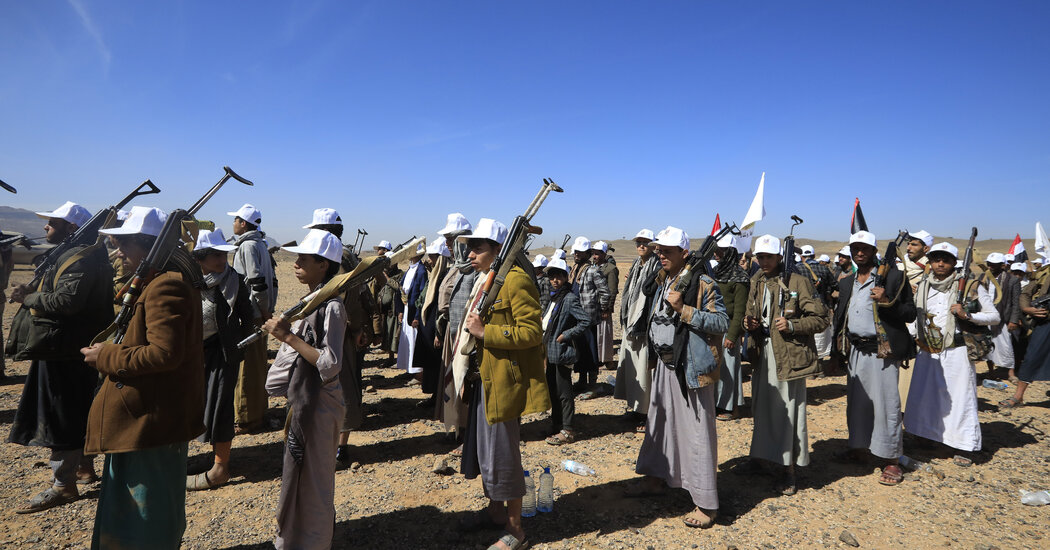

For years, the scrappy Iran-backed Yemeni rebels known as the Houthis did such a good job of bedeviling American partners in the Middle East that Pentagon war planners started copying some of their tactics.
Noting that the Houthis had managed to weaponize commercial radar systems that are commonly available in boating stores and make them more portable, a senior U.S. commander challenged his Marines to figure out something similar. By September 2022, Marines in the Baltic Sea were adapting Houthi-inspired mobile radar systems.
So senior Pentagon officials knew as soon as the Houthis started attacking ships in the Red Sea that they would be hard to tame.
As the Biden administration approaches its third week of airstrikes against Houthi targets in Yemen, the Pentagon is trying to thread an impossibly tiny needle: making a dent in the Houthis’ ability to hit commercial and Navy vessels without dragging the United States into a prolonged war.
It is a difficult task, made more so because the Houthis have perfected the tactics of irregular warfare, American military officials say. The group does not have many big weapons depots for American fighter jets to bomb — Houthi fighters are constantly on the move with missiles they launch from pickup trucks on remote beaches before hustling away.
The first barrage of American-led airstrikes nearly two weeks ago hit nearly 30 locations in Yemen, destroying around 90 percent of the targets struck, Pentagon officials said. But even with that high success rate, the Houthis retained around 75 percent of their ability to fire missiles and drones at ships transiting the Red Sea, those officials acknowledged.
Since then, the Pentagon has carried out seven more rounds of strikes. And the Houthis have continued their attacks on ships transiting the Red Sea.
“There is a level of sophistication here that you can’t ignore,” said Gen. Joseph L. Votel, who led the U.S. military’s Central Command from 2016 to 2019, as Saudi Arabia was trying to defeat the Houthis in Yemen.
So far the Pentagon strategy has been to put armed Reaper drones and other surveillance platforms in the skies over Yemen, so that U.S. warplanes and ships can hit Houthi mobile targets as they pop up.
On Monday night, the United States and Britain struck nine sites in Yemen, hitting multiple targets at each location. Unlike most of the previous strikes, which were more targets of opportunity, the nighttime strikes were planned. They hit radars as well as drone and missile sites and underground weapons storage bunkers.
This middle ground reflects the administration’s attempt to chip away at the Houthis’ ability to menace merchant ships and military vessels but not hit so hard as to kill large numbers of Houthi fighters and commanders, potentially unleashing even more mayhem into the region.
But officials say they will continue to try to hit mobile targets as analysts search for more fixed targets.
After nearly a decade of Saudi airstrikes, the Houthis are skilled at concealing what they have, putting some of their launchers and weaponry in urban areas and shooting missiles from the backs of vehicles or tractors before scooting off.
And the weapons that are destroyed are soon replaced by Iran, as a never-ending stream of dhows ferry more weaponry into Yemen, U.S. officials say.

Even a seemingly successful American commando operation on Jan. 11 that seized a small boat carrying ballistic-missile and cruise-missile components to Yemen came at a cost: the Pentagon said on Sunday that the status of two Navy SEALs reported missing during the operation had been changed to dead after an “exhaustive” 10-day search. Navy commandos, backed by helicopters and drones hovering overhead, had boarded the small boat and seized propulsion and guidance systems, warheads and other items.
The Houthis are believed to have had underground assembly and manufacturing sites even before the civil war began in Yemen in 2014. The militia seized the country’s army arsenal when it took over Sana, the capital, a decade ago. Since then, it has amassed a diverse and increasingly lethal arsenal of cruise and ballistic missiles and one-way attack drones, most supplied by Iran, military analysts said.
“It’s mind-blowing, the diversity of their arsenal,” said Fabian Hinz, an expert on missiles, drones and the Middle East at the International Institute for Strategic Studies in London.
Hezbollah, the Iran-backed Lebanese militia, has helped as well. Top Houthi commanders studied under Hezbollah trainers in Lebanon on, first and foremost, how to be adaptable, said Hisham Maqdashi, a defense adviser with the internationally recognized Yemeni government.
Hezbollah “trained them to be able to adapt to the changes of the war in Yemen,” Mr. Maqdashi said in an interview. “They did not train them on the specifics, but on how to be very dynamic.”
That leaves the United States and its coalition partners with only three viable options, given the parameters of President Biden’s strategic aims in Yemen, military analysts say. They could commandeer the weapons coming by sea from Iran; find the missiles, which requires extensive intelligence; or attack the launch sites.
The third option is the hardest. Houthi militants are believed to hide mobile missile launchers in a range of locations, anywhere from inside culverts to beneath highway overpasses. They are easily moved for hasty launches.
The Houthi mobile maneuvers worked so well against Saudi Arabia that the Marines began an experimental effort to copy them. They developed a mobile radar, essentially a Simrad Halo24 radar — you can get one for about $3,000 at Bass Pro Shops — that can be put on any fishing boat. It takes five minutes to set up. The Marines, like the Houthis, have been looking into how to use the radars to send data back on what’s going on at sea.
Lt. Gen. Frank Donovan, now the vice commander of United States Special Operations Command, noticed what the Houthis were doing with the radar back when he was leading a Fifth Fleet amphibious task force operating in the southern Red Sea. Trying to figure out how the Houthis were targeting ships, General Donovan soon realized the Houthis were mounting off-the-shelf radars on vehicles on the shore and moving them around.
He challenged his Second Light Armored Reconnaissance Battalion to develop a similar system.