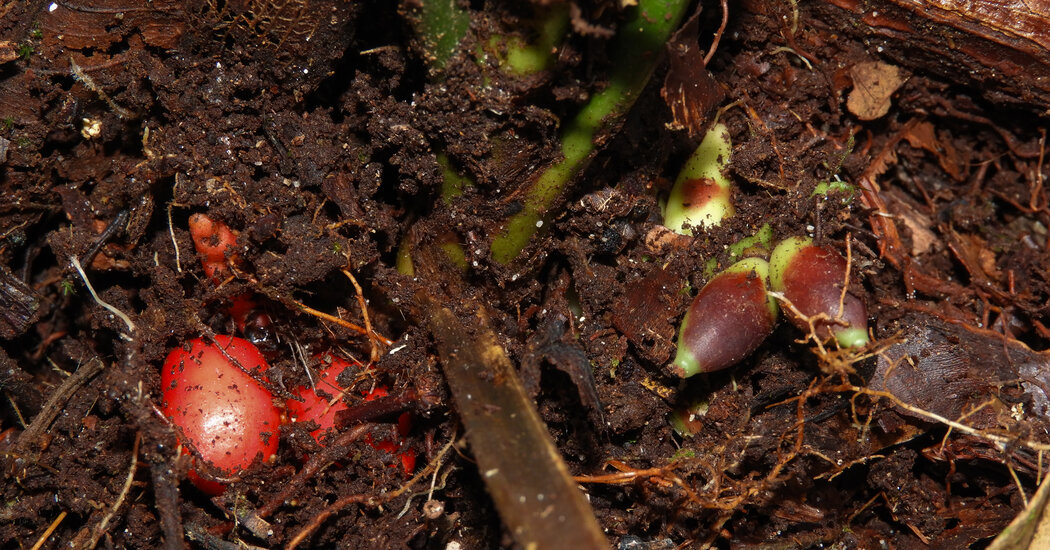

As a group of European botanists prepared to travel across Borneo by motorboat and four-wheel-drive vehicles, they heard about a species of palm with an extremely rare quirk.
It flowers underground.
The palm, Pinanga subterranea, is one of 74 plants that scientists from the Royal Botanic Gardens, Kew, in London named as new to science last year, thrilling some in the botany world. The botanists who went plant-hunting in Southeast Asia six years ago were not expecting to find it.
But the plant is not hard to find: It grows abundantly on Borneo, the third-largest island in the world, which includes parts of Indonesia and Malaysia. It is also not “new” because local Indigenous groups have known about it, two representatives for those groups said in interviews.
In that sense, the “discovery” of Pinanga subterranea is an example of conventional science catching up with Indigenous knowledge.
“We have described this as new to science,” said William J. Baker, the most senior scientist on the trip. “But the preexisting knowledge about this palm is layered, and was already there before we even got anywhere near it.”
Over the past 30 years, non-Indigenous scientists have turned more to Indigenous knowledge to expand or test their research, with varying degrees of sensitivity.
In some cases this has been seen as cultural appropriation, said George Nicholas, an archaeologist at Simon Fraser University in British Columbia who has written about the issue. Indigenous peoples have raised complaints of scientific colonialism, particularly when researchers seek to develop drugs based on untapped sources of traditional knowledge, he said.
There have been a number of collaborative studies that credit Indigenous communities with having generations of wisdom on topics that include shellfish productivity, grizzly bear management and raptor behavior. In some cases the communities lead or participate in the research.
Such collaborations are partly a function of non-Indigenous scientists acknowledging gaps in their knowledge, but there is often a hesitancy within Indigenous communities to share information with outsiders, said Lynette Russell, an anthropological historian at Monash University in Australia.
“In order to share, you really need to get to know the researchers,” she added. “That’s not something you can necessarily do by a fly in, fly out visit.”
In the case of the palm that flowers underground, the Kew scientists did not learn about it directly from Indigenous groups, but from Paul Chai, a Malaysian scientist from Borneo who had first encountered it about 20 years earlier. In October 2018, over laksa and tea in the city of Kuching, Dr. Chai told them about the plant as they were preparing to visit a wildlife sanctuary on an unrelated botanical expedition.
Dr. Chai, now 82, had learned that members of a local Indigenous group, the Kenyah, sometimes chewed the fruit of the plant with betel leaves. The Kenyah are a subgroup of a Borneo Indigenous tribe known as the Dayak. Their livelihood revolves around harvesting forest products, including agarwood, a valuable ingredient in perfume.
Dayak people typically learn about plants from their parents, and the forest is so important to them that an Indigenous idiom likens it to breast milk, said Seting Beraan, a member of the Dayak and a regional chairwoman with the Alliance of Indigenous Peoples of the Archipelago, an Indonesian nonprofit that represents several groups.

“When we were going to the forests as kids, our parents would say, ‘Don’t eat that, it can make you sick’ or ‘This can cure fever,’ or that we could eat the fruit straightaway,” she said.
As for Pinanga subterranea, the Kew researchers weren’t the only scientists to find it. Around the same time, an Indonesian botanist Agusti Randi, was learning its local Indigenous names and planting its seeds in his garden on another part of Borneo.
When the Kew scientists later told Mr. Agusti about their Borneo research, he said he had seen it as well, Professor Baker said. So the Kew crew, along with Dr. Chai, teamed up with Mr. Agusti to write a paper about the plant that was published last year in the scientific journal Palms.
Scott Zona, a botanist in North Carolina and a co-editor of Palms, said that Pinanga subterranea was “the palm discovery of 2023, if not the decade.” He added that further research on it could help explain the evolutionary pressures that drive some plants underground.
Mr. Agusti, who was the study’s lead author, said that he thinks the plant might bloom underground, where there are fewer predators, to protect its flowers. The only other known plant species that flowers and fruits underground belong to a mysterious genus of orchid in Australia.
Professor Baker said that the plant’s underground activity makes it almost impossible to study. How would one analyze its pollination process without disrupting it or decide which specimen to target in the first place?
“It’s undergroundness is probably what has prevented botanists from properly ‘discovering’ it, in inverted commas,” he added. Generally, when we go collecting, we don’t collect things that aren’t flowering and fruiting” he said.