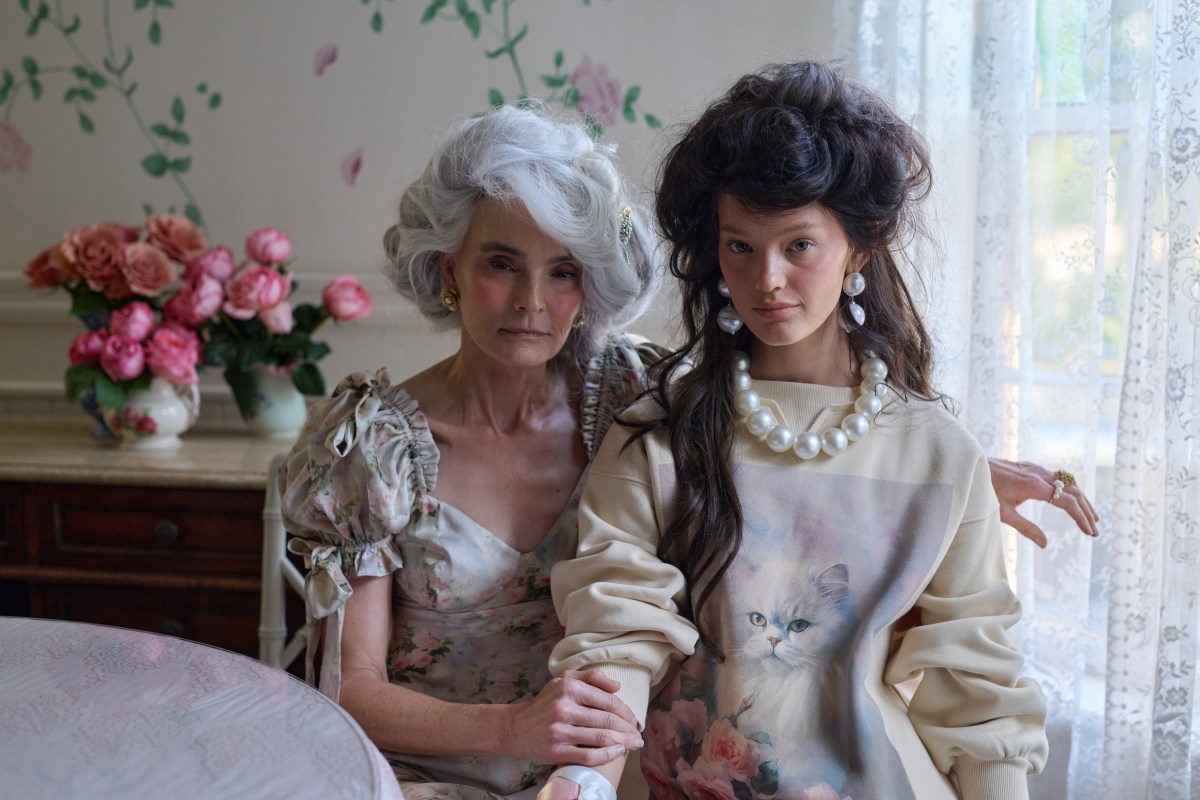

When Selkie, the fashion brand viral on Instagram and TikTok for its frothy, extravagant dresses, announces new collections, reception is generally positive. Known for its size inclusivity — its sizing ranges from XXS to 6X — and for being owned and founded by an independent artist who’s outspoken about fair pay and sustainability in fashion, Selkie tends to be highly regarded as one of the morally “good” brands online.
The brand’s upcoming Valentine’s Day drop was inspired by vintage greeting cards, and features saccharine images of puppies surrounded by roses, or comically fluffy kittens painted against pastel backdrops. Printed on sweaters and dresses adorned with bows, the collection was meant to be a nostalgic, cheeky nod to romance. It was also designed using the AI image generator Midjourney.
“I have a huge library of very old art, from like the 1800s and 1900s, and it’s a great tool to make the art look better,” Selkie founder Kimberley Gordon told TechCrunch. “I can sort of paint using it, on top of the generated art. I think the art is funny, and I think it’s cheeky, and there’s little details like an extra toe. Five years from now, this sweater is going to be such a cool thing because it will represent the beginning of a whole new world. An extra toe is like a representation of where we are beginning.”
But when the brand announced that the collection was designed using generative AI, backlash was immediate. Selkie addressed the use of AI in art in an Instagram comment under the drop announcement, noting that Gordon felt that it was “important to learn this new medium and how it may or may not work for Selkie as a brand.”
Criticism flooded the brand’s Instagram comments. One described the choice to use AI as a “slap in the face” to artists, and expressed disappointment that a brand selling at such a high price point ($249 for the viral polyester puff minidress to $1,500 for made-to-order silk bridal gowns) wouldn’t just commission a human artist to design graphics for the collection. Another user simply commented, “the argument of ‘i’m an artist and i love ai!’ is very icky.” One user questioned why the brand opted to use generative AI, given the “overwhelming number” of stock images and vintage artwork that is not copyrighted, and “identical in style.”
“Why make the overwhelmingly controversial and ethically dubious choice when options that are just as cost effective and more ethical are widely available?” the user continued. “If you have indeed done the research you claim to have on AI, then you also understand that it’s a technology that requires the theft and exploitation of workers to function.”
Gordon said she spends about a week designing collections, but it takes months to a year of development and manufacturing before they’re actually sold online. In the year since she finalized designs for this drop, public opinion of AI art has shifted significantly.
As generative AI tools become more sophisticated, the use of AI in art has also become increasingly polarizing. Some artists like Gordon, who designs Selkie’s patterns herself using a blend of royalty-free clip art, public domain paintings, digital illustration and Photoshop collaging, see AI image generators as a tool. Gordon likens it to photography: it’s new now, but future generations may accept it as another art medium. Many artists, however, are vocally opposed to the use of generative AI in art.
Their concerns are twofold — one, artists lose opportunities to cheaper, faster AI image generators, and two, that many generators have been trained on copyrighted images scraped from the internet without artists’ consent. Pushback against generative AI spans across all creative industries, not just in visual art. Musicians are speaking out against the use of deepfake covers, actors are questioning if SAG-AFTRA’s new contract adequately regulates AI in entertainment, and even fanfiction writers are taking measures to prevent their work from being used to train AI models.
Of course, not all generative AI is exploitative; as a VFX tool, it’s immensely useful to enhance animations, from creating more realistic flames in Pixar’s “Elemental” to visualizing complex scenes in HBO’s “The Last Of Us.” There are plenty of examples of morally bankrupt applications of generative AI. Creating deepfake revenge porn, for example, or generating “diverse models” instead of hiring actual people of color is objectively horrifying. But most of the generative AI debate settles into a morally gray area, where the parameters of exploitation are less defined.
In Selkie’s case, Gordon solely designs all of the graphics that are featured on Selkie garments. If someone else designs them, she makes it clear that it’s a collaboration with another artist. Her designs typically involve a collage of digital watercolor painting, stock images and “old art” that is no longer copyrighted. Many of her popular designs incorporate motifs from famous works of art, like Van Gogh’s “Starry Night” and Monet’s “Water Lilies,” which she uses as a base to create a unique, but still recognizable pattern. After she alters and builds upon the already existing work, it’s printed onto gauzy fabric and used to construct billowing dresses and frilly accoutrements.
The Valentine’s Day drop, Gordon argued, is no different, except that she used generated images as the design base, instead of public domain artwork. The patterns that she created for this collection are just as transformative as the ones she designed for previous drops, she said, and involved as much altering, original illustration and “creative eye.”

“I say this is art. This is the future of art and as long as an artist is utilizing it, it is the same as what we’ve been doing with clip art,” Gordon said. “I think it’s very similar, except it gives the artists a lot more power and allows us to compete in a world where big business has owned all of this structure.”
Gordon bristled at accusations equating her use of generative AI to that of companies that have replaced employed artists with AI image generators. She pointed out that she couldn’t have “replaced artists,” since she is the brand’s only in-house artist, and that the steep prices that Selkie charges for each ruffled dress account for material and labor cost. If clothing is cheap, she said, it’s usually because the garment workers making them are not being paid fairly. Gordon added that although she’s paid as the “business owner,” she doesn’t factor her own labor as a designer into her salary in order to cut overhead costs.
Gordon also noted that she didn’t use any other artists’ names or work as prompts when she used Midjourney to generate the base images. She turned to AI for efficiency — she said that it was a “great brainstorming tool” to visualize what she wanted the collection to look like — and out of fear of being left behind. Artists face mounting pressure to adapt to new technology, she said, and she wanted to be ahead of the curve.
“I’m not using AI models. I’m only using the AI as a tool where I would usually be doing it. I’m not trying to take away anyone’s job at my own company,” she said. “I’m using it as a way for myself to be efficient instead. If I had been utilizing lots of artists to make my prints, and then I suddenly used AI, I would definitely be taking away from them. How can I take away from myself?”
This is the nuance that isn’t always reflected in conversations about art and AI. Gordon owns a popular, but relatively small fashion brand that she uses as a vehicle to monetize her own artwork. Could she have commissioned another artist for oil paintings of lovesick puppies and kittens? Yes. Is it likely that the generated images of generic, vintage Valentine’s Day cards lifted the work of any living artist? Unclear, but so far, nobody has publicly accused Selkie of copying their art for the new collection. Gordon’s use of AI generated images is nowhere near as egregious as those of other, bigger fashion brands, but more sanctimonious critics argue that any use of AI art perpetuates harm against artists.
Gordon, for one, said she’s listened to the criticism and doesn’t plan to use AI generated images in future Selkie collections. She believes that regulation is lacking when it comes to generative AI, and suggested that artists receive some kind of payment every time their names or work is used in prompts. But she does plan to continue experimenting with it in her personal art, and maintained her stance that at the end of the day, it’s just another medium to work with.
“Maybe the way that I did it and this route is not the right way, but I don’t agree that [AI] is a bad thing,” Gordon said. “I feel that it is tech progress. And it’s neither good nor bad. It’s just the way of life.”