

As Jerry Maguire once said — “Show me the money.”
That phrase is probably something you’ve thought of as a marketer who has invested in paid advertising. With paid advertising, you want to enhance your marketing campaign by showing up in the right place, at the right time, with the right content.

But sometimes, running paid ads — like pay-per-click (PPC) on Google — feels like you’re spending a lot of money without seeing any results. And with 70% of consumers seeing irrelevant ads from brands at least once a month, it’s no wonder so many are put off by online ads.
Contextual targeting is the solution to that problem.
Below, let’s review contextual targeting and the difference between contextual and behavioral targeting. We’ll also explore contextual keyword targeting and how to get started with contextual ads.
Table of Contents:
What is contextual targeting?
Contextual targeting is a form of personalized advertising that enables your Google PPC ads to appear on relevant sites. To get started, input keywords or topics, and set your campaign to show ads on the Display Network. Google will then analyze the content on a website and match that against your ad using keywords, topics, language, and location.
Imagine you’re the proud owner of a local coffee haven, and you’ve whipped up a PPC ad to stir up some buzz. Now, picture a coffee enthusiast nearby, scouring the web for the best brews.

They stumble upon a blog about coffee wonders, and there’s your ad — like a welcome sign to your coffee shop.
Google’s not just throwing your ad anywhere. It’s selectively showing it to folks who can practically smell the coffee from their backyard.
This person’s already got coffee on the brain, so your ad isn’t a cold splash in the face — it’s a warm invite to come and sip with you.
Contextual targeting isn’t just a single-flavor technique; it’s got a variety to suit your advertising palate. Here’s a taste of what’s on the menu:
- Category Contextual Targeting. Think of this as your buffet option — it’s broad, serving up ads based on general categories like lifestyle, automotive, or tech. While it gets your ad out there, it might sit next to unrelated content, like a dessert fork at a soup setting.
- Keyword Contextual Targeting. Here’s where you get to order à la carte. You handpick target keywords, and your ads find their way to web pages that feature these select terms. It’s a more tailored fit, like finding a table at a restaurant that caters to your specific cravings.
- Semantic Contextual Targeting. Welcome to the chef’s table of contextual targeting. This method is all about the nuances, using machine learning to dig deep into the page’s content, understanding the context, and then deciding if your ad should take a seat there. It’s sophisticated, refined, and ensures your ad is more than just seen — it’s understood and relevant.
In the big picture, contextual targeting is about placing your ad into conversations where it naturally belongs.
Whether it’s activewear sidling up next to articles about high-intensity workouts or gym gear ads flexing on pages reviewing the latest protein powders, it’s all about relevance.
The goal? To make your ad feel less like an ad and more like part of the content, people are there to enjoy.
Contextual Targeting vs. Behavioral Targeting
Alright, picture this: You’re in the digital marketing ring, and in one corner, you’ve got contextual targeting, duking it out with topics and keywords. In the other corner? Behavioral targeting, squaring up with a user’s online activity.
Behavioral targeting is a bit like a detective. It’s been tailing you online, keeping tabs on your digital footprints — like what links you’ve clicked, how much time you’ve spent on a page, and what you’ve been searching for. It’s smart to use your online behaviors to figure out exactly what ad to throw at you next.
Take retargeting, for example. Say, I’ve got a thing for sneakers. I’m on the hunt, checking out “running shoes” and “hiking boots,” but I’m just window-shopping. The next thing I know, my social feeds are like a personalized shoe store, thanks to behavioral targeting.
Now, flip back to contextual targeting. Here’s how it rolls: I’m deep-diving into an article about the best running shoes, and bam! There’s an ad for the latest kicks or a local shoe shop on the page. It’s not stalking my behavior; it’s just smart enough to be in the right place at the right time.
But how does contextual targeting really work? One word — keywords.
Contextual Keyword Targeting
Let’s cut to the chase with keywords. They’re the compass for contextual targeting — pointing your ads in the direction of relevant sites.
Here’s how you get in the game: Start with your PPC campaign in Google, and choose those keywords like a pro. You want to be specific but not so niche you’re invisible.
Imagine you’re promoting dumbbells. You’d go for keywords like “dumbbells” and “strength equipment,” making sure your ad flexes its muscles on related sites. But hey, don’t let your ad crash the barbell party — throw “barbells” into your negative keywords.
If you play the topic card instead, say “health and fitness,” it’s like casting a wider net. You might catch more fish, but will they be what you really want?
Google’s two cents? Keep your ad group tight — think 5 to 50 keywords. And don’t get tangled up in long-tail keywords like you’re fishing for organic clicks. Keep it short and strong.
Contextual Ads
To begin creating contextual ads, you need to think about the buyer’s journey. First, you’ll build out your buyer persona. Second, you’ll map out your buyer’s journey. Then, you’ll think of websites your audience might look at during their journey. Lastly, you’ll draft keywords that match those sites and create an ad that would fit in.
So, what do contextual ads look like in action? Let’s review a few examples.
1. Coffee Maker Example
Roasty is a free blog that focuses on finding and brewing delicious coffee. While I was reading an article, “50+ Different Types of Coffee Drinks Explained,” I came across an ad for a Gevi pour-over coffee machine.
This ad wasn’t disruptive to my reading process because it fit in well with the content I was reading.
See the image below for what the ad looked like:

Pro tip: Seamlessly place your ads in contextually appropriate places so that it plays into viewers’ interests to increase the likelihood of clicks.
2. Pizza Cutter Example
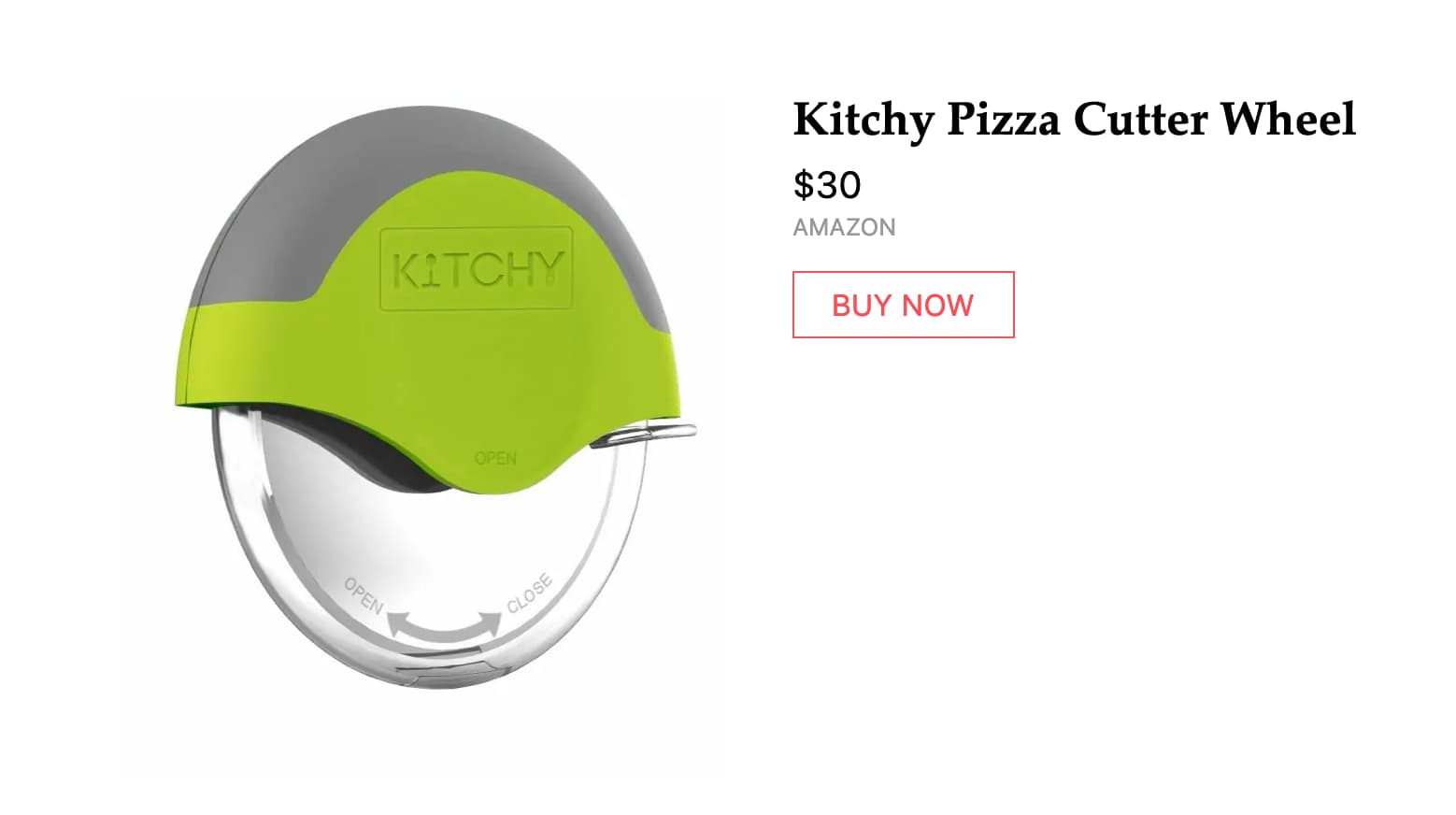
Kitchn is an online daily food magazine. While reading, “How To Make Perfect Pizza at Home,” I came across an ad for a pizza cutter.
This is a great example of contextual ads in practice:
Pro tip: When choosing your target keywords, brainstorm lots of possible scenarios and keywords which are relevant to your product or service, then narrow them down to the most relevant ones.
3. Gucci Example
Recently I was reading a Conde Nast Traveler article, “All of Our Best Packing Lists in One Place,” when I came across an ad for Gucci.
This is a contextual ad because I was reading an article about travel, and then I saw an ad for Gucci showcasing luggage and travel bags — it’s likely Gucci chose “travel” as a keyword to target for their ads.

Pro tip: When you’re running a paid advertising campaign, it’s important to be as specific as you can with your targeting options. Ultimately, your targeting can make or break the success of your ad.
Benefits of Contextual Targeting
In my time in the trenches of digital marketing, I’ve cracked the code on why some ads just work. It’s not just about showing up; it’s about showing up with style and ensuring you fit the room you’re walking into.
I’ve rolled up my sleeves and got my hands dirty with every kind of ad campaign you can imagine, and it’s this down-to-earth approach that’s shown me contextual targeting is the real deal. It’s all about making sure you’re adding to the conversation, not interrupting it.
Peek into the toolkit of any shrewd marketer, and you’ll find a gem called contextual targeting — a tool that’s about as close as you can get to a “welcome” mat in the digital ad space.
It’s like finding the right groove in a sea of tunes, where your ad dances to the same beat as the content surrounding it. Here are some of the benefits I’ve found this strategy has to offer.
Tuning Into a Receptive Audience
Imagine placing your ad not just anywhere but in a spot where eyes are wide with interest. That’s the power of contextual targeting.
Whether it’s woven through related categories or sprinkled among specific keywords, your ad lands on pages that resonate with the reader’s current vibe.
It’s the marketing equivalent of reading the room — your ads don’t just show up; they belong, increasing the chances that intrigued users will waltz right into your call-to-action.
Vitaly Pecherskiy says, “Reaching a user in the contextual environment inherently means that they’re in the moment researching relevant topics.”
A Wallet-Friendly Serenade
That’s music to every marketer’s ears: cost-effectiveness.
Contextual targeting sings the tune perfectly. With an approach that’s simpler on the wallet than, say, its high-maintenance cousin, behavioral marketing, it’s a method that lets even the leanest of budgets dance to the beat of broad exposure and relevance.
The Quick-Step Setup
In the dance of marketing strategies, contextual targeting is the easy-to-learn waltz that gets you on the floor in no time.
Forget about collecting and analyzing heaps of data before making a move. With platforms like Google Display Network leading, you can have your ad gliding across screens swiftly with just a few simple steps.
Choreographing Personalization
Digital marketing’s open secret? Personalization is the key to the audience’s heart.
In fact, 71% of consumers actually expect companies to deliver personalized interactions, and 76% get frustrated when that’s not their experience.
Using contextual targeting to create more personalized experiences offers a great way to connect with your audience and build a long-lasting relationship for a repeat buying journey.
Boosting Sales With Graceful Precision
Every business’s ultimate tango is with sales, and contextual targeting twirls you closer to that goal.
It’s about placing your ad on the right stage where the audience is already applauding, guiding more traffic to your virtual doorstep, and setting the stage for an encore performance — a conversion.
Future-Proofing with Cookie-less Cadence
In today’s world, where digital privacy is a headline act, contextual targeting moves to the forefront.
It sidesteps the legal limelight that cookies have found themselves in, offering a performance that respects privacy laws like GDPR and dances smoothly with the audience’s expectations.
Hersh Patel says, “With the demise of the cookie, advertisers need to leverage a powerful use case of contextual, which is positive targeting — to target articles that are aligned with the tops of campaigns and align with the values of the products being advertised.”
Unlock the Power of Context With Targeted Ads that Resonate and Deliver Results
Ready to jump into contextual targeting? Start by getting cozy with the topics that get your audience talking.
Pin down where these chats are happening, and set your ads to sashay into the scene right alongside the content your audience is already loving. Quick tip: Tailor your keywords to match the content topics your audience digs into.
Remember, when your ad lands on a page that’s already sparking interest, it becomes part of the landscape, not a billboard blocking the view.