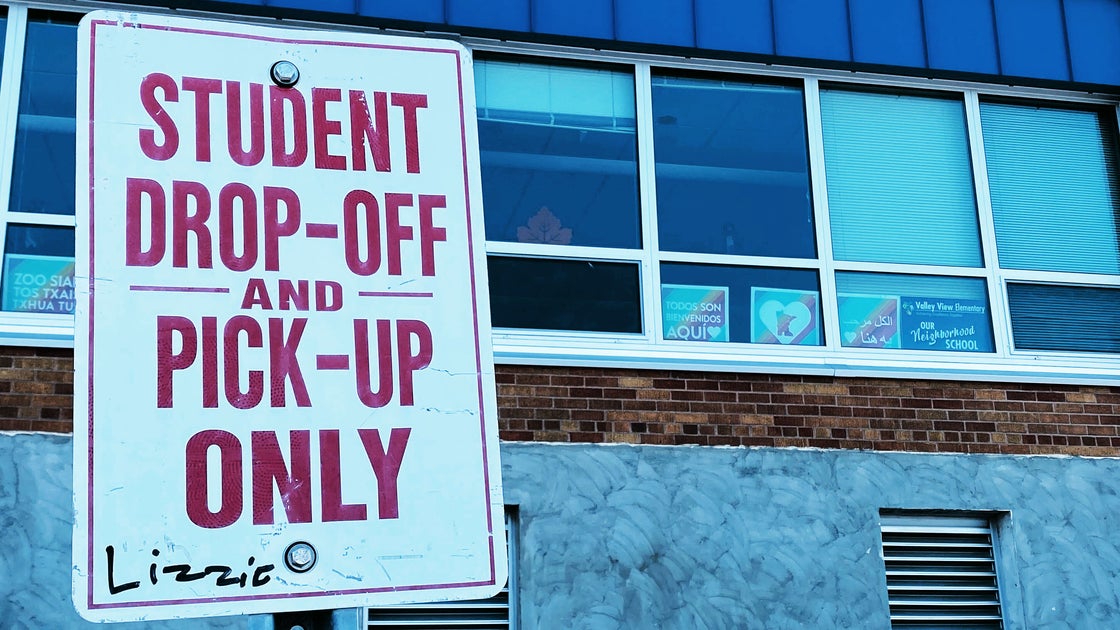

COLUMBIA HEIGHTS, Minn. – The hallways at Valley View Elementary School used to be bustling with children, eager to get to class and see their friends. They’re silent now.
Outside, immigration agents drive up and down the street multiple times a day. They linger at dismissal time, when kids are walking home or being picked up. They follow parents driving other people’s kids home; those kids’ families are too scared to leave their houses. They wait at bus stops. At the nearby high school, Immigration and Customs Enforcement agents sit out back to try to catch students exiting that way. School staff, retired teachers, parents and grandparents stand outside in shifts, with whistles, ready to blow if they see unmarked cars driving near the school when children are outside.
It’s common to see a string of empty cars lining the main road through this Minneapolis suburb. Doors are thrown open and the cars are sometimes still running, but there’s nobody in them — ICE agents ripped the people out of them and whisked them away.
This is how life is now for families in this largely Latino community that has been, for the past two months, under what the Trump administration says is a campaign to deport undocumented immigrants who are criminals. Except that’s not at all what’s happening here. Masked and heavily armed federal agents are just terrorizing brown and Black people, regardless of their citizenship status or criminal background.
School leaders are caught in the middle of this, trying to keep providing kids with a safe space to learn as their friends disappear and children cry about not knowing whether their parents will be home when they get off the bus. Even Zena Stendvik, the superintendent of the Columbia Heights public school district, often patrols outside with parents and staff.
“I stopped wearing my high heels to work,” Stendvik told HuffPost. “I wear my boots to work, because I have had to run out onto a corner or into the back of the high school.”
“I stay on the perimeter of our school and help direct students, either to go back into the building or, you know, just stay with me and watch for a second to make sure it’s OK,” she said. “We have numerous staff and, like you said, grandmas and grandpas and other people at every corner of every school building, every morning, every afternoon.”
Liam Conejo Ramos, the 5-year-old whose photo went viral after ICE agents nabbed him last week in front of his house, is a preschool student at Valley View Elementary School. He’s now locked up in a Texas detention center with his dad, his mental and physical health deteriorating as his desk sits empty at school. ICE agents allegedly used Liam as bait to detain his father, who is not in the country illegally and has no criminal record.
Ramos is one of six children in this school district recently detained by ICE. Two were just detained Thursday, a second-grader and a fifth-grader, both students at Ramos’ school. Federal agents nabbed their mother after a court appointment she had earlier in the day for an update on her asylum status.
With no other family in Minnesota to care for her children, she contacted the school’s principal, Jason Kuhlman, and asked him to bring her two boys to the detention center to be with her.
“I’m bringing kids to jail, in my mind that’s what I was wrestling with,” Kuhlman told HuffPost on Friday. “Something that I’m fighting so hard to not do, I ended up doing.”
“I stopped wearing my high heels to work. I wear my boots to work, because I have had to run.”
– Zena Stendvik, superintendent of Columbia Heights public school district
By Friday morning, less than 24 hours after their detention, the boys and their mom had already been shipped off to the same nightmarish Texas detention facility as Ramos. There’s another fourth-grader there from their school, too.

“In 28 years, I’ve lost kids to cancer. I’ve lost kids to violence. I’ve lost parents,” Kuhlman said. “I am losing two children to a detention center and I don’t know if we’ll ever see them again.”
A 17-year-old almost became the seventh student detained on Tuesday. He was on his way to high school, alone, when ICE agents stopped his car. They ultimately let him go, but only because he was carrying his passport.
President Donald Trump suggested this week that he planned to “de-escalate” his crackdown in Minnesota, after federal agents fatally shot Alex Pretti, but Stendvik said nothing has changed in her community
“They’re very active still,” she said. “We haven’t seen any change.”
Some families have stopped sending their kids to school at all. About 20% of the school district’s students have enrolled in virtual school over the past month, Stendvik said, and it’s taking a toll on students academically and socially.
For those still coming into Valley View Elementary School, they are greeted with signs on the front doors warning ICE agents they can’t come onto the property without a signed judicial warrant. These messages are a stark contrast to the rows of rainbow signs in classroom windows along the side of the school that read, “TODOS SON BEINVENIDOS AQUI.” (“All are welcome here.”)

Photo by Jen Bendery/HuffPost
“It’s kind of eerie in the hallways, because there are so many less students right now,” Stendvik said. “I just keep reminding everyone that we cannot normalize this.”
Minneapolis-area educators and parents came together for a Tuesday press conference to try to convey how devastating ICE has been for children and their learning experience. Peg Nelson, a 33-year teacher in Columbia Heights public schools, said every student from pre-K through high school “has been terrorized by ICE operations.”
“These actions have changed the very fabric of our Columbia Heights schools and have made every student, teacher and parent less safe,” said Nelson. “Families are afraid to leave their homes for fear of racial profiling and wrongful arrest. Students are afraid to come to school. We haven’t seen absenteeism like this since COVID.”
Meanwhile, educators are being forced to take on responsibilities far beyond their normal duties. After teaching all day, they’re delivering food to families and waiting with students at bus stops and parent pick-up zones, she said, moving as quickly as possible so families can avoid run-ins with ICE. They’re raising funds to support immigrant families, and every school in the district has become a food-collection and distribution center.
“Even while delivering food, educators have been followed by ICE,” said Nelson. “Staff are doing their best to hold it together, but every day we wonder, ‘How long is this sustainable?’”
“Our community is giving everything it has to face these dangers, which have been forced upon us by our federal government,” she added, choking up. “It is a time for our leaders to do what’s right and protect Minnesota’s children and educators by ending ICE operations in our state.”

Columbia Heights Public Schools
At the same event, the mother of a South Minneapolis elementary school student laid out what a typical day looks like for her now.
“In between bites of breakfast and sips of coffee, I’m checking the neighborhood feeds to see what the neighborhood is like around our school and our most important bus stops,” said Elizabeth, who only gave her first name. “Once I have successfully gotten my child dressed for school, we head outside, both with our whistles around our neck, just in case we need to alert our neighbors of danger.”
Through tears, she described her child walking kids into class when they’re too scared to go alone, and her “car service” of taking other people’s kids home because they’re afraid to get them themselves. Some parents haven’t left their homes in seven or eight weeks, she said, and she can barely communicate with them. And yet, they’ve trusted her, a virtual stranger, to make sure their kids come home after school every day.
“All this is racing through my mind as I’m checking my mirrors for safety and still singing along with K-Pop Demon Hunters,” Elizabeth said. “It is their parents that should be in the car singing and hearing their stories of the day.”
“This is not an acceptable way to raise our next generation,” she added. “This is why we need ICE out of our schools and out of Minnesota.”
Kuhlman, the school principal, said he worries that people don’t realize what’s happening in Minnesota is just the beginning of ICE’s plans for other cities and states. Trump isn’t de-escalating at all in this community, he said.
He’s come to dread the weekends because Mondays are when he finds out how many other kids and their families were taken away.
“Pardon this analogy, because it’s horrible, but it sure the hell fits — it feels like we’re in a school shooting,” Kuhlman said. “We’re not stopping it, we’re just minimizing it.”