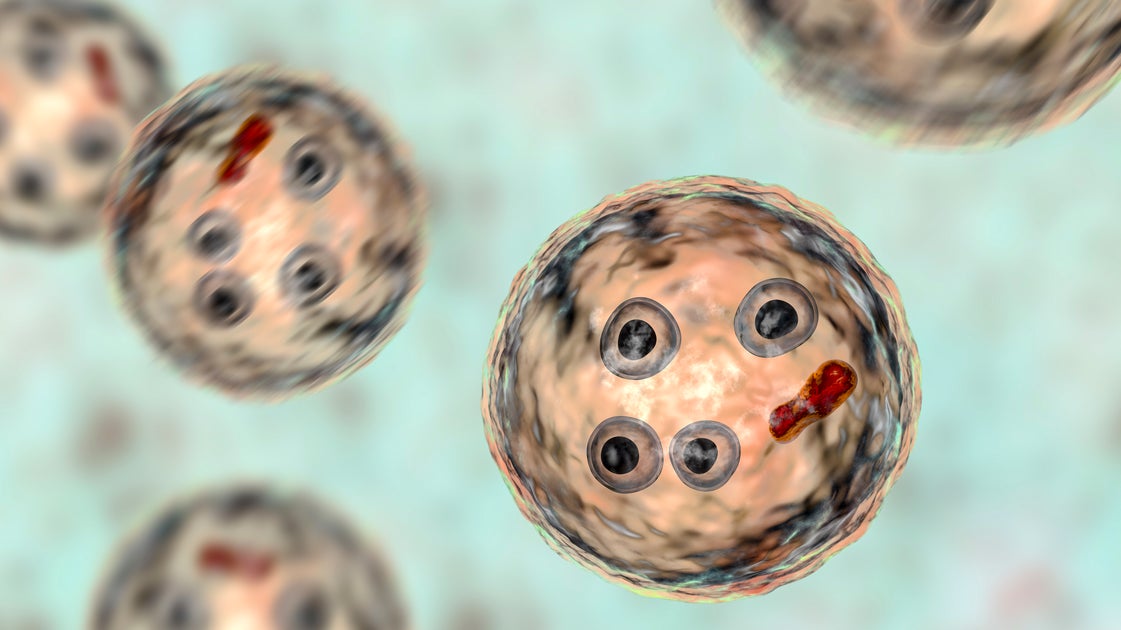

Cyclosporiasis, an explosive-diarrhea-causing illness, is sickening people in at least 17 states, although the exact number of cases is likely underestimated. Surveillance at the Centers for Disease Control and Prevention is not as robust as it once was, and some people don’t get medical attention when they have a diarrheal illness.
The exact source of the current cyclosporiasis outbreaks is unknown, but the parasite (known as Cyclospora cayetanensis) that causes the illness has historically been found on certain fresh fruits, vegetables and herbs, and is most seen in the summer months.
According to Dr. Michael Cappello, a professor and chair of the Department of Epidemiology (Microbial Diseases) at the Yale School of Public Health, “you typically see the parasite in people who have ingested various fruits and vegetables. … Typically, they have been contaminated with human sewage or waste is sort of the generally accepted route of transmission.”
“And that’s why it’s very important with any fresh produce that you might purchase here in the United States, you really have to wash it well,” he added.
“It’s not a disease that can spread person to person. It’s a fecal-oral route,” added Dr. Jennifer Horney, a professor and founding chair of the Department of Epidemiology and core faculty at the Disaster Research Center at the University of Delaware.
The illness causes nasty symptoms, including loud and explosive diarrhea, bloating, fatigue, nausea and stomach pain.
It’s unknown what’s causing the current cyclosporiasis outbreak, but previous outbreaks have been tied to raspberries, basil, parsley, leafy greens and more.
The produce that’s making people ill this summer hasn’t been identified, but certain fruits and veggies have been the cause of outbreaks in the past.
“The one that we are most familiar with is raspberries, but there have also been outbreaks going back in the last decade or two that were traced to basil, cilantro, lettuce and especially some of the lettuce mixes that have been produced that come prepackaged,” Cappello explained.
Horney added that parsley, snow peas and green onions have also been the source of the infection in the past.
This doesn’t mean you shouldn’t eat these items this summer, however.
“We’ve had outbreaks linked to these kinds of products in the past,” said Dr. Donald W. Schaffner, a distinguished professor and extension specialist in food science at Rutgers University in New Jersey. “It doesn’t mean that those kinds of products will be a source in the future.”
“It’s very difficult to tell people to avoid any one particular fruit or vegetable, because there are a number of them that could potentially get through the system and be sold even though they’re contaminated with Cyclospora,” Cappello said.
“Certainly, I think we will continue to see outbreaks associated with fresh produce generically. … It has to do with how the produce is grown, but also the fact that we don’t cook it,” Schaffner noted. “We know that Cyclospora can be associated with water, and one of the things that we need to grow produce out in the field is water, and so crops that see a lot of exposure to water might be risky. But really anything out there that could be irrigated could be a risk.”

While the sources of previous outbreaks may offer a clue into what is getting people sick now, the infection source could be something else this summer, Schaffner said.

ingwervanille via Getty Images
Washing your produce well is the best way to protect yourself from getting sick.
“It’s a good general recommendation to wash carefully under running water any fruits or vegetables that you bring home from the grocery store,” Cappello said.
You don’t need to add soap or any fancy produce sprays; cold water is all you need. A salad spinner can be helpful, too, according to Horney.
“For people who are concerned, hygiene is really the most important thing. Just really good hand washing, as well as washing produce, especially those leafy greens and fresh herbs,” Horney said.
Schaffner noted that, while important, washing produce isn’t a perfect solution. Cyclospora can still live in hard-to-reach nooks and crannies.
Cappello added, “You can be a little more aggressive with fruits and vegetables that you’re planning to peel, but with things like raspberries, it’s very difficult to get inside the various folds and cracks within raspberries, as you can imagine.”
“So, most of the recommendations are simply to just really carefully and somewhat extensively wash them just under running cold water is about the standard recommendation, at least at this point,” Cappello said.
If you want to take it one step further, cooking produce “is a great intervention that does take care of a whole host of food-safety problems, but obviously, if you cook your raspberries, they’re going to be different than if you hadn’t already cooked them,” Schaffner said.
The fear of getting sick shouldn’t be a reason you stop consuming salads, basil or raspberries this summer. Fresh produce has great nutritional value.
“I can tell you from my own perspective … I am not changing my consumption habits. There’s nothing I am doing in particular to avoid consuming certain food products,” Schaffner said.
That said, people are getting sick in states across the country, including Michigan, Connecticut, Texas, Maryland, New York and more. “There are antibiotics, so I think it’s important if people do feel this very severe diarrhea or dehydration or nausea, that they consider going to the doctor,” Horney said.
Outbreaks like this one speak to the importance of public health agencies.
“I’m really disappointed that there’s not more information coming from the CDC, but I also understand that’s a tough time to be at a federal agency,” Schaffner said. “We count on this public health infrastructure to help us in situations like this, and if it’s been gutted because of DOGE, well, that’s not good.”
“I think it’s important to advocate with our state and federal government to really sustain the kinds of food surveillance and foodborne illness surveillance programs that have been, for the most part, quite effective both at preventing, identifying, and responding to these types of foodborne illnesses,” Cappello said.
These outbreaks have been reported in produce from other countries and produce that’s grown within the U.S., according to Cappello, and when you go to the grocery store, the produce you’re getting is coming from all over the country and world.
This “points to how important it is that we maintain our regulatory systems in our surveillance and oversight, so that whenever possible we can identify potentially contaminated food and produce, and hopefully use that information to prevent outbreaks, as opposed to reacting to them the way we seem to be doing now,” Cappello added.